
Home › Musty smells
Topic
Musty smells
A musty smell is mould or mildew growing on something that has stayed wet, somewhere air does not move. How to track it down room by room, what the usual culprits are, and when it needs a surveyor or a plumber rather than a cleaner.

Start here
Air fresheners hide a musty smell for an hour. The smell itself is a signal: mould or mildew is growing on a damp surface you cannot see, usually somewhere dark, still and cold. Behind a wardrobe on an outside wall, inside a cupboard under the sink with a slow drip, in a washing machine seal, in underlay that got wet once, in a loft where a fan duct ends, or under a timber floor whose air bricks are blocked. Find the wet thing, dry it or remove it, and fix why it was wet.
The guide in this topic is a method rather than a list of products: two hygrometer readings, a slow walk with your nose, and a room-by-room checklist from the most common sources to the ones that need a professional. It also covers the case where the smell is drains rather than damp, and what to do when the source is somewhere you cannot see.
Which guide do you need?
| What you notice | Points to | Read |
|---|---|---|
| A damp, cellar-like smell in one room, worse in the morning | Condensation and mould behind furniture or in a cupboard | Musty smell in the house: find the source room by room |
| Musty clothes and shoes at the back of the wardrobe | A wardrobe against a cold outside wall | Mould in the bedroom |
| The smell is strongest near a plughole or an unused toilet | Drains, not damp | The drains section of the musty smell guide |
| The whole house reads high on a hygrometer | General ventilation and heating | How to reduce humidity in your house |
| Smell plus a stain, a tidemark or soft plaster | Water coming in | Damp or condensation? |
Guides

Method
Musty smell in the house
Two readings, a walk with your nose, and a room-by-room checklist from wardrobes to under-floor voids and drains.
Sources: GOV.UK, Energy Saving Trust, RICS
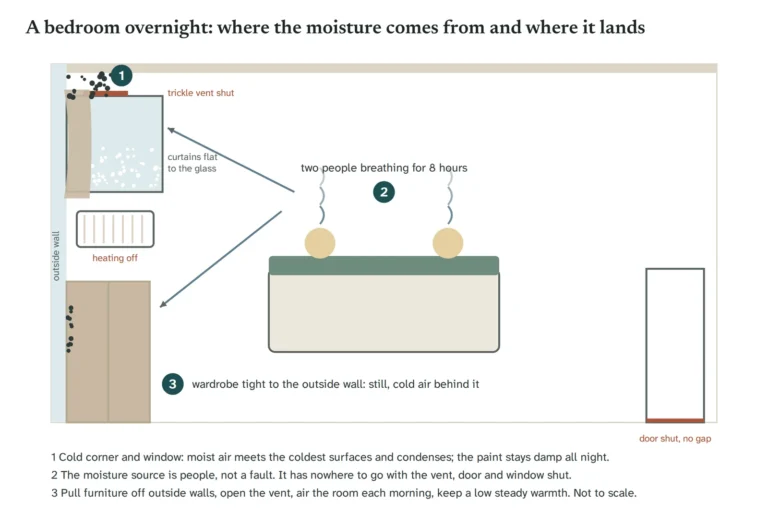
Bedrooms
Mould in the bedroom
The wardrobe on the outside wall, the cold corner and the overnight routine that fixes both.
Sources: GOV.UK, Energy Saving Trust
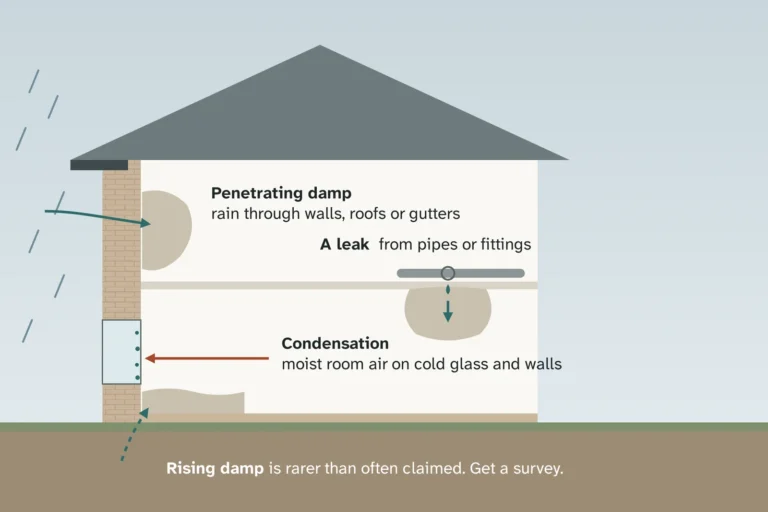
Diagnosis
Damp or condensation?
When the smell comes with a stain or a tidemark: the four moisture routes and when to get a survey.
Sources: RICS, Energy Saving Trust
The five usual answers
- Furniture against a cold outside wall. Move it, look, clean, leave a gap.
- A slow leak under a sink, bath or appliance. Feel the cupboard base; look under the bath panel.
- Something that got wet once and never dried: underlay, a mattress, bagged clothes, boxes. Often not worth saving.
- Moist air reaching a cold loft or a blocked-up chimney. Fan ducts, insulation gaps, a missing vent.
- Under the floor: blocked air bricks or a leaking pipe. A surveyor or a plumber.
Safety
Look into a loft only from a safe, boarded position with a fixed ladder and a light; never walk on joists or insulation. Do not lift floorboards near pipes or cables. If the smell is gas rather than damp, leave the house and call the National Gas Emergency number.
If you rent
Report the smell in writing, saying where it is strongest, when it is worst and what you have checked. A leak, a blocked air brick, a fan venting into the loft or an uninsulated cold wall is the landlord’s to fix.
Coming next in this topic
Guides in preparation: getting a musty smell out of clothes and towels, and mould in or behind a wardrobe. No fixed dates.
Next step
Musty smell in the house: how to find the source room by room
Start with the two readings and the walk.