
Home › Dehumidifiers and drying laundry
Topic
Dehumidifiers and drying laundry
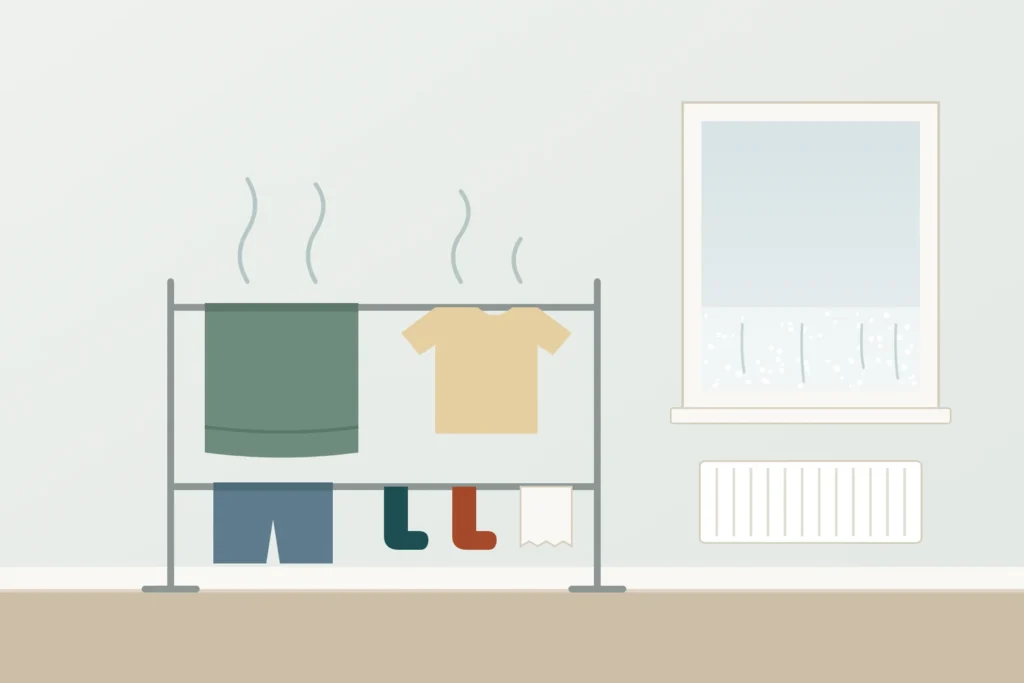
Washing dried indoors is the biggest avoidable source of moisture in a UK home in winter. How to dry it without condensation, and when a dehumidifier is worth having, where to put it and what it cannot do.
Start here
A dehumidifier pulls water out of the air into a tank. It is the right tool when the moisture in a room cannot be ventilated away: washing that must dry indoors most days, a bedroom that runs wet after everything else has been tried, or a room drying out after a leak. It is the wrong tool when the extractor fans are broken, the trickle vents are shut and the bathroom door is left open: there it collects litres a day without getting ahead of the problem, and it costs electricity to do it.
So this topic starts with the laundry, because that is where most indoor moisture comes from, and treats the dehumidifier as the last step in the Energy Saving Trust’s order: cut moisture at source, ventilate, heat steadily, then dehumidify. This site does not name products or quote running costs, because tariffs and models change; the guides show how to work both out from the label and your bill.
Which guide do you need?
| What you are dealing with | Points to | Read |
|---|---|---|
| Washing on radiators; windows streaming the next morning | Moisture from laundry with nowhere to go | Drying clothes indoors without causing condensation |
| You have done the ventilation and heating and a room still reads high | A dehumidifier may now earn its place | How to reduce humidity in your house |
| You want to know what the reading on the hygrometer means | Depends on room temperature and the coldest surface | What humidity should a house be? |
| A wall stays wet however long the dehumidifier runs | Water is coming in, not condensing | Damp or condensation? |
Guides
Laundry
Drying clothes indoors without causing condensation
How much water a load carries, why radiators are the worst place, the options compared, and the one-room routine.
Sources: Energy Saving Trust, Wealden DC, GOV.UK

Humidity
How to reduce humidity in your house
Measure, cut moisture at source, ventilate, heat steadily; when a dehumidifier is worth it and how to size the running cost from the label.
Sources: Energy Saving Trust, Approved Document F, CSE

Readings
What humidity should a house be?
The target range at UK room temperatures, room by room, and the 80 per cent surface rule that matters for mould.
Sources: CSE, RICS, Historic England
Compressor or desiccant, in one paragraph
A compressor (refrigerant) dehumidifier condenses moisture on a chilled coil. It is efficient in a warm room and loses output in a cold one, where it spends time defrosting. A desiccant dehumidifier uses a moisture-absorbing wheel, keeps working in a cold bedroom or conservatory, gives off a little warmth and is usually quieter, at the cost of more electricity for the same water. Desiccant for a cold room in winter; compressor for a warm living room or a whole-house unit in a heated hallway.
Working out the running cost
Find the power in watts on the rating plate (the peak figure; a unit draws less as the room dries). Divide by 1,000 for kilowatts, multiply by the hours a day it will run, and multiply by the unit price in pence per kWh on your latest bill. A 300 W unit for six hours is 1.8 kWh a day. Your own tariff beats any figure on a website.
What a dehumidifier cannot do
It cannot fix a leak, penetrating damp or a bridged damp-proof course; it dries the room while the wall stays wet. It cannot replace an extractor fan in a bathroom. And it cannot warm a cold wall, so a cold corner can still condense with the room reading 55 per cent. If the tank fills every day with no washing in the room, read damp or condensation?.
Safety
Empty the tank into a sink, not the bath with the window shut. Keep the unit off carpets that could get wet, away from curtains, and never cover the grille. Do not use unflued bottled-gas or paraffin heaters to “dry a room”; burning the fuel adds water to the air.
If you rent
A tenant can be expected to dry washing sensibly; a landlord can be expected to provide a working extractor fan, windows that open with trickle vents, and heating that works. GOV.UK guidance is that it is unreasonable to blame damp and mould on lifestyle alone. Report building problems in writing.
Coming next in this topic
Guides in preparation: what size dehumidifier you need, where to put a dehumidifier, dehumidifier running costs, desiccant versus compressor, and why a dehumidifier stops collecting water. These need the products in hand; no fixed dates.
Next step
Drying clothes indoors without causing condensation and mould
One room, door shut, window open or dehumidifier running.