
Dew point calculator
Enter your room’s air temperature and relative humidity to find the dew point: the temperature at which water starts to condense on a surface. Add a surface temperature to see how close that surface is.
13.2 °C
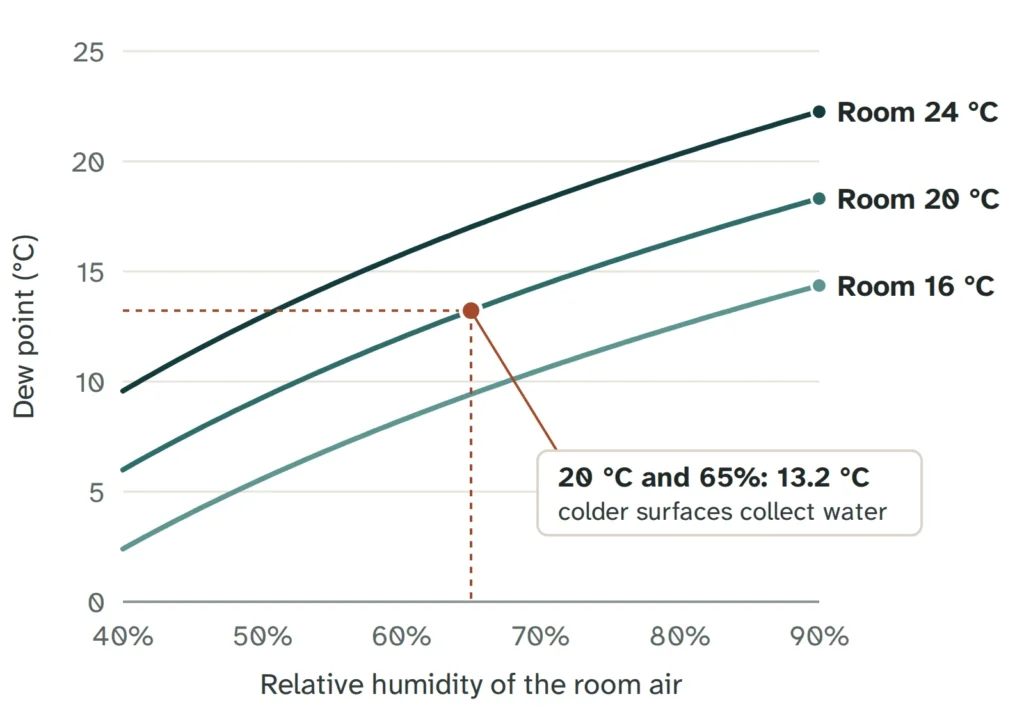
Air at 20 °C and 65% relative humidity has a dew point of 13.2 °C. Any surface at or below this temperature will collect condensation.
How to use it
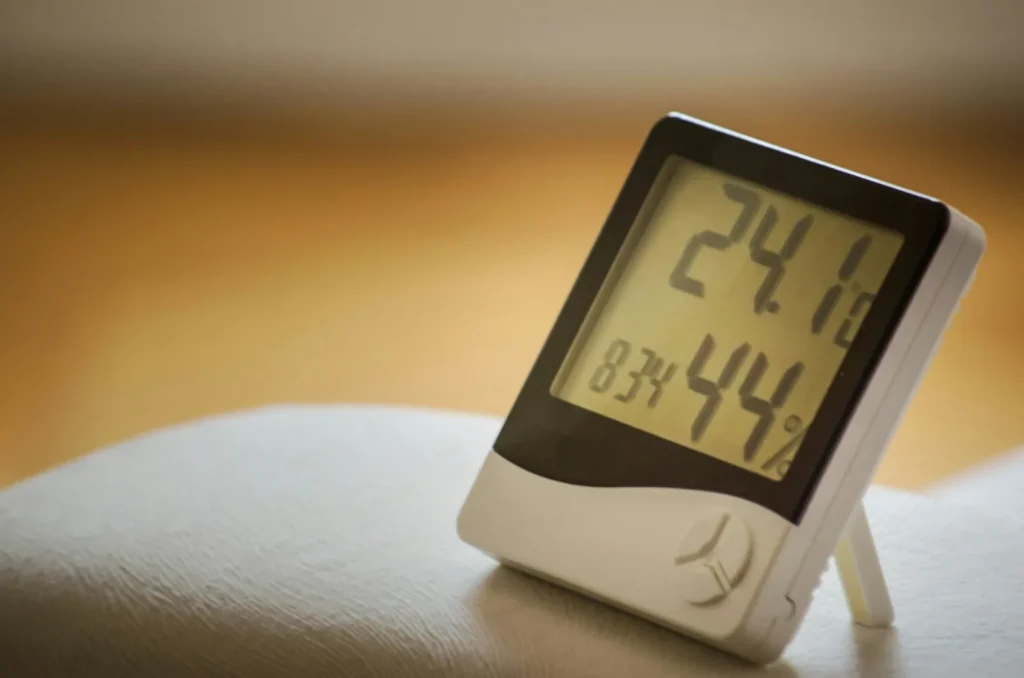
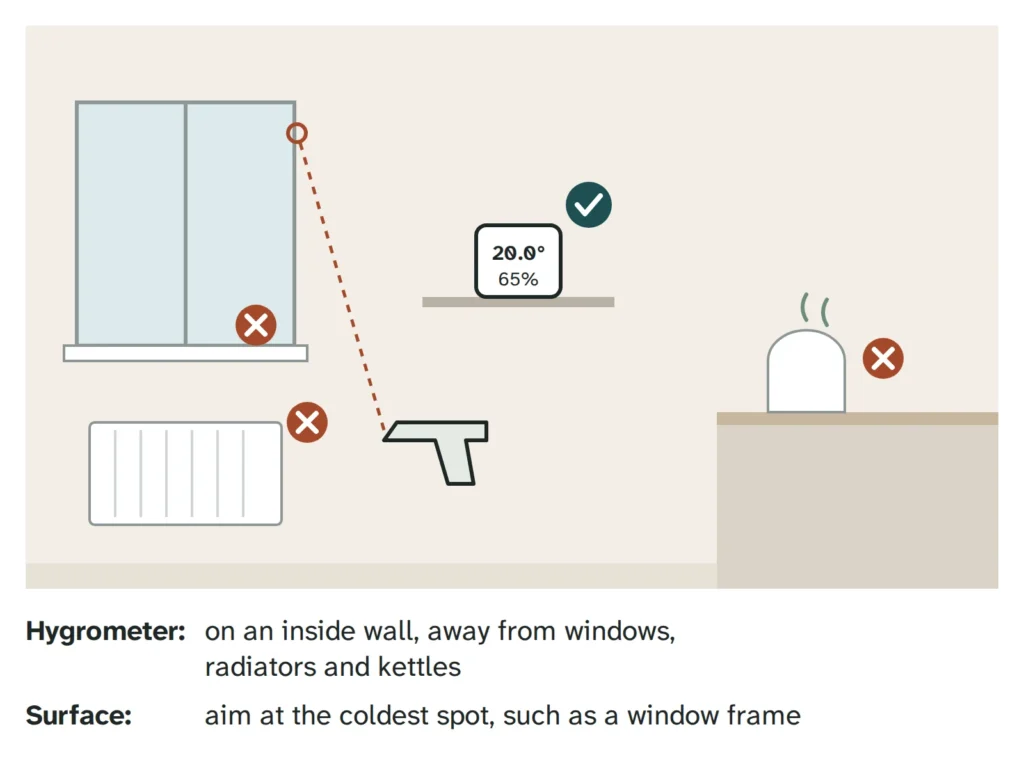
- Read the air temperature and relative humidity from a hygrometer placed away from windows, radiators and kettles.
- Enter both figures. The dew point updates as you type.
- If you have a surface reading, for example from an infrared thermometer, add it to compare.
Worked examples
These are example figures, not readings from a real home.
| Room temperature | Relative humidity | Dew point |
|---|---|---|
| 20 °C | 65% | 13.2 °C |
| 20 °C | 50% | 9.3 °C |
| 21 °C | 60% | 12.9 °C |
| 15 °C | 80% | 11.6 °C |
Assumptions and limits
- The result is only as good as your readings. Humidity varies across a room, and consumer hygrometers have a stated tolerance, usually a few per cent.
- Surface temperatures vary across a wall. An infrared thermometer measures surface temperature only, and shiny surfaces give false readings unless you adjust for emissivity.
- The calculator shows where condensation can form. It does not predict mould or diagnose damp.
- Below 0 °C it gives the dew point over water. Frost can form at a slightly different temperature.
What the result means, and what it does not
The dew point is a property of the air, not of the wall. It tells you the coldest a surface can be before water from that air starts to settle on it. Three readings matter:
- Surface at or below the dew point: condensation forms. On glass you see droplets; on plaster the surface goes damp and cold and dries out again during the day, so you may never see water, only the mould that follows.
- Surface above the dew point but below the 80 per cent line: the surface stays dry to the eye, but the air right against it is over 80 per cent humidity. Building standards (BS 5250 is the usual reference) treat sustained surface humidity of about 80 per cent as the point at which mould can grow. The calculator now shows this temperature as well. Cold corners and the wall behind a wardrobe often sit in this band all winter.
- Surface more than a couple of degrees above the dew point: no condensation at these readings. A colder night, a shower or washing drying in the room raises the dew point, so recheck on a bad morning rather than a mild afternoon.
What it does not do: it does not measure anything (it works from the readings you type in), it does not tell you where the moisture comes from (a leak, penetrating damp and condensation can all give a wet wall), and it does not diagnose mould or health risk. If a wall is wet while the calculator says it should be dry, water is probably arriving from somewhere else; read damp or condensation?.
Typical UK winter readings
Rounded to one decimal place. The last column is the surface temperature below which surface humidity passes 80 per cent.
| Room air | Humidity | Dew point | Mould-risk line (80 per cent at the surface) |
|---|---|---|---|
| 20 C | 50% | 9.3 C | 12.6 C |
| 20 C | 60% | 12.0 C | 15.4 C |
| 20 C | 65% | 13.2 C | 16.7 C |
| 20 C | 70% | 14.4 C | 17.9 C |
| 18 C | 65% | 11.3 C | 14.7 C |
| 18 C | 75% | 13.5 C | 17.0 C |
| 16 C | 70% | 10.5 C | 13.9 C |
| 15 C | 80% | 11.6 C | 15.0 C |
Read across: a bedroom at 18 C and 75 per cent, which is common on a winter morning, needs every surface warmer than 13.5 C to stay dry and warmer than 17 C to stay clear of the mould band. The plaster in an outside corner of a solid-walled house can easily be colder than that. The way out is to lower the humidity (the reduce humidity guide), warm the surface with steady heat and air movement (condensation on walls), or both. What humidity should a house be? explains what the readings mean room by room.
How the calculator was tested
The dew point uses the Magnus approximation with the Alduchov and Eskridge (1996) coefficients (a = 17.625, b = 243.04 C). It was checked against two independent references: the Arden Buck (1981) saturation vapour pressure equation, solved numerically, agrees within 0.01 C across 16 test points from −5 C to 35 C and 40 to 90 per cent humidity; and the IAPWS SR1-86 formulation agrees within 0.04 C between −10 and 40 C at 10 to 100 per cent humidity. Consumer hygrometers are usually only accurate to a few per cent, which moves the dew point by about 1 C, so the readings you type in are the real limit on accuracy, not the formula. The mould-risk line uses the same formula with 80 per cent in place of 100 per cent, which is the surface temperature at which the same air would reach 80 per cent relative humidity.
The formula
The calculator uses the Magnus approximation with the coefficients recommended by Alduchov and Eskridge (1996) for water, where T is the air temperature in °C and RH is the relative humidity in per cent:
γ = ln(RH ÷ 100) + (a × T) ÷ (b + T)
Dew point = (b × γ) ÷ (a − γ)
with a = 17.625 and b = 243.04 °C.
Alduchov and Eskridge give this form a maximum error of under 0.4% in saturation vapour pressure between −40 and 50 °C, as summarised by Huang (2018). We also compared every result between −10 and 40 °C and 10 to 100% relative humidity with the IAPWS reference equation for water: the largest difference was 0.04 °C. Results are rounded to 0.1 °C. Your hygrometer and thermometer readings will usually be the bigger source of error.
Sources
- Alduchov and Eskridge (1996), Improved Magnus form approximation of saturation vapor pressure, Journal of Applied Meteorology 35(4), 601 to 609
- Huang (2018), A new simple and very accurate formula for calculating the saturation vapor pressure of water and ice, Journal of Applied Meteorology and Climatology 57(6)
- IAPWS SR1-86(1992): Revised supplementary release on saturation properties of ordinary water substance
- Fluke: What is an infrared thermometer?