
How to Reduce Humidity in a House (UK Guide)
How to reduce humidity in a UK house: measure it, cut moisture at source, ventilate properly, heat steadily and know when a dehumidifier is worth it.
Quick answer
Measure first with a cheap hygrometer, then work through four things in order: cut moisture at source (lids on pans, extractor fans run on for 15 minutes, no washing on radiators), ventilate properly (trickle vents open, windows opened for a few minutes several times a day, a 10 mm gap under internal doors), keep rooms steadily warm rather than blasting heat in bursts, and only then add a dehumidifier if the first three are not enough.
On this page
What the numbers mean
Relative humidity (RH) is the amount of water vapour in the air as a percentage of the most that air could hold at its current temperature. Warm air can hold far more water than cold air, so the same moisture gives a low reading in a warm room and a high reading in a cold one. Air that reads 55 per cent at 20 C reads about 75 per cent once it cools to 15 C, without a drop of water being added.
That is why a cold bedroom at 65 per cent is riskier than a warm living room at 65 per cent. In the cold room the air is already close to its dew point, the temperature at which it can hold no more water and condensation starts, so the coldest surfaces (window glass, the wall behind a wardrobe, a ceiling corner) are likely to be wet most nights. Building standards use about 80 per cent surface humidity, sustained, as the mould-risk threshold, and a cold wall can be at 80 per cent while the hygrometer in the middle of the room reads something far more reassuring.
Two rules of thumb follow:
- Judge readings against the room temperature, not a single target number. The guide to what humidity a UK house should be gives targets by room and season.
- Work out the dew point of your air with the dew point calculator. Air at 20 C and 65 per cent RH has a dew point of about 13.2 C, so any surface at or below that will condense.
Buy a hygrometer before you buy anything else
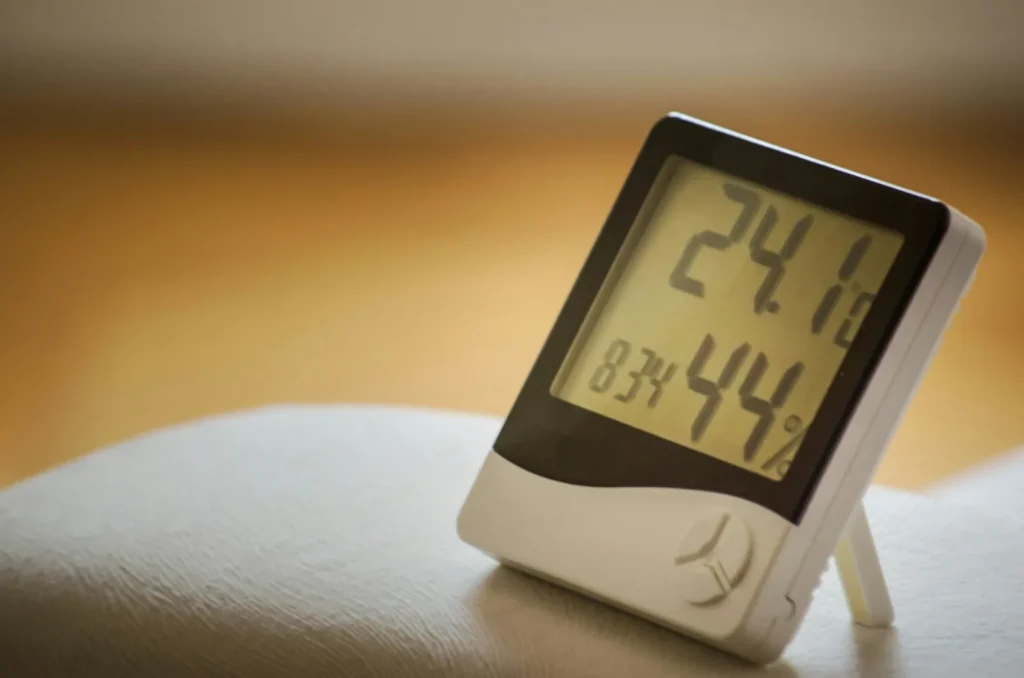
A digital thermo-hygrometer costs a few pounds and shows temperature and RH together. Put it where the problem is, at roughly head height, away from radiators, windows and direct sunlight. Note the reading last thing at night and first thing in the morning for a week before changing anything. If you have two, put the second in the coldest room. Cheap units can be several percentage points out, so watch the trend: what matters is whether the number falls once you act.
Where the moisture comes from
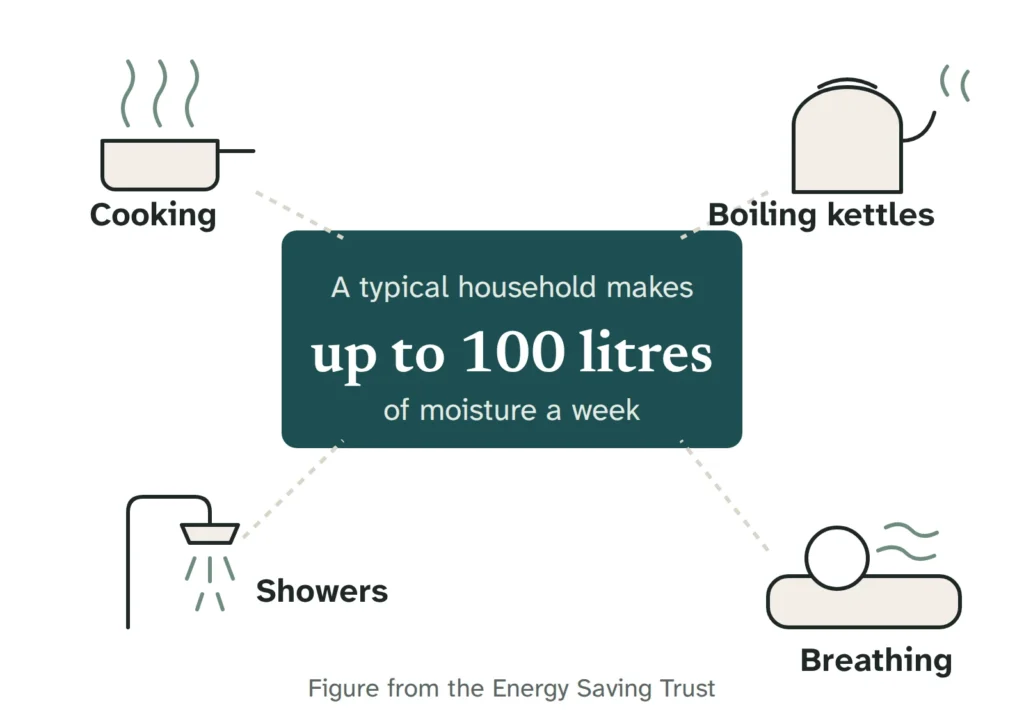
The Energy Saving Trust says a household typically produces up to 100 litres of moisture a week from ordinary living. Unless it is removed as it is made, it ends up in the air and on the coldest surfaces.
| Source | Why it matters | What to do |
|---|---|---|
| Drying washing indoors | A full load of wet clothes releases litres of water into one room, usually a bedroom or living room with the door shut and the radiator on | Dry outside whenever weather allows; otherwise use one room with the door closed and a window open or an extractor running, and a dehumidifier if you dry indoors most days |
| Showers and baths | Steam at the warmest, wettest moment of the day, often in the coldest room | Run the extractor during and for at least 15 minutes after; keep the door closed while the room clears; wipe down tiles and the screen |
| Cooking | Boiling pans and kettles push steam straight into the air | Lids on pans, extractor hood on and left running for at least 15 minutes after cooking, kitchen door closed |
| Breathing and sweating | Two adults sleeping add a surprising amount of water to a closed bedroom over eight hours | Trickle vent open overnight, door not fully shut, bedroom aired in the morning |
| Unvented tumble dryers | A vented dryer with no hose to outside dumps every drop it removes from the clothes into the room | Vent it outside through a proper hose, or switch to a condenser or heat-pump dryer that collects the water |
| Bottled-gas and paraffin heaters | Burning the fuel produces water vapour; the Centre for Sustainable Energy says not to use portable gas heaters indoors because they make the air very moist | Do not use them as a fix for a cold, damp room; they make the humidity worse |
| Aquariums, lots of houseplants, water features | Constant slow evaporation | Fit a lid on the tank, group plants in one ventilated room, do not overwater |
| Leaks and building faults | Not lifestyle at all: a dripping pipe, a failed seal or water coming through the wall | Find and fix the source; see the section on when humidity is a symptom below |
If you do only one thing from this table, stop drying washing on radiators in closed rooms. It is the biggest avoidable source in most UK homes in winter.
Ventilation done properly
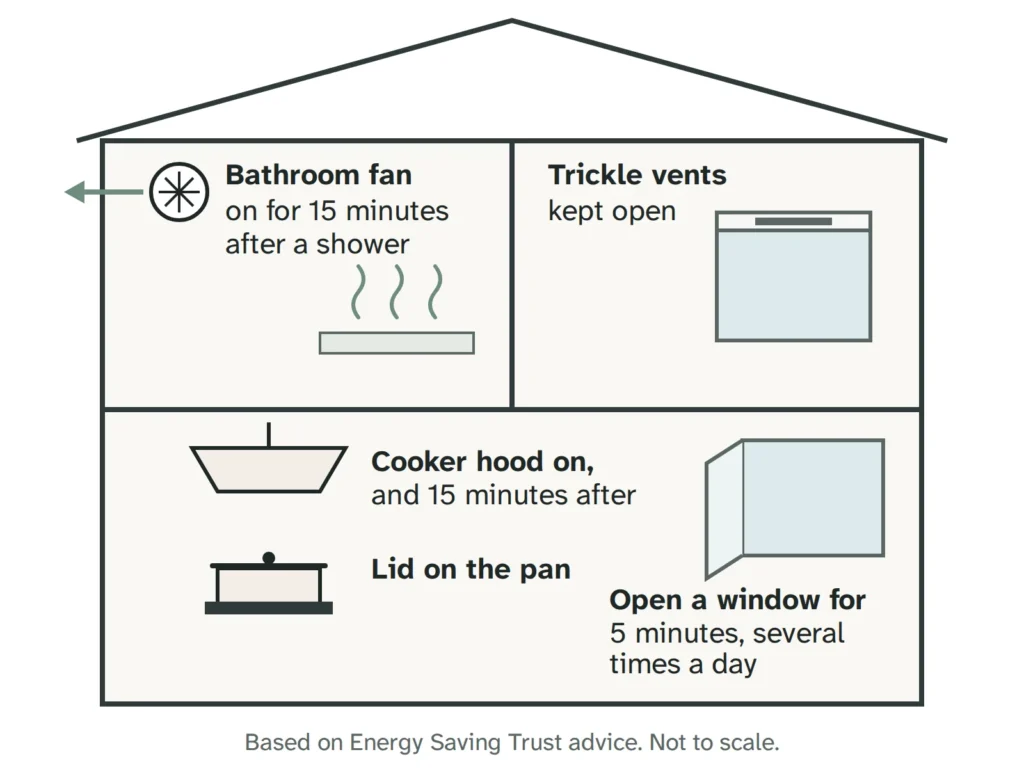
Ventilation is how the moisture leaves, and there are three layers: extractor fans in wet rooms, background ventilation in every room, and short bursts of purge ventilation through open windows.
Extractor fans
Bathroom and kitchen fans should run whenever the room is producing steam and, following Energy Saving Trust advice, for at least 15 minutes afterwards. A fan with a timer or humidity sensor does this for you; one on the light switch stops the moment you leave.
Approved Document F of the Building Regulations sets minimum intermittent extract rates for new work: 15 litres per second in a bathroom, 30 in a kitchen where the cooker hood extracts to outside (60 otherwise), 30 in a utility room and 6 in a WC. Older homes were built to older rules, but these are a fair benchmark. Many fans in older bathrooms are far below this, or clogged with dust.
Checks you can do yourself:
- Clean the cover and grille. A fan choked with fluff moves very little air.
- Hold a single sheet of tissue near the running fan. If it is drawn firmly to the grille, the fan is pulling. If it barely moves, the fan is weak, blocked, or the duct to outside is kinked or disconnected. A rough check, not a measurement.
- Look outside for the vent terminal. A flap that never opens when the fan runs suggests a blocked or disconnected duct.
- Do not run a fan with the window wide open beside it; it pulls in outside air instead of clearing the room.
Wiring, replacing the fan or adding a timer is work for an electrician under Part P of the Building Regulations. Ducting changes in a loft are also a job for a professional.
Trickle vents
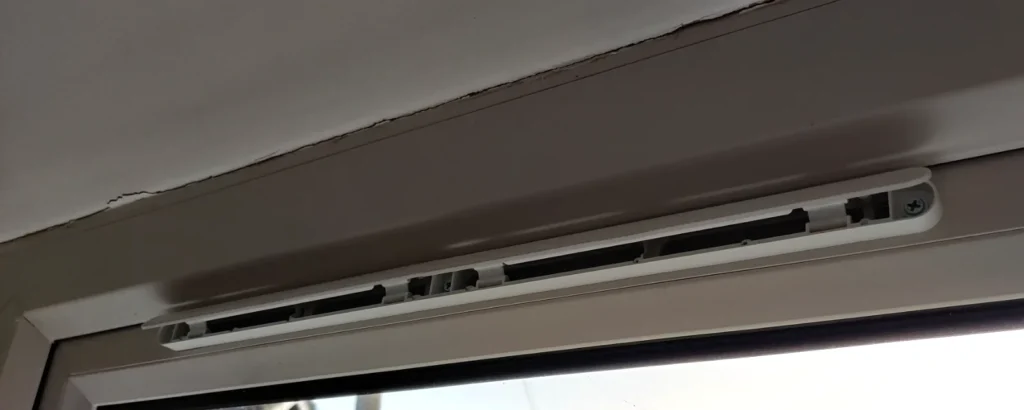

Trickle vents are the narrow slots in the top of window frames that let a small, constant flow of air through the house. For new windows, Approved Document F expects around 8,000 square millimetres of equivalent area per habitable room in a multi-storey home (10,000 in a single-storey home) and 4,000 in bathrooms. They are designed to be left open all year. Closing them to keep warmth in is a common reason a house becomes damp after new windows go in. Open them, keep them clear of dust and curtains, and if your windows have none, ask a glazier about retrofitting them.
Purge ventilation
The Energy Saving Trust suggests opening windows several times a day for at least five minutes, longer if you can. Opening windows on opposite sides of the house at the same time clears a room in minutes because the air is replaced rather than stirred. A short, sharp airing loses far less heat than a window left on the latch all day.
Doors and draughts
Internal doors need a gap of at least 10 mm underneath so air can move between rooms and reach the fans and vents; the gap is deliberate. Draught-proofing external doors and windows is sensible, but sealing every gap in a house with no working trickle vents or fans removes the only ventilation it had. If the windows started streaming after draught-proofing, that is usually why.
Positive input ventilation (PIV)
A PIV unit sits in the loft or on a wall and gently pushes filtered air into the house, usually onto the landing, so stale humid air is pushed out through the vents and gaps. It runs continuously at low power and suits houses with a loft where condensation and mould keep returning in several rooms. It does not remove moisture directly, so it works alongside extractor fans, not instead of them, and it will not fix a leak. Installation and wiring are for a professional installer or electrician.
Mechanical ventilation with heat recovery (MVHR)
MVHR extracts stale air from wet rooms and supplies fresh air to living rooms and bedrooms through ducts, with a heat exchanger that keeps most of the warmth. It is standard in new, airtight homes and can be retrofitted to some existing ones, but it needs ducting to every room and a reasonably airtight building, so it is a professional project rather than a quick fix for a humid bedroom.
Heating: steady, not in bursts
Heating a room does not remove any water from the air. It raises the temperature, which lowers the relative humidity of the same air, and it warms the walls, windows and corners so they sit above the dew point. So heating reduces the reading and the condensation without removing the water; ventilation does the removing.
The pattern of heating matters more than the total. A cold house heated hard for an hour in the evening warms the air quickly, but the walls stay cold far longer, so the moist air condenses on them as soon as the heating goes off. A lower, steadier heat keeps the fabric of the building warmer through the night. The RICS consumer guide gives 18 to 21 C as the ideal internal range; rooms where the heating is off or turned right down go damp first. Leaving the heating on all the time just to avoid damp would use a lot of energy, so the target is a steady moderate temperature in the rooms you use, not warmth everywhere around the clock.
Two habits that cost nothing: heat the bedroom lightly in the evening rather than sleeping in a stone-cold room with the window shut, and pull furniture a few centimetres off outside walls so warm air reaches the plaster.
When a dehumidifier is worth it
A dehumidifier is the right tool when you have done the first three things and readings are still high, when you must dry washing indoors most days, or when you are drying a room out after a leak. It is the wrong tool when the fans are broken, the trickle vents are shut and the bathroom is never aired; there it will collect litres a day without getting ahead of the problem.
The two common types behave differently in a cold room. A compressor (refrigerant) dehumidifier condenses moisture on a chilled coil and works best in warm rooms; in a cold bedroom or conservatory its output falls away and it may spend time defrosting. A desiccant dehumidifier uses a moisture-absorbing wheel, keeps working in the cold, gives off a little warmth and is usually quieter, at the cost of higher electricity use for the same water. Desiccant for a cold bedroom in January; compressor for a warm living room. Set the target below 60 per cent, put the unit where the moisture is made and keep that room’s doors closed while it runs.
This site does not name products. To estimate running cost, use the rating on the label rather than a figure from a website:
- Find the power in watts on the rating plate (the peak figure; most units draw less once the room is drier).
- Divide by 1,000 to get kilowatts.
- Multiply by the hours per day you expect to run it.
- Multiply by your electricity unit price in pence per kWh from your latest bill.
A 300 W unit running six hours a day is 1.8 kWh a day; multiply by your unit rate for the daily cost. Your own tariff beats the out-of-date figures that circulate online.
“Naturally” and “without a dehumidifier”: the honest version
The ventilation and moisture-source sections above are the natural, no-appliance answer, and where the real reductions come from. The products sold as natural fixes are a different story.
- Moisture absorber pots and crystal tubs pull a few hundred millilitres of water from the air over weeks. Against a household producing up to 100 litres a week, that is a rounding error. They are useful in a shut wardrobe, a caravan or a car, not for a room.
- Bowls of salt, rice, bicarbonate of soda or cat litter do the same thing on a smaller scale.
- Charcoal, plants that “absorb humidity” and scented candles do nothing measurable; plants add moisture.
- Anti-condensation paint changes the surface, not the air. It can slow condensation on a cold wall but does not lower humidity.
To lower humidity fast without buying anything: open windows on two sides of the house for ten minutes, put the extractor fans on, close the bathroom door, take the washing off the radiators, and heat the room gently. That drops a reading by more in an hour than an absorber pot will in a month.
A routine that keeps it down
- Every day: pan lids on, extractors run on 15 minutes after showers and cooking, windows opened for five minutes in the morning and after any steam, trickle vents open.
- Every day in winter: bedrooms aired before bed, heating on a low steady setting in used rooms, curtains opened in the morning so window frames dry.
- Wash days: washing dried outside if possible; otherwise in one closed room with a window open or a dehumidifier running.
- Weekly: check the hygrometer readings, wipe condensation off windows and sills (wring the cloth out into the sink, not on the sill), wipe down the shower.
- Monthly: clean the extractor fan grilles, check trickle vents are open, look behind wardrobes on outside walls for damp or mould spots.
- Each autumn: test both fans, clear gutters if you can do it safely from the ground with the right tools or get someone in, and check the tumble dryer hose.
If you rent
Most of this routine is within a tenant’s control. Where the problem goes beyond it, report in writing and keep a copy:
- A bathroom or kitchen with no extractor fan, or a fan that does not work.
- Windows with no trickle vents or vents that are painted shut.
- Heating that cannot keep the rooms at a reasonable temperature, or a boiler fault.
- Any leak, wet patch or mould that comes back after you have cleaned it.
Report to your private landlord or letting agent, or to the housing association or council if you are a social tenant. From 27 October 2025, under Awaab’s Law, social landlords must investigate a potential hazard within 10 working days, make significant damp and mould hazards safe within 5 working days of identifying them, and complete emergency work within 24 hours. Private tenants are due to be covered later under the Renters’ Rights Act. If a private landlord does not act, the council’s environmental health team can inspect. For anything about your rights or a dispute, ask Shelter or Citizens Advice.
Common mistakes
- Buying a dehumidifier first. It treats the symptom while the fans stay broken and the washing stays on the radiators.
- Closing the trickle vents to keep the heat in. The heat saving is tiny; the humidity rise is not.
- Heating in short blasts, so warm air condenses on cold walls the moment the boiler stops.
- Drying clothes in a closed bedroom overnight: sleeping people plus a load of washing plus a shut window means a mouldy window frame by morning.
- Running the extractor with the window wide open beside it.
- Trusting a single hygrometer reading in the middle of a warm room. The cold corner is what matters.
- Treating a cold, damp wall as a humidity problem when it is a leak. See below.
When humidity is a symptom, not the cause
Readings that stay high after a fortnight of the routine above, damp that is worst in one patch rather than on cold surfaces generally, a tidemark low on a wall, a patch that darkens after rain, or a wet area under a bathroom or near a pipe run all point to water getting into the building. No amount of ventilation fixes a dripping overflow, a failed gutter joint or rain driving through cracked render. The Energy Saving Trust describes penetrating damp as concentrated patches from faulty guttering or roofing, and rising damp as a tidemark at the bottom of walls. The guide to telling damp from condensation walks through the differences and the foil test; the signs of penetrating damp guide covers the outside checks. For a structural problem, RICS advises an inspection from someone with no commercial interest in selling you a treatment, and the Energy Saving Trust suggests three quotes from TrustMark-certified professionals.
Where mould has already appeared, the guide to removing mould from walls covers what is safe to clean yourself. For health questions, ask the NHS website or your GP.
FAQ
Is 70 per cent humidity in a room too high?
For a heated living room it is on the high side and worth acting on; for a cool bedroom in winter it is a warning. At 70 per cent the air is close to its dew point, so windows and cold outside walls will be condensing most nights, and surface humidity on those walls will be above the level building standards treat as a mould risk. Use the dew point calculator with your own room temperature to see how close you are, and aim for the ranges in the ideal humidity guide.
Sources
- Fixing damp and condensation, Energy Saving Trust, updated 22 May 2026
- Condensation, damp and mould, Centre for Sustainable Energy, reviewed December 2025
- Approved Document F, Volume 1: Dwellings (2021 edition), HM Government
- Damp and mould consumer guide, RICS, 16 June 2025
- Understanding and addressing the health risks of damp and mould in the home, GOV.UK (DLUHC and UKHSA), updated 1 April 2026
- How Awaab’s Law changes the rules on hazards in social housing, Shelter, October 2025
- Electrical safety in the home and Part P, Electrical Safety First