
What Humidity Should a House Be? The Ideal Level for UK Homes
The ideal humidity for a UK home is roughly 40 to 60 per cent at room temperature. What your hygrometer reading means, room by room, and what to do next.
Quick answer
For a UK home in the heating season, aim for a relative humidity of roughly 40 to 60 per cent at a room temperature of about 18 to 21 C. The Centre for Sustainable Energy recommends 40 to 60 per cent and says mould risk rises above 60 per cent; Historic England uses a slightly wider 40 to 65 per cent at around 20 C for looking after buildings. Treat 60 to 65 per cent as the point to start acting and 70 per cent or more as a problem. The number on a hygrometer is only half the story: relative humidity depends on the temperature of the air, and the real mould risk is on cold surfaces such as external walls and window reveals, where the air is cooler and the humidity higher than the room average.
On this page
Why one number is not enough
Relative humidity (RH) is the amount of water vapour in the air as a percentage of the most that air can hold at its current temperature. Warm air holds more water than cold air, so if you cool a fixed amount of moist air the percentage rises even though nothing has been added. A reading of 55 per cent can be fine in a heated living room and a problem in the unheated bedroom next door: the same air that reads 55 per cent at 20 C reads about 75 per cent at 15 C.
The temperature at which air can hold no more moisture and starts to condense is the dew point. Any surface at or below the dew point of the air touching it gets wet. For air at 20 C and 65 per cent RH the dew point is about 13.2 C, so a window pane or a corner of an outside wall at 13 C will condense.
The table follows the same air, with nothing added or removed, as it cools. “Condensing” means the air has reached its dew point and moisture is coming out of it.
| Reading at 20 C | Dew point | Same air at 16 C | Same air at 15 C | Same air at 12 C |
|---|---|---|---|---|
| 40 per cent | 6.0 C | 51 per cent | 55 per cent | 67 per cent |
| 50 per cent | 9.3 C | 64 per cent | 69 per cent | 83 per cent |
| 55 per cent | 10.7 C | 71 per cent | 75 per cent | 92 per cent |
| 60 per cent | 12.0 C | 77 per cent | 82 per cent | condensing |
| 65 per cent | 13.2 C | 84 per cent | 89 per cent | condensing |
| 70 per cent | 14.4 C | 90 per cent | 96 per cent | condensing |
Figures calculated with the Magnus formula and rounded. You can run your own numbers in our dew point calculator.
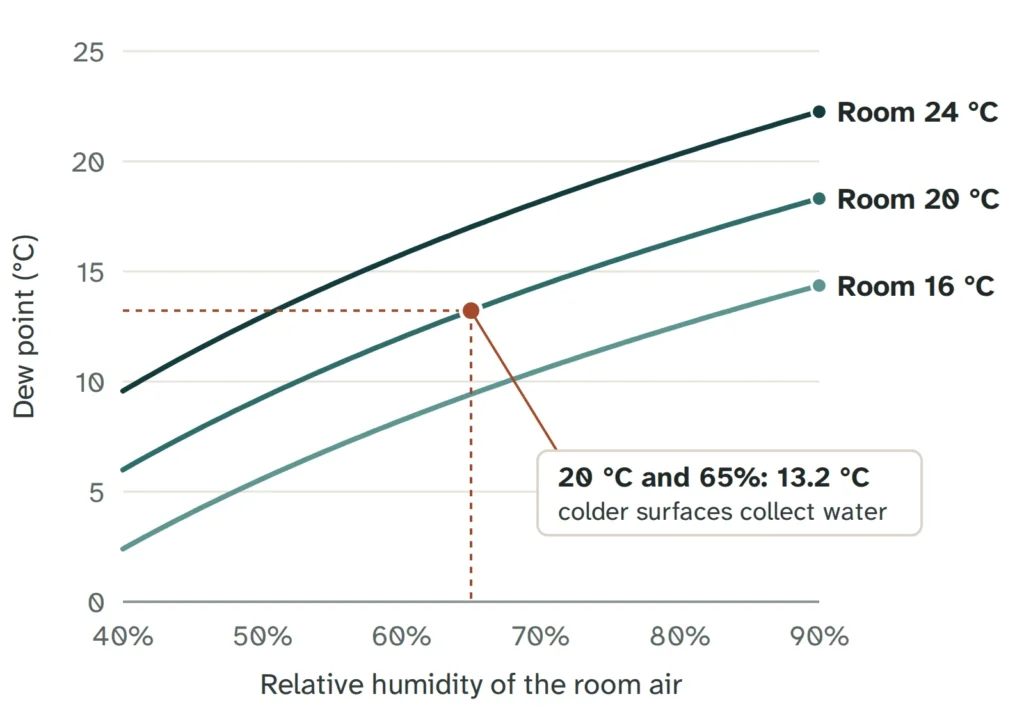
Two things follow. A target range only means something at a stated temperature, which is why this guide pairs 40 to 60 per cent with 18 to 21 C (the RICS consumer guide on damp and mould advises keeping internal temperatures “ideally between 18C and 21C”). And heating a room does not remove moisture; it lowers the percentage by warming the air. Let the room cool overnight and the percentage climbs back, which is why condensation appears on bedroom windows by morning.
What your hygrometer reading means
These bands assume a room temperature of about 18 to 21 C. If your room is colder, a reading in the amber band deserves more concern, because the same air reads higher still at the cold surfaces.
| Reading | What it usually means | What to do |
|---|---|---|
| 30 per cent or below | Dry. Uncommon in UK homes in winter unless the room is heated hard and ventilated well, or a dehumidifier has been left running. | Turn the dehumidifier off or raise its target. Nothing else is normally needed. |
| 40 per cent | Comfortable and low risk. | Nothing. This is a good winter reading. |
| 50 per cent | Comfortable. Normal for a lived-in home. | Nothing, but keep an eye on cold rooms and corners. |
| 60 per cent | The upper end of the recommended range. Fine in a warm room after cooking or a shower, as long as it comes back down. | If it sits at 60 all day, add ventilation and check the cold rooms. |
| 65 per cent | Top of the Historic England building-care range. Cold surfaces in this room are likely to be at 80 per cent or more. | Act: ventilate, check extractor fans, look for a moisture source. |
| 70 per cent | Too high for a sustained reading. Condensation on windows is likely on cold nights. | Follow our guide to reducing humidity in the house. |
| 80 per cent | Very high. Air at this level is close to its dew point in any cool room and mould can grow on surfaces. | Look for a leak or a large moisture source as well as ventilating. If it stays this high, get advice. |
A reading that spikes and then falls is normal. A reading that stays high for days is what matters.
Is 70 per cent humidity too high?
Yes, if it stays there. At 20 C, air at 70 per cent has a dew point of about 14.4 C, so any surface cooler than that will be wet. In a bedroom that drops to 15 or 16 C overnight, the air itself reaches 90 per cent or more, and the walls and window reveals will be at or past the dew point.
Is 60, 63 or 55 per cent humidity bad?
Not in a warm room, and not on its own. Readings in the mid-50s to low 60s are the top of normal for a UK home in winter. Ask two questions: does the reading come back down after the activity that caused it, and how cold are the surfaces in the room? A reading of 63 per cent at 20 C becomes about 86 per cent when that air reaches a 15 C wall, which is mould territory if it stays like that. The same 63 per cent is much less of a concern at 21 C in a well-insulated room.
Room by room
Bedroom. Overnight is the hard case. Two people breathing in a closed room, with the heating off and the temperature falling, raise the humidity and lower the temperature at the same time. A morning reading of 60 to 65 per cent is common; if it is regularly 70 or more, or there is water on the glass most mornings, ventilate the room during the day and leave a trickle vent open at night. Our separate guide covers mould in a bedroom.
Bathroom. A reading of 80 or 90 per cent straight after a shower is normal. What matters is how fast it clears. The Energy Saving Trust advises running the bathroom extractor for at least 15 minutes after a shower. If the reading is still in the 70s an hour later with the door shut, the fan is not doing its job.
Kitchen. Cooking, kettles and washing up push humidity up in short bursts. Lids on pans and a cooker hood that extracts outside (not recirculating) keep the bursts short. The Energy Saving Trust says a household typically produces up to 100 litres of moisture a week, and most of it starts in the kitchen and bathroom.
Living room. Usually the warmest room, so usually the lowest reading. Do not let a comfortable living-room figure reassure you about the rest of the house.
Unheated spare rooms. Here the room-average reading is most misleading. A spare room at 14 C can read 80 per cent with no moisture source in it at all, because warm damp air from the rest of the house drifts in and cools. Keep the door shut, the room slightly heated and a window or vent cracked.
Lofts and cellars. Cellars are often naturally humid because the ground around them is cool and damp; a high reading there is not on its own evidence of a leak. Lofts vary with the weather outside. Neither is a good place to judge the living space from.
What humidity causes mould
Mould does not grow because the room average hits a particular number. It grows on a surface that stays damp. Building standards use about 80 per cent surface humidity for long periods as the mould-risk threshold, which is why a room reading of 60 per cent can still produce a black patch in a cold corner: the air against that corner is cooler than the air in the middle of the room, so its humidity is higher.
The coldest surfaces in a UK home are usually:
- external walls, especially corners where two outside walls meet
- the reveals around windows and the wall above them
- the wall behind wardrobes, sofas and beds pushed against an outside wall
- window frames and glass
- lintels and other cold bridges, where a solid part of the structure carries the cold straight through the insulation
So the practical target is not just “keep the number below 60” but “keep cold surfaces warm enough and the air dry enough that the surfaces stay under 80 per cent”. Our guide to condensation on walls explains cold bridges and what to do about them, and the dew point calculator tells you how cold a wall can get before it condenses at your current reading.
How to measure humidity at home
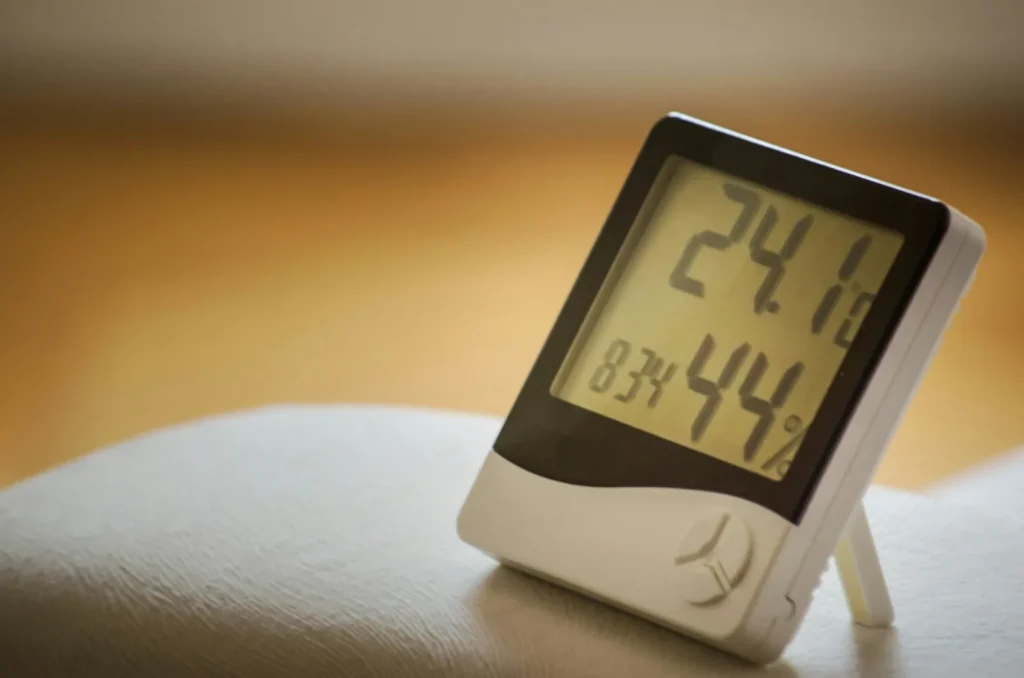
You need a hygrometer. A basic digital thermo-hygrometer, which shows temperature and relative humidity together, is enough. The Centre for Sustainable Energy notes they “can be bought for as little as £8.00”.
Where to put it
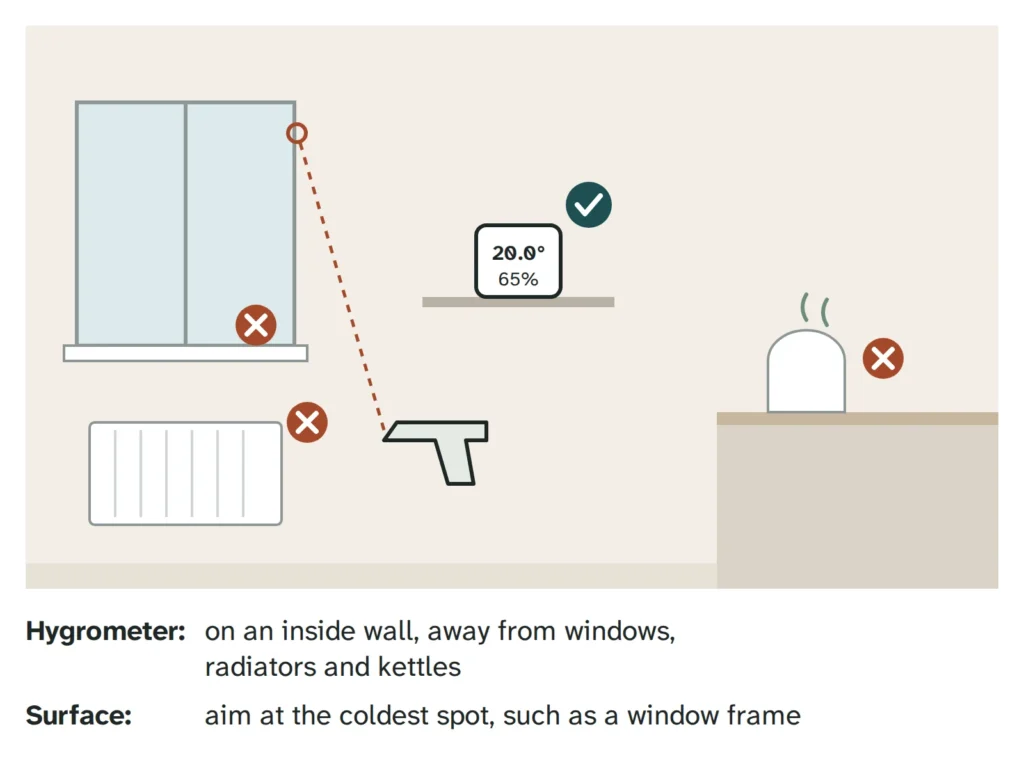
- On an internal wall or a shelf against one, not an outside wall.
- Away from radiators, heaters, direct sunlight and windows.
- Away from the kettle, the shower and the tumble dryer.
- At roughly chest height, in open air, not in a cupboard or behind a curtain.
When to read it
Take a reading first thing in the morning before windows are opened and again in the evening. The morning reading is usually the highest of the day and the one that matters most for condensation. To see what a particular activity does, read before and an hour after: a shower, a load of washing on the airer, a cooked meal.
Accuracy
Cheap hygrometers are usually within a few per cent, and that is good enough. Do not worry about the difference between 58 and 61, or about two units that disagree slightly. What you are looking for is the pattern: which rooms are high, whether readings clear after a burst of moisture, and whether things improve when you change something. A week of morning and evening readings for each room tells you far more than any single number.
What to do if the reading is high
The full method is in our guide to reducing humidity in the house. The short version, from the Energy Saving Trust’s advice:
- Deal with the source: lids on pans, cooker hood on, bathroom extractor running for at least 15 minutes after a shower, washing dried outside or in a closed room with the window open or a dehumidifier running, never on radiators in living areas.
- Ventilate: open windows several times a day for at least five minutes, keep trickle vents open, and make sure internal doors have a gap of at least 10 mm underneath so air can move around the house.
- Keep the house warm enough: RICS suggests 18 to 21 C. Rooms left cold turn moisture in the air into moisture on the walls.
- If the reading is still high, a dehumidifier will hold the level down. The Centre for Sustainable Energy suggests setting it to under 60 per cent.
If none of this brings the reading down, or the house is high everywhere without an obvious cause, look for a leak or a structural damp problem rather than more ventilation. Our guide to damp or condensation explains how to tell the difference, and a chartered surveyor can diagnose what a household check cannot. Health questions about damp and mould are for the NHS or your GP; this guide covers the building, not the person.
What to do if it is high in only one room
A single high room usually has one of three explanations.
- The room is cold. Check the temperature on the same hygrometer. If the room is several degrees cooler than the rest of the house, the moisture is arriving from elsewhere and cooling. Heat the room a little, keep the door closed so warm wet air does not drift in, and ventilate it.
- There is a moisture source in the room. A shower without a working fan, washing on an airer, an unvented tumble dryer, a lot of houseplants, or a fish tank. Remove or vent the source and see if the reading follows.
- Water is getting in. If the room is warm and has no obvious source but still reads high, especially if it is worse after rain or there is a patch on a wall or ceiling, treat it as possible penetrating damp or a leak. Compare the patterns in damp or condensation and get it looked at.
If a small patch of mould has already appeared, our guide to removing mould from walls covers how to clean it safely. Mould that keeps returning after cleaning means the underlying moisture has not been fixed.
Renters: record your readings
If you rent and the humidity stays high despite doing everything above, the problem is likely to be the building: no working extractor, blocked or missing vents, an uninsulated cold wall, a leak. A dated log of morning and evening readings for each room, with the temperature at the same time, is useful evidence when you report the problem to a private landlord, letting agent, housing association or council environmental health team. It shows the readings are high even when the room is heated and ventilated, and gives whoever inspects something concrete to work from.
For social housing tenants, Awaab’s Law applies from 27 October 2025: the landlord must investigate a potential hazard within 10 working days and make significant damp and mould hazards safe within 5 working days of identifying them. Private renters are due to get similar rights under the Renters’ Rights Act at a later date. If anyone in the home is in a higher-risk group, say so when you report it; the GOV.UK guidance says landlords should not wait for medical evidence before acting.
Sources
- Condensation, damp and mould, Centre for Sustainable Energy, reviewed December 2025
- Damp and mould consumer guide, RICS, 16 June 2025
- Fixing damp and condensation, Energy Saving Trust, updated 22 May 2026
- Assessing damp in historic buildings, Historic England
- Understanding and addressing the health risks of damp and mould in the home, GOV.UK (DLUHC and UKHSA), updated 1 April 2026
- How Awaab’s Law changes the rules on hazards in social housing, Shelter, October 2025