
Condensation on Walls: Why It Happens and How to Stop It
Why condensation forms on some walls and not others, how to tell it from damp, dew point figures and fixes ranked honestly, from ventilation to insulation.
Quick answer
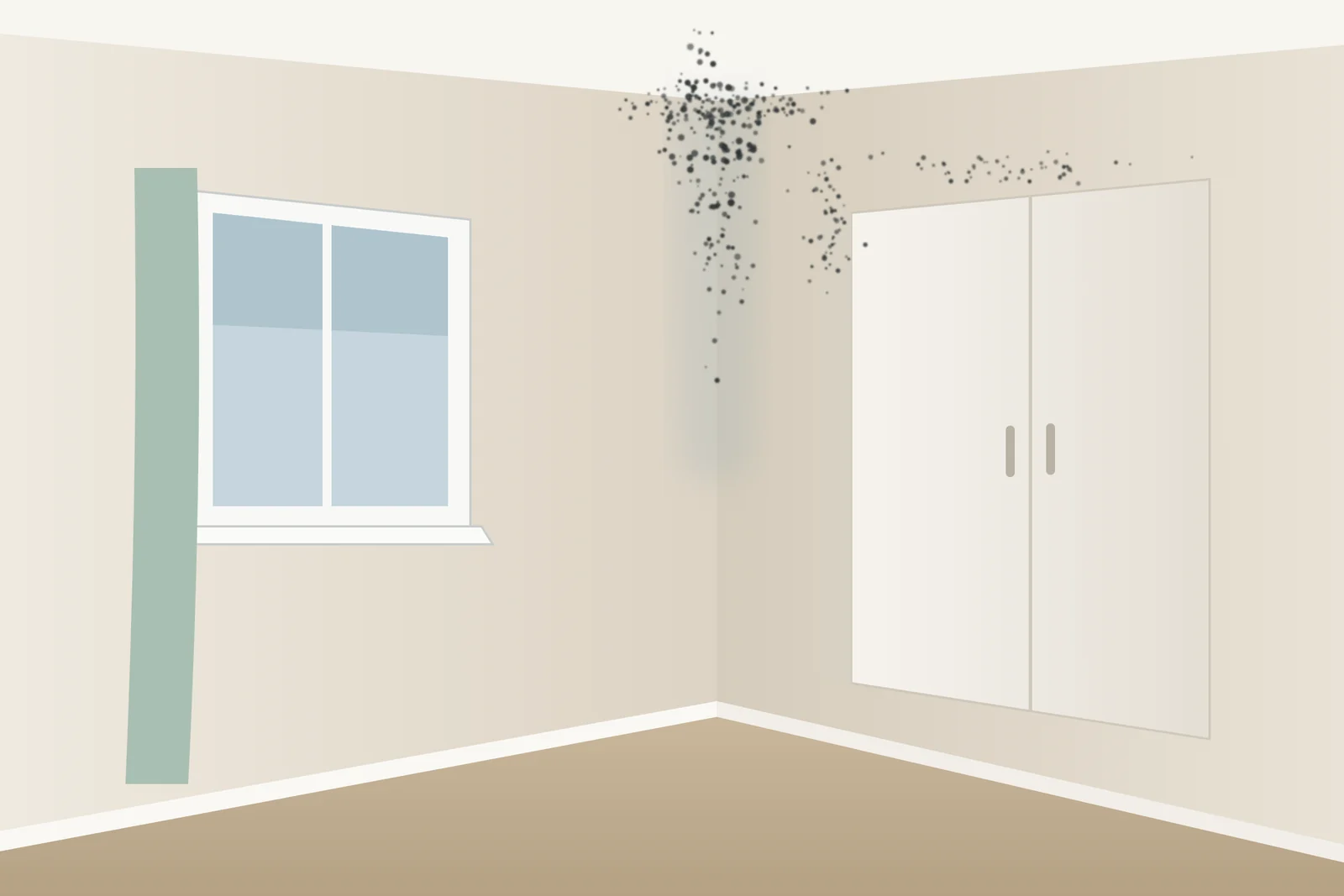
Condensation forms on a wall when the wall surface is colder than the dew point of the room air, the temperature at which that air can no longer hold its moisture. That is why it appears on the coldest surfaces first (external wall corners, behind wardrobes, window reveals, uninsulated solid walls) and why it is worse in winter. The fix has two halves: cut the moisture in the air and get it out (ventilation, extractor fans, no washing on radiators), and keep the wall surface warmer (steady background heat, furniture off external walls and, where suitable, insulation). Paints and thermal linings help a little at the surface but do not remove moisture.
On this page
- Is it condensation, or damp from outside?
- Why walls sweat: surface temperature and dew point
- Cold bridges: why one wall streams and the next is dry
- House types in brief
- How to stop condensation on walls: fixes ranked honestly
- Cleaning the mould off the wall
- Renters: what to report and to whom
- Common mistakes
- When to get professional help, and who
- FAQ
Is it condensation, or damp from outside?
Check the wall against this list before you buy anything:
- Worst in cold weather, better in warm, dry spells.
- In the coldest places: external wall corners, behind wardrobes and beds on outside walls, north-facing walls, window reveals and lintels.
- Mould, where present, is black or dark green and speckled, in a spreading cloud rather than a defined patch.
- No tidemark. Wealden District Council’s tenant guidance says condensation does not leave one, and if there is a tidemark the dampness “might have another cause, such as water leaking into your home from a plumbing fault, loose roof tiles or rising damp”.
- Windows in the same room stream in the mornings.
Penetrating damp shows as a concentrated patch below a fault such as a blocked gutter and worsens after rain, not cold nights. Rising damp, rarer than the trade suggests, shows as a tidemark at the bottom of a wall. The guide to telling damp from condensation covers the foil test and the four damp patterns side by side, with detail in penetrating damp signs and rising damp signs.
This is an indicator, not a diagnosis. If the pattern does not fit, or there is a tidemark, staining or failing plaster, involve a surveyor.
Why walls sweat: surface temperature and dew point
Warm air holds more water vapour than cold air. Relative humidity (RH) is how full the air is: 60 per cent means it holds 60 per cent of the vapour it could hold at that temperature. Cool the air and the percentage rises with no change in the amount of water: air at 20 C and 55 per cent reads about 75 per cent at 15 C. At 100 per cent it has reached its dew point, and below that temperature the vapour comes out as liquid water.
A wall only needs to be at or below the dew point of the air touching it. Figures for a room at 20 C, from the Magnus formula:
| Room air at 20 C | Dew point | What that means for the wall |
|---|---|---|
| 50 per cent RH | about 9.3 C | Only very cold surfaces are at risk |
| 60 per cent RH | about 12.0 C | Cold corners and uninsulated solid walls can dip this low on a winter night |
| 70 per cent RH | about 14.4 C | Common in bedrooms overnight; large areas of external wall are at risk |
| 80 per cent RH | about 16.4 C | Almost any external wall surface will be wet |
The dew point rises steeply with humidity, so taking a bedroom from 70 per cent down to 60 does more than most people expect. And mould does not wait for running water: building standards use about 80 per cent surface humidity as the mould-risk threshold, so a wall a few degrees above the dew point can still grow mould through a winter. Put your own readings into the dew point calculator. Historic England gives about 40 to 65 per cent RH at around 20 C as a common comfort and building-care range; the guide to what humidity a UK home should be covers measuring it.
Cold bridges: why one wall streams and the next is dry
The air is the same across a room, so the difference between a wet wall and a dry one is almost always surface temperature. Anything that lets heat out faster than the wall around it makes a cold spot, where the dew point is crossed first. Builders call these cold bridges (or thermal bridges).
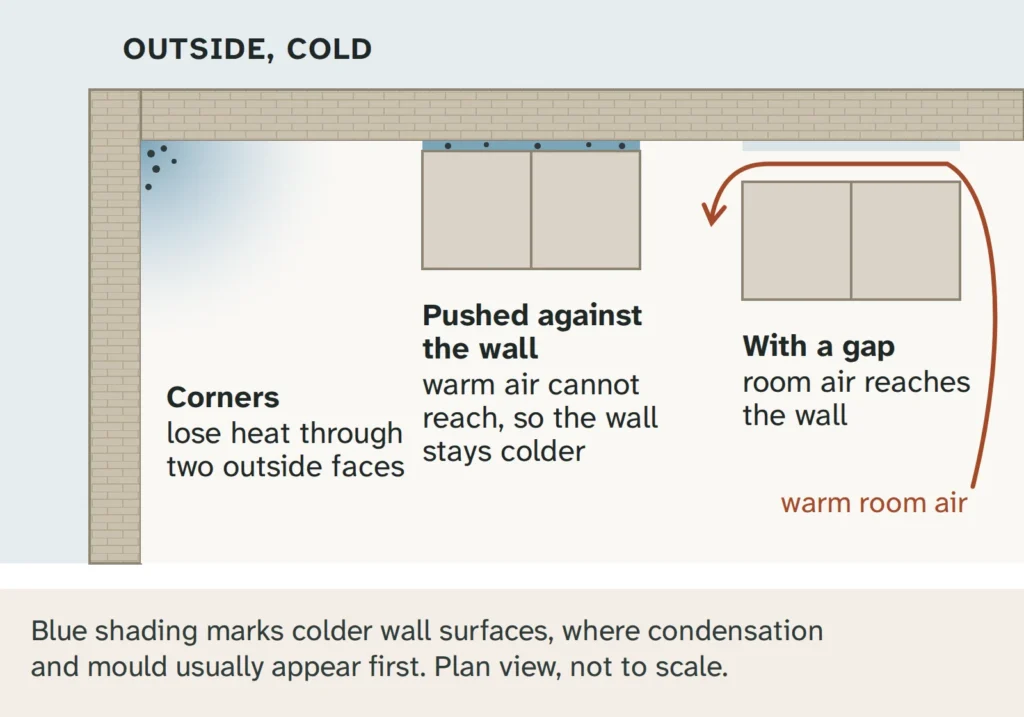
The usual suspects in UK homes:
- External corners. More outside surface losing heat than inside surface receiving it, and the stillest air. Wyre Forest District Council notes condensation “often appears as a dark patch in corners near the skirting”.
- Behind furniture on an external wall. A wardrobe or headboard stops warm room air reaching the plaster, which cools while the trapped air stays humid. Wyre Forest points to “behind furniture, particularly wardrobes and beds if they have been placed against an outside wall”.
- Window reveals and lintels. The wall thins around an opening and a concrete or steel lintel conducts heat well, so the plaster beside and above a window is often the coldest wall surface in the room; see condensation on windows.
- North-facing walls. No sun during the day, so they start each night colder.
House types in brief
- Solid-wall homes. The Energy Saving Trust says homes built before 1920 are generally more likely to have solid walls. From outside, solid walls usually show some bricks laid across the wall so you see their short ends; cavity walls usually show every brick lengthways. With no insulating gap, one thickness of brick or stone loses heat all night, and on a cold, still morning the whole inside face can sit below the dew point. These are the homes where condensation on walls is most stubborn.
- Cavity-wall homes. An unfilled cavity still loses heat, and even a filled one has cold bridges at corners, lintels and openings.
- Flats in concrete-framed blocks. Where the frame or floor slab runs through from inside to outside it conducts heat better than brick, so mould that follows straight structural lines or sits in the outer corners of the block points to a cold bridge in the frame.
How to stop condensation on walls: fixes ranked honestly
1. Cut the moisture and get it out
This does the most and is skipped most often. The Energy Saving Trust says a household typically produces up to 100 litres of moisture a week; Wealden’s worked example for one day comes to 26 pints (14.8 litres), with drying clothes indoors (9 pints) and cooking and the kettle (6 pints) the biggest items. From the council and Energy Saving Trust pages in the sources:
- Run the bathroom extractor for at least 15 minutes after a shower and the cooker hood for at least 15 minutes after cooking, with the door closed.
- Lids on pans; run the cold into the bath before the hot (Wyre Forest says this cuts the steam).
- Dry washing outside where you can. Indoors, hang it in the bathroom with the door closed and the window slightly open or the extractor on, never on radiators in living rooms or bedrooms.
- Air the home daily. Wealden suggests cross-ventilation through small windows on opposite sides for about 30 minutes, and 20 minutes for the kitchen and bathroom after use. Keep trickle vents (the small slotted vents in window frames) open.
- Leave at least 10 mm under internal doors so air can move through the home.
- A dehumidifier helps in a room you cannot ventilate, but it treats the air, not the wall, and will not fix a cold bridge.
Camden Council’s short video (in the sources, also in BSL and several community languages) covers the same steps; the guide to reducing humidity in the house ranks them by how much moisture each removes.
2. Keep the heating steady rather than high
Wealden recommends “a medium-to-low level of heat throughout the house”; Wyre Forest says it is “better to heat the whole home to a lower temperature, rather than one room to a very high temperature”, and that warming the cold spots is what reduces condensation. RICS suggests 18 to 21 C as the ideal internal range. Heating in bursts lets walls cool fully overnight, so moist air lands on a cold surface; steady heat keeps it a few degrees above the dew point.
Wyre Forest adds a caution: over-ventilating in cold weather drops the indoor temperature and can make condensation worse, so air briefly and on purpose rather than leaving windows open all day in January.
3. Pull furniture off external walls and free the curtains
Wealden’s advice is to “keep a small gap between large pieces of furniture and the walls, and where possible place wardrobes and furniture against internal walls”. A gap of about 5 to 10 cm is commonly suggested, enough for air to move behind the piece. Curtains touching the wall, or blinds pressed against a reveal, trap still, humid air against a cold surface in the same way, so keep them clear of the wall, reveal and radiator.
4. Warm the wall surface with insulation
If ventilation and heating are right and a wall still runs wet, the durable fix is to raise the surface temperature. This is where cost and risk both jump.
Internal wall insulation (IWI) lines the inside of the wall with insulation. It works, but it needs design, not a Saturday job on one wall:
- Historic England’s guidance (October 2025) reports that in its case studies “installing IWI always led to an increased moisture risk, even when only a thin layer of insulation was applied”. The wall behind the insulation gets colder, and the Energy Saving Trust warns that “moisture may build up inside the wall”: the risk moves from the room face into the wall, where you cannot see it.
- Older buildings need breathable approaches. Historic England advises permeable insulating materials and finishes for traditional buildings and against closed-cell foam and other plastic-based insulations; the right permeability varies case by case, so specialist assessment is needed.
- The Energy Saving Trust says wall insulation cannot be done before fixing any existing damp, and that it reduces room size, is disruptive and makes fixing heavy items to the wall harder.
Cavity wall insulation is cheaper if you have unfilled cavities, but only where the building suits it. The Energy Saving Trust lists exposure to driving rain, walls in poor condition, cavities narrower than 50 mm and existing internal damp as reasons it may be unsuitable, and says the installer or a building professional should survey the walls first.
External wall insulation avoids the moisture-in-the-wall risk of IWI but changes the building’s appearance and is a whole-house project, not a one-wall fix.
5. Thermal lining paper and anti-condensation paint
Thermal lining paper is a thin insulating layer hung like lining paper and decorated over. It separates the room-facing surface from the cold masonry by a few millimetres, so that surface runs slightly warmer, which can keep a marginal wall above the dew point on an average winter night. It does not warm the wall beneath or touch the moisture in the air, and on a cold solid wall at 70 per cent RH it will be overwhelmed.
Anti-condensation paint is sold on one of two principles: insulating fillers that keep the painted surface a touch warmer, or a finish that absorbs moisture and releases it later so droplets do not form. Ronseal, for example, says its product “adds an extra layer of insulation to your wall and puts a stop to condensation building up and mould growing”; that is the manufacturer’s description, not something verified here. A coat of paint cannot remove moisture from the air or change the temperature of the masonry behind it by more than a small margin. On a cleaned wall where ventilation and heating have been sorted, a paint or lining may tip a borderline surface the right way; used instead of those steps, it fails, and any fungicidal effect wears off.
Never paint or paper over untreated mould (Oxford City Council’s guidance); it grows back through.
Cleaning the mould off the wall
Small patches of condensation mould on a painted wall are a household job; retailers commonly use under 1 square metre as a rule of thumb, a trade convention rather than an official figure. Use a mould and mildew product rather than bleach (GOV.UK prefers them for health and safety reasons), wear a mask, gloves and goggles, wipe only when the mould is wet, throw the cloth away, and never mix products or use one after another on the same patch: bleach plus an acid such as vinegar releases chlorine gas. The full method is in removing mould from walls.
Larger areas, returning mould, or anyone in a higher-risk group in the home mean professional treatment and, for renters, the landlord. GOV.UK’s higher-risk groups are people with pre-existing conditions such as allergies, asthma, COPD, cystic fibrosis and other lung and cardiovascular disease; people with weakened immune systems, including those having cancer treatment, who have had a transplant or take immune-suppressing medication; pregnant women, their unborn babies and women who have recently given birth; children and young people, including those at risk of worsening mental health; older people; people with a mental health condition; and people who are bedbound, housebound or have mobility problems. Health questions about mould are for the NHS website or your GP.
Renters: what to report and to whom
A home with cold bridges, no working extractor fans and single glazing will condense however carefully it is run. Report in writing with dated photos and keep copies.
- Council or housing association tenants. Under Awaab’s Law, from 27 October 2025 social landlords must investigate a potential hazard within 10 working days, make significant damp and mould hazards safe within 5 working days of identifying them, complete emergency works within 24 hours, and offer alternative accommodation if they cannot. GOV.UK guidance also says landlords should not wait for medical evidence and should revisit at least six weeks after treatment.
- Private tenants. Report to the landlord or letting agent in writing. If nothing happens, the council’s environmental health team can inspect. Awaab’s Law is due to extend to private renters under the Renters’ Rights Act at a later date.
- Disputes or compensation. Shelter and Citizens Advice.
Common mistakes
- Heating one room hard with the door shut: the moist air escapes to the cold bedroom and condenses there.
- Assuming rising damp. RICS notes it is often misdiagnosed and that failure of an original damp-proof course is extremely rare; speckled black mould in a cold corner is not rising damp.
- Sanding or scraping old surfaces before painting. Textured coatings in buildings from before 2000 may contain asbestos (HSE) and paint from before 1992 may contain lead (UKHSA); do not sand, scrape or drill suspect materials without checks.
- Brushing or vacuuming mould, which Oxford City Council advises against.
When to get professional help, and who
- A surveyor if the pattern does not match condensation, there is a tidemark or blown plaster, or mould returns after a winter of doing everything right. RICS advises a Joint Position Statement (JPS 2022) compliant inspection by someone with no commercial interest in selling a treatment, and warns that damp meters measure electrical conductivity and can read high from salts.
- An electrician (Part P) for any extractor fan wiring; a Gas Safe registered engineer for any gas appliance, including a bottled gas heater, which Wealden’s table shows adds 4 pints of water a day to the air.
- A specialist installer for internal, external or cavity wall insulation. The Energy Saving Trust recommends three quotes from TrustMark-certified professionals for structural damp work.
FAQ
Will condensation on walls clear up on its own?
The water evaporates when the weather warms, so it seems to vanish each spring. The cause does not change, so it returns each autumn, and the mould that grew while the wall was wet stays and spreads a little further each year. Clean the mould and fix the moisture and the cold surface.
Sources
- Controlling Condensation and Mould, Wealden District Council
- How to prevent condensation, damp and mould (video), Camden Council
- Damp, Mould and Condensation, Wyre Forest District Council
- Fixing damp and condensation, Energy Saving Trust, 22 May 2026
- Solid wall insulation, Energy Saving Trust, 18 June 2026
- Cavity wall insulation, Energy Saving Trust, 8 May 2026
- Internal Wall Insulation, Historic England, 29 October 2025
- Assessing damp in historic buildings, Historic England
- Understanding and addressing the health risks of damp and mould in the home, GOV.UK (DLUHC and UKHSA), 1 April 2026
- Damp and mould consumer guide, RICS, 16 June 2025
- Get rid of mould, Oxford City Council
- How Awaab’s Law changes the rules on hazards in social housing, Shelter, October 2025
- Asbestos, Health and Safety Executive
- Anti Condensation Paint, Ronseal (manufacturer’s product page)