
Rising Damp Signs: What It Looks Like and What Gets Mistaken for It
The signs of rising damp (tide mark, salts, rotting skirting), the six problems usually mistaken for it, a safe self-check, and what a real fix looks like.
Quick answer
Rising damp is moisture from the ground drawn up through a wall by capillary action (the way a paper towel soaks up a spill). The textbook signs are a horizontal tide mark low on a ground-floor wall, white salt crystals on the plaster, blistering paint and rotting skirting boards. But the RICS consumer guide says rising damp “is often misdiagnosed” and that “failure of an original damp-proof course is extremely rare”, so before accepting the label, rule out the look-alikes: raised ground outside, a leaking downpipe or pipe, plaster bridging the damp-proof course, and condensation behind furniture. Most are cheaper to fix than a new damp-proof course, and none is fixed by one.
On this page
- What rising damp is, and why the label matters
- The signs of rising damp
- What is often mistaken for rising damp
- A safe self-check before you call anyone
- Why a free survey is not an independent one
- What a real fix looks like
- Buying or selling a house with a "rising damp" note on the survey
- If you rent
- Common mistakes
What rising damp is, and why the label matters
A damp-proof course (DPC) is a horizontal barrier built into a wall near ground level, usually a strip of slate, bitumen felt or plastic a few brick courses up, to stop ground moisture climbing the masonry. Rising damp is what happens when ground water gets past that barrier, or where there is none, and soaks upward through the pores of the brick or stone.
Two things follow, both from the RICS consumer guide:
- Rising damp is a route, not a diagnosis. RICS puts it plainly: “‘Rising damp’ is not a conclusion, as it does not identify the source of the excess moisture.” Somebody still has to say where the water comes from.
- An original DPC very rarely fails. RICS calls the typical misdiagnosis “that ‘rising damp’ is the cause of your problem and that your home needs a new damp-proof course.” Water is usually getting round or over the DPC, not through it.
Historic England’s guide to assessing damp in historic buildings adds a number. When the Building Research Establishment analysed 1,500 damp investigations, “rising damp accounted for only 4% of cases.” Damp at the base of a wall is common; true rising damp is not.
The signs of rising damp
Water is pulled up from below, so the damage sits low, runs along the wall, and stops where evaporation beats capillary pull.
| Sign | What you see | Why it happens |
|---|---|---|
| Tide mark | A horizontal band of staining or darker plaster with a fairly level upper edge along the bottom of the wall | Water rises to the height where it evaporates as fast as it climbs. Pennington Choices, a housing consultancy, gives about 1.5 metres as the maximum; most cases sit well below that |
| Salts (efflorescence) | White, fluffy or crystalline deposits on the plaster or brick, often along the tide mark | Ground water carries dissolved salts and leaves them behind as it evaporates. Efflorescence is the name for that white crust |
| Blistering or flaking paint and lifting wallpaper | Paint bubbles, emulsion peels in sheets, paper comes away at the skirting | Salt crystals growing behind the finish push it off; damp plaster will not hold a coating |
| Crumbling plaster | Plaster that is soft, powdery or sandy low on the wall | Salt-contaminated plaster breaks down and keeps pulling moisture from the air |
| Rotting or stained skirting boards | Skirting that is dark, soft, springy or shows fungal growth along its bottom edge | Timber in contact with persistently wet masonry |
| Ground floor only | Ground-floor or below-ground walls, nothing similar upstairs | Water can only rise so far. Damp upstairs has a different cause |
| Seasonal, not shower-by-shower | Worse in wet months and slow to change, not tied to individual downpours or bath time | Ground moisture changes over weeks. Rain-driven damp reacts within hours; condensation follows household routines |
| Musty smell | A persistent earthy or musty odour near the affected wall | Long-term damp in plaster and timber |
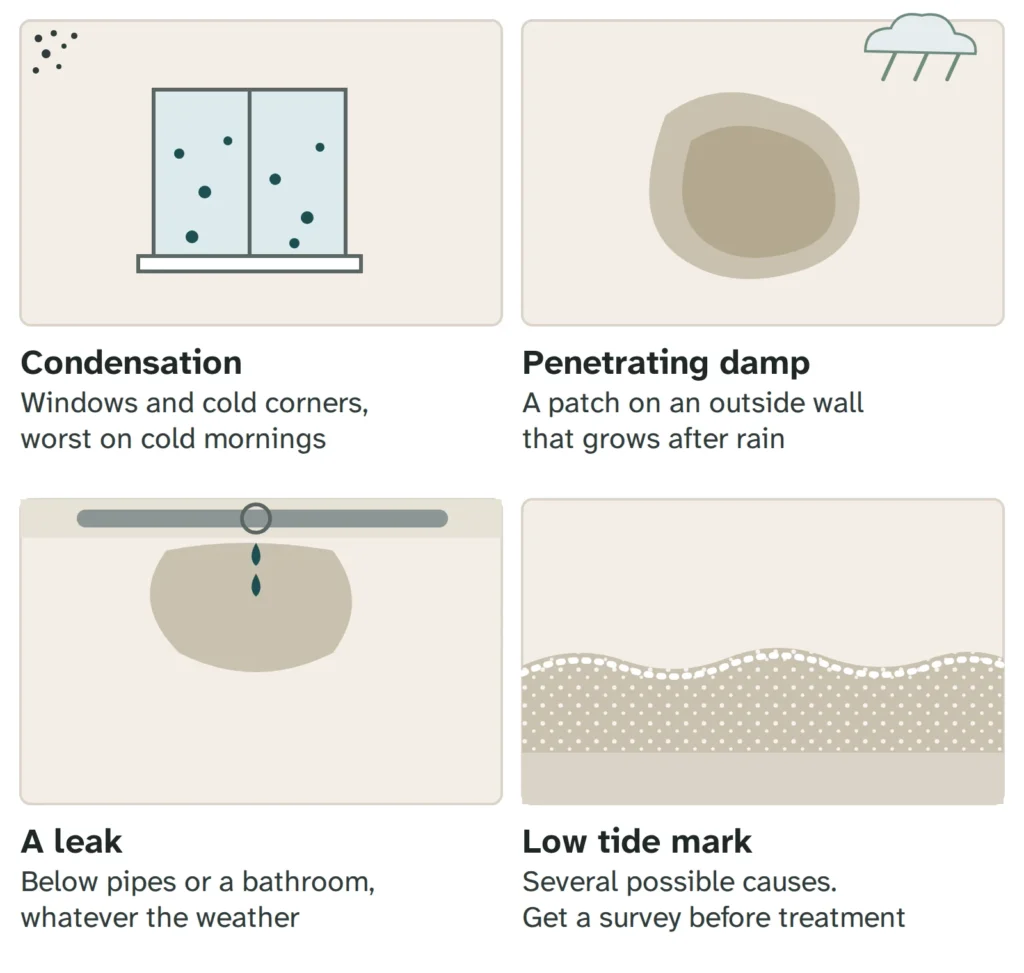
If your patch fails the last three rows (it is upstairs, it appears after heavy rain, or it comes and goes with showers and cooking), it is probably not rising damp however much it looks like it.
What is often mistaken for rising damp
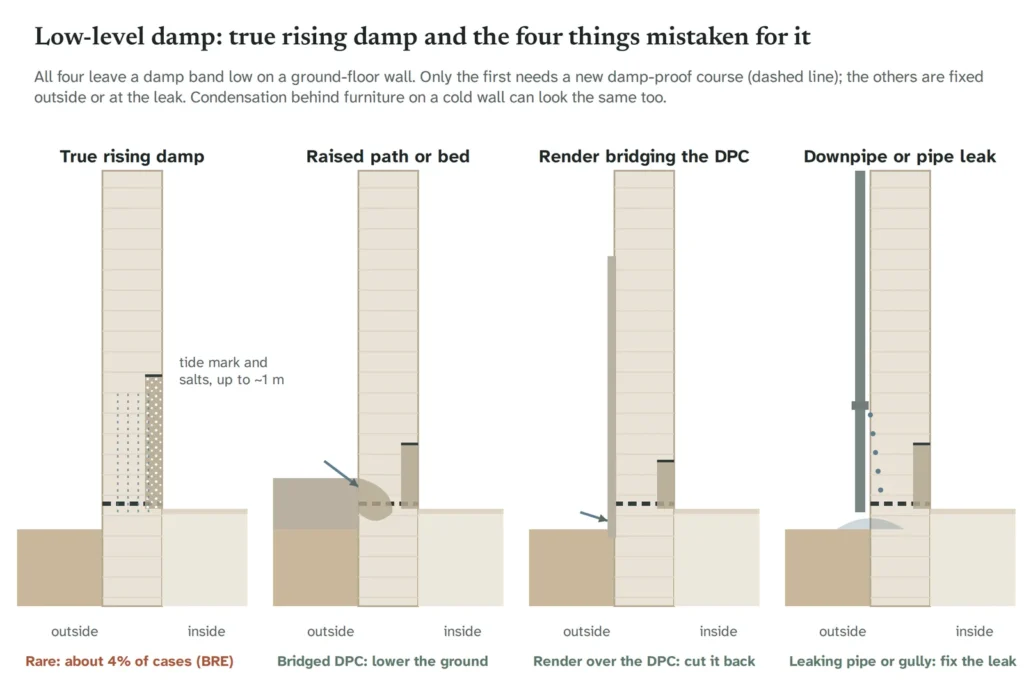
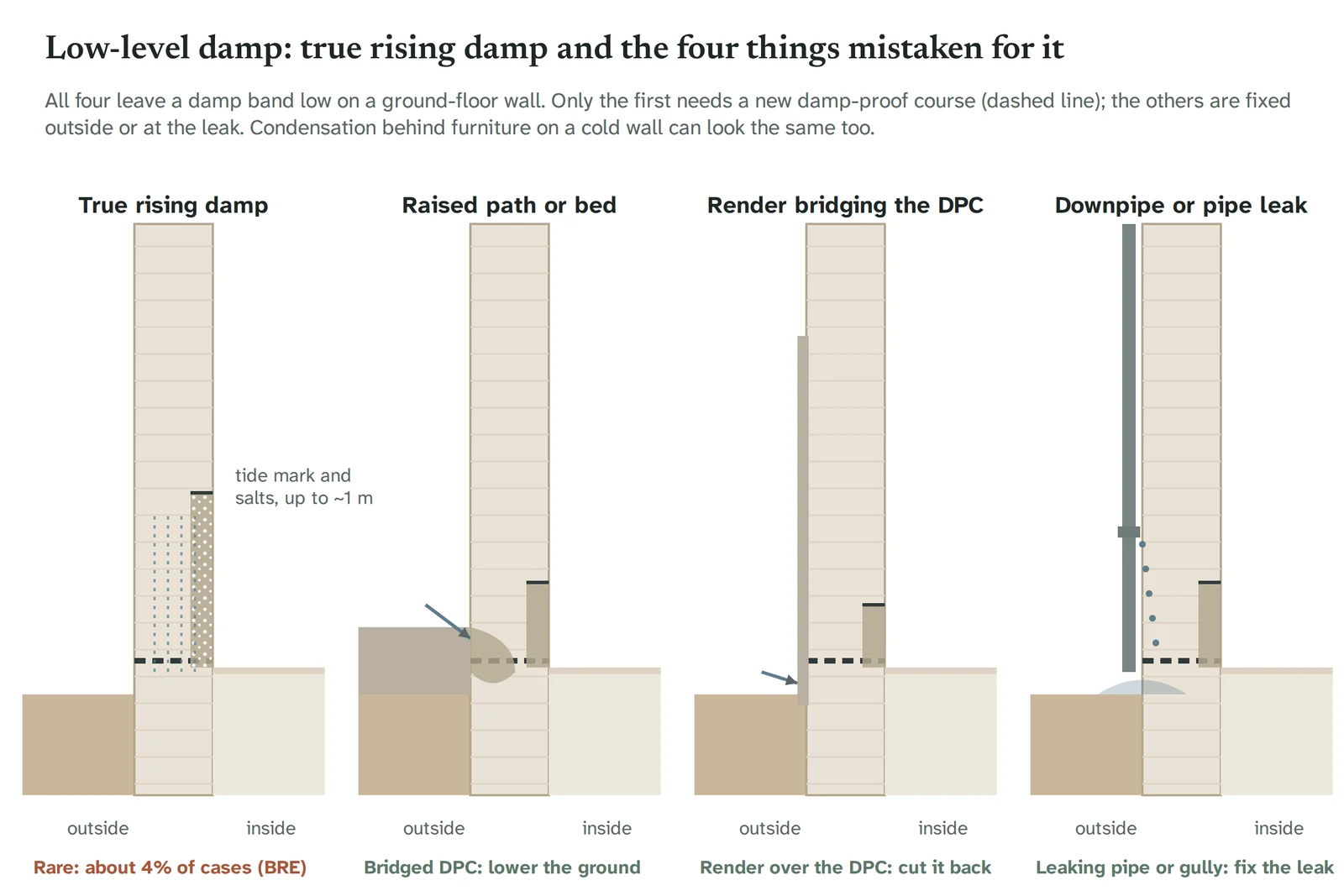
RICS, Pennington Choices and Historic England all list the same culprits. Each gives the same low-level tide mark, and each is a different repair.
Raised ground or paths outside (a bridged DPC)
The most common one. A DPC only works if the ground outside sits below it. If a patio, path, flower bed, driveway or built-up soil has crept above the DPC line, moisture soaks into the wall above the barrier and the DPC is “bridged”. Historic England calls this “a common accidental problem, particularly with raised patios and flower beds”, and says the resulting sideways moisture is “frequently mistaken for rising damp”. The fix is to lower the ground, not to inject the wall.
Debris in the cavity
In a cavity wall, mortar droppings, rubble or badly installed insulation at the bottom of the cavity can sit across the DPC and carry moisture from the outer leaf to the inner one. Pennington lists “debris in wall cavities or subfloor voids” and “inappropriate insulation material in the cavity” among the causes misread as rising damp. You cannot see this from inside; it takes a borescope inspection through a small hole.
Render or plaster bridging the DPC
External render taken down over the DPC into the ground, or internal plaster carried down behind the skirting to the floor slab, gives water a path round the barrier. Pennington names “plaster or render overlapping the DPC” as a cause. Look outside for a bell-cast drip or a horizontal break in the render a few courses up; render that runs continuously into the soil may be the bridge.
A leaking pipe under the floor, or a leaking downpipe nearby
A slow leak from a heating, supply or waste pipe under a solid floor keeps the ground under the wall permanently wet and can produce a classic tide mark on one wall only. Outside, a cracked or blocked downpipe, a leaking gully or a dripping tap does the same to a short stretch of wall. The giveaway is location: the patch centres on the pipe, tap or downpipe, not the whole wall.
Condensation low on cold walls behind furniture
Ground-floor external walls are the coldest surfaces in the house, and the bottom of a wall behind a sofa, wardrobe or bed gets no warm air over it. Condensation forms, mould follows, and the result is a dark, patchy band read as rising damp. Pennington Choices notes that rising damp “is often confused with other forms of damp, particularly condensation”. The tells: black spotting rather than salts, a patch that follows the furniture rather than the wall, and a problem that worsens after showers, cooking and drying clothes. See condensation on walls and damp or condensation?.
Penetrating damp at low level from splashback
Rain hitting a hard path or patio bounces up the bottom half-metre of the wall. Add porous old brick, failed pointing or a saturated plinth and the wall wets from the outside in. This is penetrating damp that happens to be low down: it grows after heavy rain and dries in dry weather, which ground moisture does not. See penetrating damp signs.
A safe self-check before you call anyone
None of this is a diagnosis. It is a way to arrive at a surveyor with facts rather than a hunch, and to spot the cheap causes first. Everything is done from ground level with a tape measure and a torch.
- Find the DPC line outside. Look for a thin horizontal line of slate, black bitumen or plastic in a mortar joint, usually a few brick courses above the original ground level. On rendered walls look for a horizontal break or drip bead. Some older houses have no DPC at all (see the section on older buildings below).
- Compare outside ground level to it. Is the path, patio, soil, decking or gravel level with or above the DPC line anywhere along the affected wall? If so, you have found a bridge and it is the first thing to fix.
- Look for a downpipe, gully or outside tap within a couple of metres. Check the joints and gully for staining, moss or a green streak on the brick. Run the tap and see whether water pools against the wall.
- Check render and plaster. Outside, does render run below the DPC into the ground? Inside, if a section of skirting is loose, does the plaster continue down to the floor slab?
- Note whether the patch changes with weather. Mark the edge of the stain lightly in pencil and date it. Check after heavy rain and after a dry week. Ground moisture moves over weeks; rain-fed damp moves in hours or days.
- Note whether it changes with household routine. Worse on cold mornings and after showers, better when the room is heated and aired, points to condensation.
- Foil test, with a caveat. Tape a square of kitchen foil to a dry part of the affected wall, edges sealed, and leave it for a day or so. Moisture on the room side suggests condensation; on the wall side, moisture coming through the wall. It is a rough indicator only and cannot tell rising damp from a bridge or a leak.
A note on damp meters. The cheap pin meters sold online are the type many contractors wave at your wall. RICS explains that they “test an electric current through a material” and are accurate for timber, “but in other materials may register high readings from other conductive materials, not just moisture.” Salt-laden plaster, foil-backed plasterboard and some paints all read “wet”. RICS says to “be wary of any surveyor or commercial specialist who uses only a damp meter to diagnose the source of dampness, especially in hard walls and solid floors.” A high reading on plaster tells you something is going on, not what.
Why a free survey is not an independent one
Most of the top search results for “rising damp” come from damp-proofing contractors or makers of DPC injection chemicals, and many offer a free survey. The survey is free because the business model is the treatment: a damp meter, a diagnosis of rising damp and a quote for injected DPC and replastering. That conflict of interest is why RICS separates diagnosis from treatment.
RICS recommends instead a Joint Position Statement 2022 (JPS22) compliant inspection, JPS22 being the joint industry standard for investigating moisture in buildings. RICS says such an inspection “will give you an unbiased professional opinion from someone who does not have a commercial interest in selling you a product.”
Ask any surveyor three questions before booking:
- Do you or your company sell or install damp-proofing treatments?
- Will the inspection follow JPS22?
- Will you identify the moisture source, or only the moisture route?
Look for independent building surveyors (MRICS or FRICS after the name), chartered building engineers or damp diagnosticians who do not sell treatment. Once you know what needs fixing, the Energy Saving Trust’s advice for structural damp is to get quotes from three TrustMark-certified professionals.
What a real fix looks like
Because most “rising damp” is a bridge or a leak, most real fixes are boring and relatively cheap:
- Lower the outside ground level so it sits clearly below the DPC, or dig a narrow gravel-filled channel against the wall where it cannot be lowered. This is landscaping, not damp-proofing.
- Clear the cavity at the base of the wall of mortar droppings or debris, through removed bricks or a cavity-cleaning service.
- Cut back render to above the DPC and finish with a bell-cast bead; strip and replace plaster that runs down to the slab behind the skirting.
- Fix the leak: a plumber for underfloor pipework, a roofer or general builder for downpipes and gullies.
- Then let the wall dry. Masonry that has been wet for years takes months to dry, and salt-contaminated plaster may need replacing with one that will not keep pulling moisture from the air. Redecorating too soon wastes paint.
Rising damp does not go away on its own while the source remains. A patch that clears in summer is more likely condensation.
Chemical DPC injection, where a water-repellent cream or fluid is injected into a line of drilled holes in the mortar bed, is a last resort for a wall that an independent survey has shown to have no working DPC. It does nothing for a bridge, a leak or condensation, and is often sold with “tanking” (a waterproof render inside), which can trap moisture in the wall. Cost depends entirely on the cause: lowering a patio or repairing a downpipe is usually a modest job, while an injected DPC with replastering is a much bigger bill, and wasted if the real cause was a bridge. Pay for an independent survey before you pay for treatment.
Older and solid-walled buildings
If your house has solid walls (no cavity), or is listed or in a conservation area, be more cautious still. Historic England’s guidance is that these buildings manage moisture by letting it move and evaporate through lime mortar, lime plaster and breathable paints. Its damp guide notes that “many cement-based mortars lack the capillary pathways to allow absorbed moisture to return freely to the surface and evaporate”, so “water becomes trapped.” Cement render, waterproof paints, tanking and injected chemicals can all make an old wall wetter. Historic England’s advice is “careful and methodical observation” that takes account of the building’s environment, construction and history. Find the moisture route; do not cover it.
Buying or selling a house with a “rising damp” note on the survey
A RICS HomeBuyer or Level 3 survey often flags “high damp meter readings” or “possible rising damp” and recommends a specialist report. That note is a prompt for an independent JPS22 inspection, not a reason to accept a contractor’s quote. Selling a house with damp is not illegal in itself, but sellers answer questions about known problems on the property information form, and buyers rely on their own survey and may renegotiate or ask for works. What must be disclosed, who pays, and whether you can withdraw are legal questions for Citizens Advice, Shelter, GOV.UK or a conveyancing solicitor. This site does not give legal advice.
If you rent
Report it in writing to your landlord, letting agent or housing association, with dated photos and a note of where it is and whether it changes with rain. Keep copies. Landlords are responsible for the structure, including the DPC, external walls, drainage and pipework, so bridged ground levels, leaking downpipes and underfloor leaks are theirs to fix.
If you rent from a council or housing association, Awaab’s Law applies: from 27 October 2025 social landlords must investigate a potential hazard within 10 working days, make significant damp and mould hazards safe within 5 working days of identifying them, complete emergency works within 24 hours, and offer alternative accommodation if they cannot. Private renters are due to be covered under the Renters’ Rights Act at a later date. If your landlord does not act, your council’s environmental health team can inspect. Shelter and Citizens Advice explain your options.
If there is mould on the wall, removing mould from walls covers what is safe to clean yourself. For the condensation route, see reducing humidity in the house.
Common mistakes
- Accepting “rising damp” from a free survey without an independent second opinion.
- Injecting a DPC while the patio outside still sits above it.
- Painting, tanking or dry-lining over a damp wall before the source is fixed.
- Reading a high pin-meter figure on plaster as proof of rising damp.
- Ignoring the cheap checks (ground level, downpipe, tap) because the damage looks serious.
- Treating a solid-walled Victorian house with cement and waterproof coatings.
Next step
Sources
- Damp and mould consumer guide, RICS, 16 June 2025
- Assessing Damp in Historic Buildings (HEAG311), Historic England, 2026
- Understanding Rising Damp: Misdiagnoses, signs, and next steps, Pennington Choices, 15 October 2024
- Fixing damp and condensation, Energy Saving Trust, updated 22 May 2026
- Understanding and addressing the health risks of damp and mould in the home, GOV.UK (DLUHC and UKHSA), updated 1 April 2026
- How Awaab’s Law changes the rules on hazards in social housing, Shelter, October 2025