
Home › Ventilation
Topic
Ventilation
Condensation is moisture with nowhere to go. Extractor fans, trickle vents and a few minutes of open window a day are how it leaves. What each does, how to check yours, and which jobs are for an electrician.
Start here
A UK household puts up to 100 litres of water vapour a week into its air (Energy Saving Trust) from showers, cooking, washing drying and breathing. In a draughty old house that moisture leaked out through the gaps. In a house with new windows, draught-proofing and cavity insulation it stays in, and it shows up as misted windows, black corners and a musty smell. Ventilation is the deliberate replacement for the draughts: extractor fans in the wet rooms, background ventilation through trickle vents in every room, and short bursts of open window.
The guides in this topic follow one principle: remove moisture at source, from the bathroom and kitchen, before it spreads. The Building Regulations give useful benchmarks even for older homes: a bathroom fan for new work should move 15 litres a second, a kitchen fan 30, and trickle vents are expected in replacement windows. Wiring or fitting a fan in a bathroom is notifiable electrical work under Part P and is for a registered electrician.
Which guide do you need?
| What you are seeing | Points to | Read |
|---|---|---|
| Bathroom ceiling and tiles wet long after a shower; mould on the ceiling | The extractor fan is weak, off, or stops with the light | Bathroom extractor fans |
| Condensation started after new windows or draught-proofing | Background ventilation was lost; trickle vents shut or missing | Condensation on windows |
| The whole house reads high on a hygrometer | Too much moisture, too little ventilation overall | How to reduce humidity in your house |
| Damp patches on top-floor ceilings on frosty mornings | Moist air reaching a cold loft | Damp patch on the ceiling |
| Washing dried indoors most days | The drying room needs its own ventilation | Drying clothes indoors |
Guides
Fans
Bathroom extractor fans
The 15 litres a second benchmark, the tissue test, timer and humidistat fans, and why fitting one is an electrician’s job.
Sources: Approved Document F, Energy Saving Trust, Electrical Safety First

Humidity
How to reduce humidity in your house
The three layers of ventilation, extractor fan checks, trickle vents, purge ventilation and door gaps.
Sources: Energy Saving Trust, Approved Document F

Windows
Condensation on windows
Why new airtight windows show condensation first, and the trickle vent rules for replacement windows.
Sources: FENSA, Approved Document F, Energy Saving Trust
The three layers of ventilation
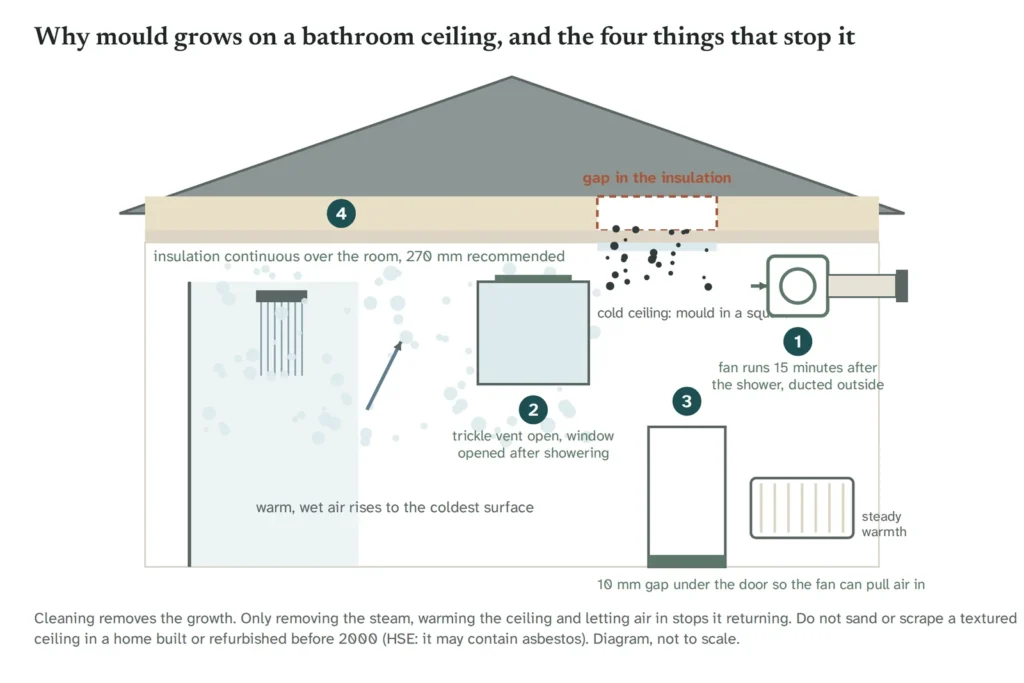
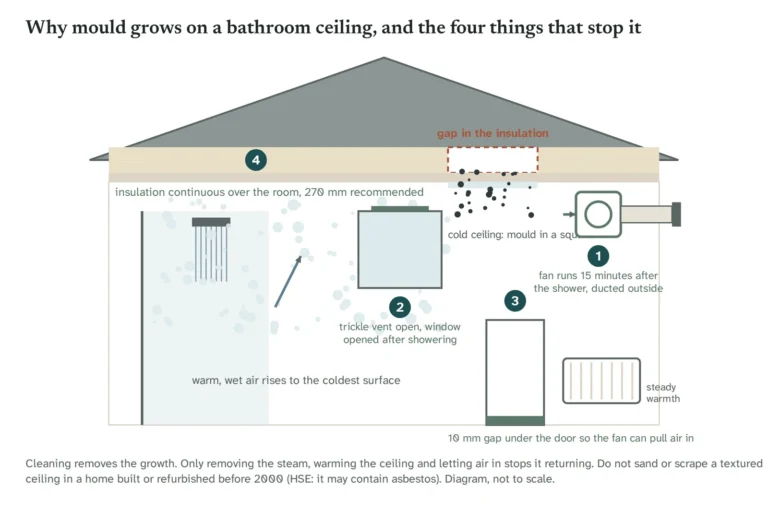
- Extract ventilation in wet rooms. Bathroom and kitchen fans that run while the room is steaming and for at least 15 minutes afterwards, ducted to the outside. This removes moisture where it is made.
- Background ventilation everywhere. Trickle vents left open, and a gap of at least 10 mm under internal doors so air can move from room to room and reach the fans (Energy Saving Trust).
- Purge ventilation. Windows opened wide for a few minutes several times a day. Cross-ventilation through windows on opposite sides clears a room fastest and loses least heat.
Before you buy anything
Most ventilation problems are a fan that is dirty, blocked or switched off, a trickle vent painted shut, or a door with no gap. Check those first. Positive input ventilation (a loft unit that gently pressurises the house with filtered air) and mechanical ventilation with heat recovery are real solutions for homes where condensation returns in several rooms, but they are professional installations and they do not fix a leak.
Safety
Fitting, replacing or rewiring an extractor fan in a bathroom or kitchen is notifiable electrical work under Part P of the Building Regulations. Use a registered electrician. Never vent a fan or tumble dryer into a loft. Do not block air bricks or sub-floor vents.
If you rent
A bathroom or kitchen with no extractor fan, a fan that does not work, or windows with no trickle vents is a fair thing to report in writing. Social landlords must investigate potential hazards within 10 working days and make significant damp and mould hazards safe within 5 working days under Awaab’s Law (from 27 October 2025). Private tenants can ask the council’s environmental health team to inspect.
Coming next in this topic
Guides in preparation: trickle vents and whether they stop condensation, positive input ventilation, and condensation on the outside of windows. Added as sources are checked; no fixed dates.
Next step
Bathroom extractor fans: sizing, timers and how to tell if yours works
Start with the four checks.