
Bathroom Extractor Fans: Sizing, Timers and How to Tell If Yours Works
What a bathroom extractor fan needs to do to stop condensation and mould, how to check whether yours is working, what to look for in a replacement, and who can fit it.
Quick answer
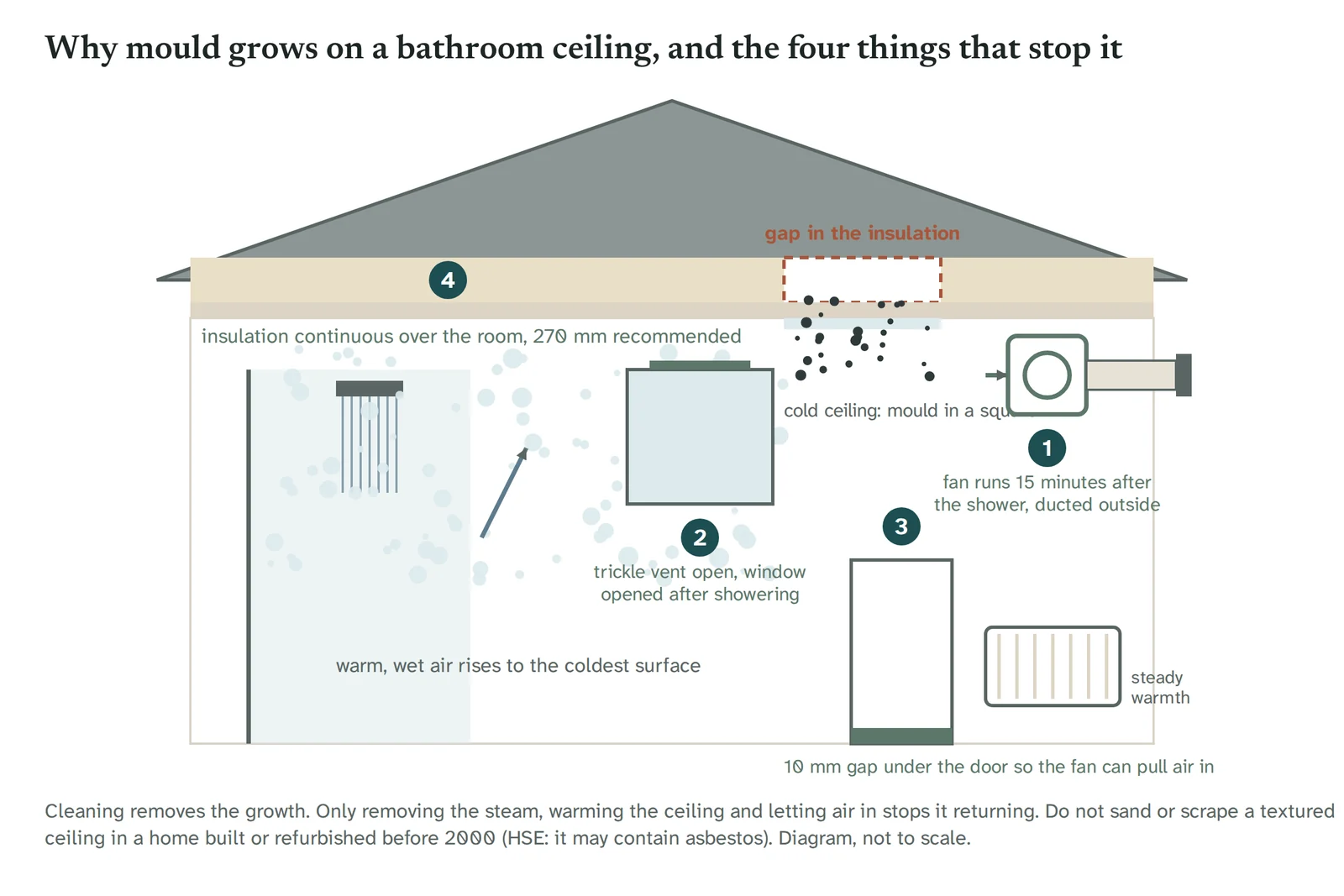
A bathroom extractor fan clears the steam from a shower before it settles on the coldest surfaces as condensation. To do that it has to move real air (the benchmark in the Building Regulations for new work is 15 litres per second), run for at least 15 minutes after the shower rather than switching off with the light, and duct to the outside rather than into the loft. A quick check with a sheet of toilet paper tells you whether yours is pulling anything. Cleaning the grille and opening the door gap are the free fixes; replacing or rewiring a fan is electrical work under Part P and is for a registered electrician.
On this page
Why the fan matters more than the window
A shower or bath puts a lot of water vapour into a small, cool room in a few minutes. The Energy Saving Trust puts a household’s output at up to 100 litres of moisture a week, and the bathroom is one of the two rooms where most of it starts. Warm, wet air rises, meets the ceiling, the tiles and the window, and condenses. Leave that to happen every day and you get black spots on the ceiling, mould in the silicone and grout, and a musty smell in the towels.
Opening the window helps, but only while it is open, and in January nobody leaves it open for long. An extractor fan removes the moist air at source, and a fan with a timer or humidity sensor does it without anyone remembering. The Energy Saving Trust’s advice is to run the fan during a shower or bath and for at least 15 minutes afterwards, with the bathroom door shut so the steam goes out through the fan instead of across the landing.
If the mould is already there, the guides to mould on a bathroom ceiling and removing mould from walls cover cleaning it safely. This guide is about stopping the steam that feeds it.
The 15 litres a second benchmark
Approved Document F, the ventilation part of the Building Regulations for England, sets minimum extract rates for new work: 15 litres per second for a bathroom with an intermittent fan (the ordinary kind that switches on and off), 30 for a kitchen where the cooker hood extracts to outside (60 where it does not), 30 for a utility room and 6 for a WC. Those rules apply to new homes and new installations, not to the fan already in your wall, but they are a fair test of whether a fan is worth having.
Fans are sold with their extract rate on the box, usually in litres per second (l/s) or cubic metres per hour (m³/h). To convert, divide m³/h by 3.6: a fan rated at 54 m³/h moves 15 l/s. A fan that can only manage 8 or 10 l/s in free air will manage less again once it has to push through a length of duct and an outside grille.
Two things reduce a fan’s real output well below its rating:
- Duct length, bends and crushed flexible duct. Every bend and every metre of flexible hose adds resistance. A fan in a ceiling with a long, sagging run to the eaves may deliver a fraction of the box figure.
- A starved room. A fan can only pull air out if air can get in. The Energy Saving Trust recommends a gap of at least 10 mm under internal doors; a bathroom door fitted tight to a new floor, or draught-stripped all round, chokes the fan.
The four checks: is your fan actually working?
None of these needs tools, and none involves the wiring. Do them with the fan running and the door shut.
- Look at the grille. A fan grille furred with dust and lint is moving little air. Clean the visible surface with a damp cloth once the fan is switched off at the isolator or the fused spur, and switched back on only when dry. Do not remove the cover unless you know the fan is isolated.
- The tissue test. Hold a single sheet of toilet paper flat against the grille with the fan running. A working fan holds the sheet firmly. A sheet that flutters or falls means the fan is weak, blocked, or its duct is kinked or disconnected. This is a rough check, not a measurement; it separates “working” from “ornamental”.
- Find the outside grille. Go outside and look for the vent on the wall or under the eaves that matches the fan. With the fan running, its flap should lift or air should be felt at it. A flap that never moves points to a blocked or disconnected duct, or a fan venting into the loft, which is the worst outcome of all because it moves the condensation into the roof space.
- Time the run-on. Turn the light off after a shower and listen. A fan that stops the moment the light goes off has no overrun timer and is doing perhaps a third of the job. Most of the steam is still in the air when you leave the room.
If the fan fails checks 2 or 3, it needs an electrician to look at the duct, the motor or the wiring. If it only fails check 4, a timer or humidistat model at the next replacement is the answer.
Timer, humidistat, continuous: what to ask for
Four types of fan are common in UK bathrooms.
| Type | How it runs | Where it suits | Watch out for |
|---|---|---|---|
| Standard (switched with the light) | On with the light, off with it | Rarely the right choice for a bathroom without a window | Stops before the steam has cleared |
| Timer overrun | On with the light, keeps running for a set time afterwards (commonly 5 to 30 minutes, adjustable) | Most bathrooms; the minimum worth fitting | Needs a permanent live feed as well as the switched live, so a simple swap is not always simple |
| Humidistat | Switches itself on when room humidity rises above a set level and off when it falls | Bathrooms used by people who forget, rooms where the light is not always used | Set too high it never starts; set too low it runs constantly. Some models combine a timer and a humidistat, which covers both cases |
| Continuous (dMEV) | Runs all the time at a low trickle and boosts when the light goes on or humidity rises | New builds and homes with persistent condensation; the approach Approved Document F favours for new work | Higher purchase cost; needs a permanent supply; the trickle must not be switched off |
Whichever type, specify: an extract rate that comfortably meets 15 l/s once duct losses are allowed for; a rigid or smooth-walled duct where possible, kept short and straight; an outside grille with a backdraught shutter; and, for a fan in the ceiling or near the bath, the correct IP rating for the bathroom zone it sits in (an electrician will know the zones). A quieter fan is more likely to be left on; noise is given in decibels on the box.
Where the fan should go
The steam is at the ceiling, over the shower or bath. A fan high on the wall or in the ceiling near that point, with the door on the far side of the room, draws air across the room and out. A fan next to the door, or a window vent on the door side, pulls in air from the landing and leaves the shower corner untouched. Ceiling fans need a duct to a wall or roof terminal; that duct is where loft condensation and disconnected hoses cause trouble, so it should be insulated where it passes through a cold loft and run with a slight fall to the outside so water does not pool.
Who does the work, and why
Fitting a new fan, replacing one with a different type, or running a new cable is electrical work in a bathroom, which is a special location under Part P of the Building Regulations. That means it is notifiable work, done by a registered electrician who can self-certify it, or inspected by building control. Electrical Safety First’s guidance is that electrical work in bathrooms should be left to a registered electrician. A like-for-like replacement on the same wiring is less involved, but the fan still needs isolating properly and the connections checked, and a timer model needs a permanent live that a plain fan did not.
Cutting a new hole through an outside wall for a duct is a builder’s job on most walls, and a roofer’s where it goes through a roof. In a rented home all of this is the landlord’s responsibility; report a broken fan in writing.
Trickle vents and windows: the rest of the system
An extractor fan is one part of a bathroom’s ventilation. The other parts are background ventilation and the occasional open window.
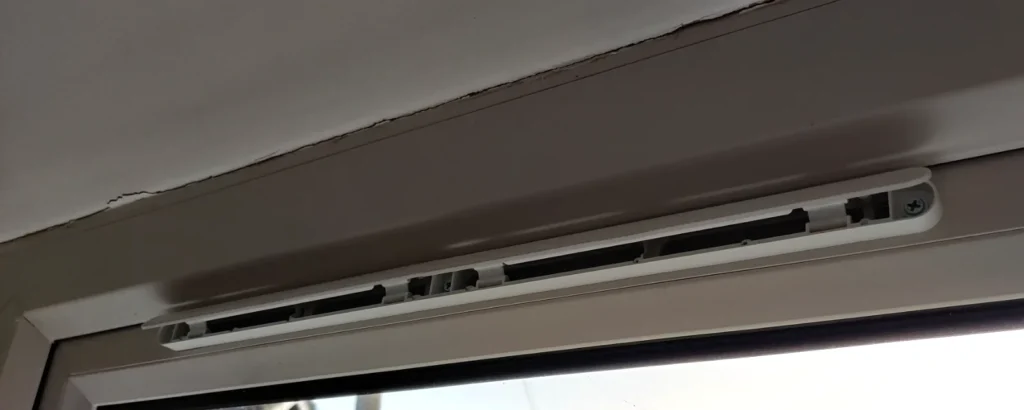
Trickle vents are the small slotted vents in the top of a window frame. They give a small, steady change of air without a draught, and they are the route by which replacement air reaches a fan in a room with the door shut. Energy Saving Trust advice is to keep them open and unobstructed; GOV.UK notes that replacement windows are required to have them under building regulations. For new work Approved Document F expects background ventilators with an equivalent area of 4,000 square millimetres in a bathroom.

Opening the window for a few minutes after a shower is worthwhile as well as the fan, not instead of it. Do not run the fan with the window wide open beside it: the fan then pulls in outside air and the steam stays where it is.
Common mistakes
- Switching the fan off at the isolator “to save electricity” or because of the noise. A modern fan costs very little to run; the mould and redecoration cost more.
- Draught-proofing the bathroom door and then wondering why the fan is useless.
- Venting the duct into the loft instead of outside, which moves the condensation to the roof felt. See damp patch on the ceiling for what that looks like from below.
- Buying by price rather than extract rate and noise. The cheapest fans move very little air and are the ones that get switched off.
- Treating a fan as the whole answer. Steam from a bath with the door open, or clothes drying on the bathroom radiator with the fan off, will beat any fan.
If you rent
If you rent, report it in writing with dated photographs and keep a copy. Under Awaab’s Law, from 27 October 2025 social landlords must investigate a potential hazard within 10 working days, make significant damp and mould hazards safe within 5 working days of identifying them, complete emergency safety works within 24 hours and offer alternative accommodation if they cannot. Private renters are due to be covered under the Renters’ Rights Act at a later date; meanwhile the council’s environmental health team can inspect a private rented home. Shelter and Citizens Advice cover the legal side; this site does not give legal advice.
A bathroom with no fan, or a fan that does not work, is a fair thing to report. Say what you have already done: door shut, window opened, fan run on. A dated log of when the ceiling condenses helps.
Sources
- Approved Document F, Volume 1: Dwellings (2021 edition), HM Government
- Fixing damp and condensation, Energy Saving Trust, updated 22 May 2026
- Understanding and addressing the health risks of damp and mould in the home, GOV.UK (DLUHC and UKHSA), updated 1 April 2026
- Electrical Safety First: Part P and electrical work in the home
- Damp and mould consumer guide, RICS, 16 June 2025
- How Awaab’s Law changes the rules on hazards in social housing, Shelter, October 2025