
Mould on a Bathroom Ceiling: Why It Grows and How to Stop It
Why mould grows on a bathroom or bedroom ceiling, how to clean a small patch safely, and the fan, insulation and heating fixes that stop it coming back.
Quick answer
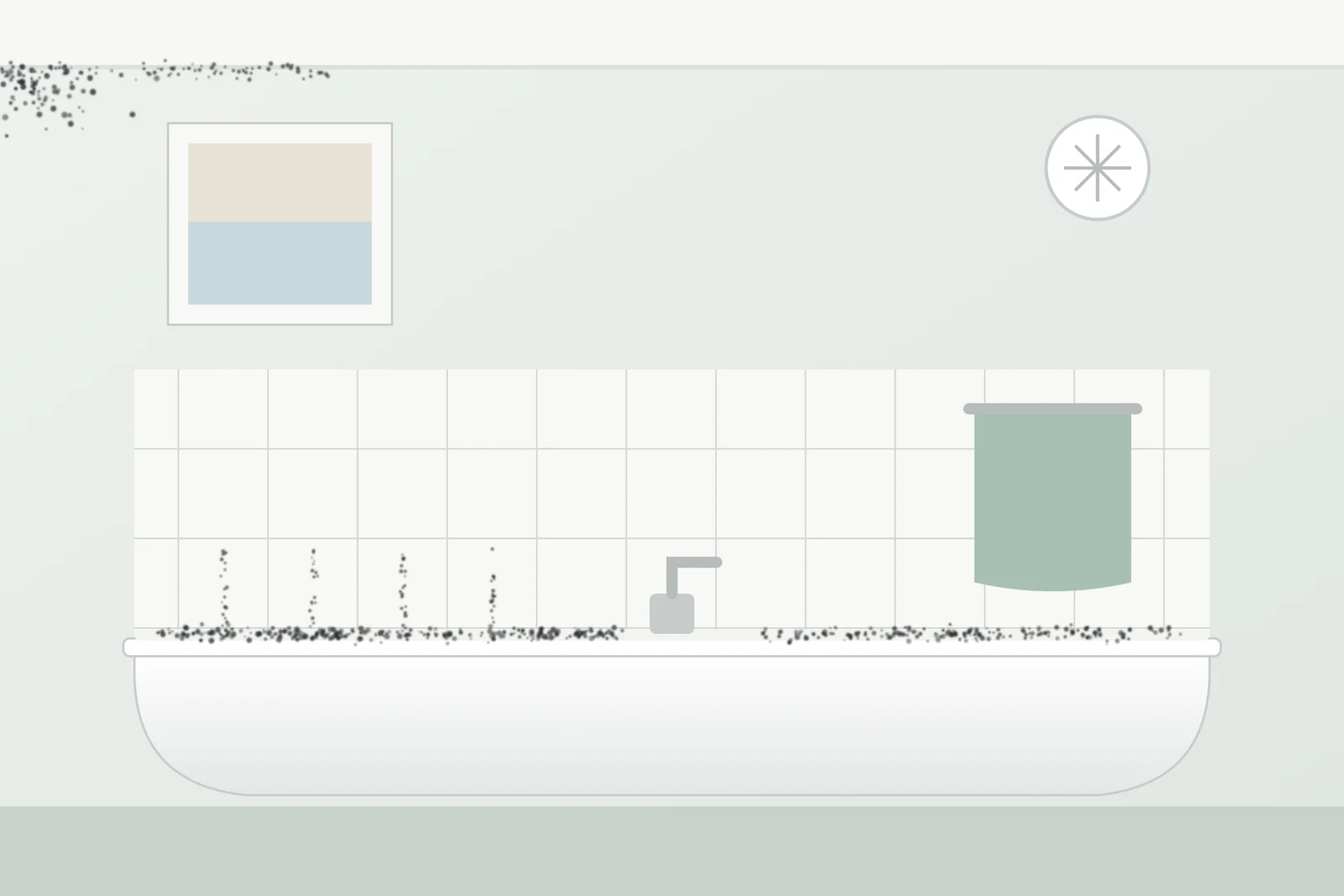
Mould grows on a bathroom ceiling because warm, moist air rises and the ceiling is often the coldest surface in the room, especially under a cold loft or where the extractor fan is weak or unused. Water condenses on the cold plaster, stays there, and mould follows. A small patch can be cleaned with a mould and mildew product from a stable pair of steps (never a ladder on a wet floor), but it will return unless you fix the moisture: a working extractor fan run for at least 15 minutes after every shower, a 10 mm gap under the door, insulation above the bathroom and steady heating. One warning first: if the ceiling has a textured coating (Artex or similar) and the home was built or refurbished before 2000, do not sand or scrape it, because textured coatings from that era may contain asbestos (HSE).
On this page
- Why the ceiling, and why the bathroom
- Is it condensation, or a leak from above?
- A safety check before you clean
- How to get rid of mould on a bathroom ceiling
- How to permanently stop mould on a bathroom ceiling
- Anti-mould paint and bathroom paint
- Renters: what to report and to whom
- Common mistakes
- When to get help, and from whom
- FAQ
Why the ceiling, and why the bathroom
Every shower fills the air with water vapour, and warm air carries it up to the ceiling, the first cold surface it meets. Whether water forms there depends on the dew point, the temperature at which air can no longer hold all its moisture and starts to release it as liquid. Air at 20 C and 65 per cent relative humidity has a dew point of about 13.2 C, so any surface colder than about 13 C will fog. After a shower the air is far wetter than 65 per cent, which pushes the dew point closer to room temperature, so even a mildly cool ceiling runs wet. Building standards use about 80 per cent surface humidity as the mould-risk threshold, and a ceiling that condenses every morning sits above that for hours. Check your own room’s numbers with the dew point calculator.
Why is the ceiling colder than the walls? In most UK homes the bathroom sits under the loft or the roof. If the loft insulation above it is thin, patchy or has been pushed aside for a light fitting or water tank, the plasterboard above is effectively touching outside air. A gap in the insulation shows up as a mould patch in one spot, often a rough square or strip, while the rest of the ceiling stays clean. Mould in parallel stripes points the same way: the plasterboard between the joists is colder than the plasterboard fixed to them.
The pattern differs by room:
| Room | Typical pattern | Usual cause |
|---|---|---|
| Bathroom | Speckles across the whole ceiling, worst above the shower or bath and in the corners | Shower steam, fan not running or not running long enough, window shut |
| Bedroom | Patch in an outside corner or along the outside wall edge of the ceiling, worst in winter | Breathing and drying clothes overnight, room heated less than the rest of the house, cold corner under the eaves |
| Kitchen | Above the hob or kettle, and in the corner furthest from the window | Cooking steam, cooker hood recirculating instead of extracting outside |
Bedroom ceilings have their own guide because the fixes lean more on heating and humidity than on a fan: see mould in a bedroom.
Is it condensation, or a leak from above?
Condensation mould is a scatter of small dark or grey-white spots on a ceiling that is otherwise sound. A leak is different: a brown or yellow ring, a bulge, paint that lifts, plaster that stays damp when the room has been unused for a day. The water can come from a bathroom or tank above, a cracked roof tile, a blocked gutter or chimney flashing. Mould can grow on a leak stain too, so do not let it distract you from the ring around it.
If you see a tidemark, a stain that grows after rain, or a patch directly under a bathroom or tank, read damp patch on a ceiling before cleaning anything; the water will bring the mould back. For the wider picture, see damp or condensation.
A safety check before you clean
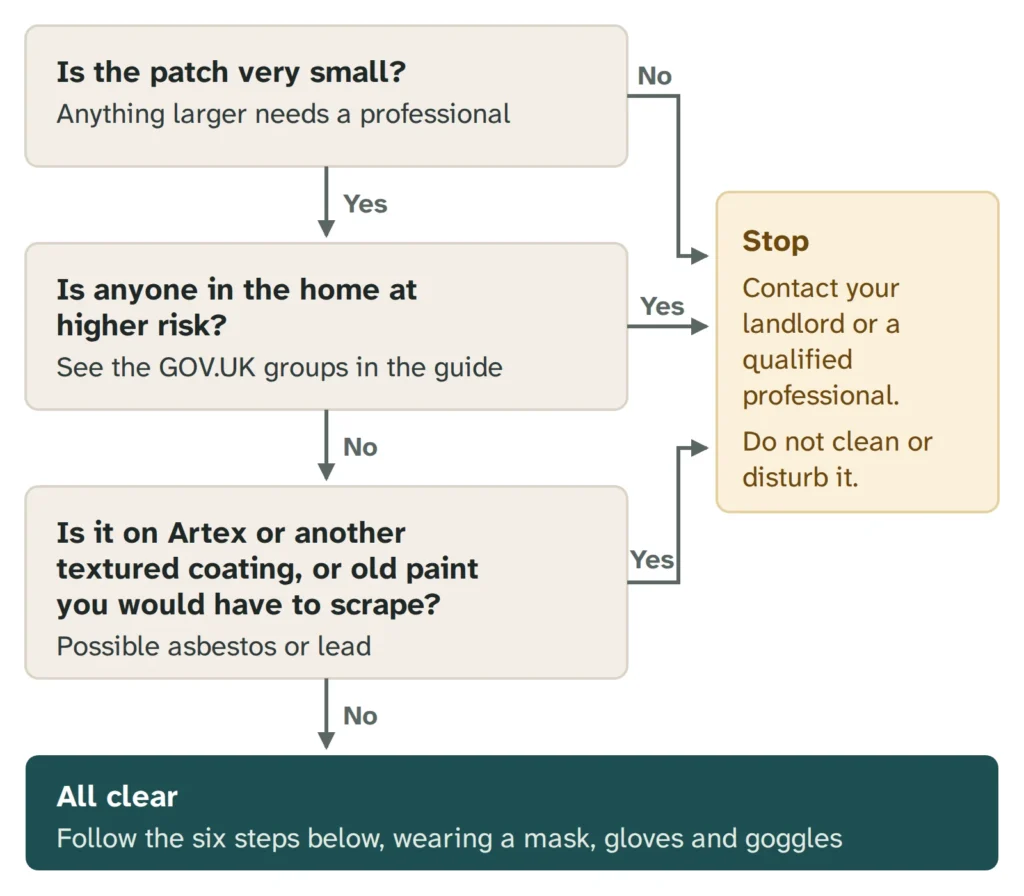
- Who lives here? GOV.UK lists higher-risk groups for damp and mould: people with pre-existing conditions such as asthma, COPD, allergies or other lung and heart disease; people with weakened immune systems, including those who have had a transplant or take immune-suppressing medication; pregnant women, their unborn babies and women who have recently given birth; children and young people, including those at risk of worsening mental health; older people; people with a mental health condition; and people who are bedbound, housebound or have mobility problems. If anyone in the home is in one of these groups, someone else should deal with the mould and the cause should be investigated. Any health question is one for the NHS website or a GP.
- How big is it? GOV.UK says tenants “could reasonably be expected to remove condensation and very small amounts of mould”, and that larger areas should only be dealt with by qualified professionals. Retailers commonly use under one square metre as a rule of thumb for a DIY-sized patch; that is a trade convention, not an official limit. A patch bigger than that, or one that has come back after two cleans, is a job for a professional and, if you rent, for the landlord.
- Is the ceiling textured? Swirled, stippled or combed coatings (Artex is the best known brand) in homes built or refurbished before 2000 may contain asbestos. HSE advice is not to sand, scrape or drill suspect materials. You can wipe a textured ceiling gently with a wet cloth and a mould product; you must not scrape it, rub hard enough to break the surface, or sand it before painting. If the coating is already flaking or damaged, stop and get it checked by an asbestos surveyor.
- Can you reach it safely? Overhead, drips and spray come down into your face, so goggles matter more than on a wall. Use stable, dry platform steps with both feet on the platform, not a ladder, and not in the bath or on a wet floor. Never lean out sideways. If you cannot reach the patch comfortably from steps, it is a job for someone with proper access equipment.
- Do you rent? Report the mould in writing to your landlord, letting agent or housing association before cleaning, with a dated photo. Cleaning it first removes the evidence of how bad it was.
How to get rid of mould on a bathroom ceiling
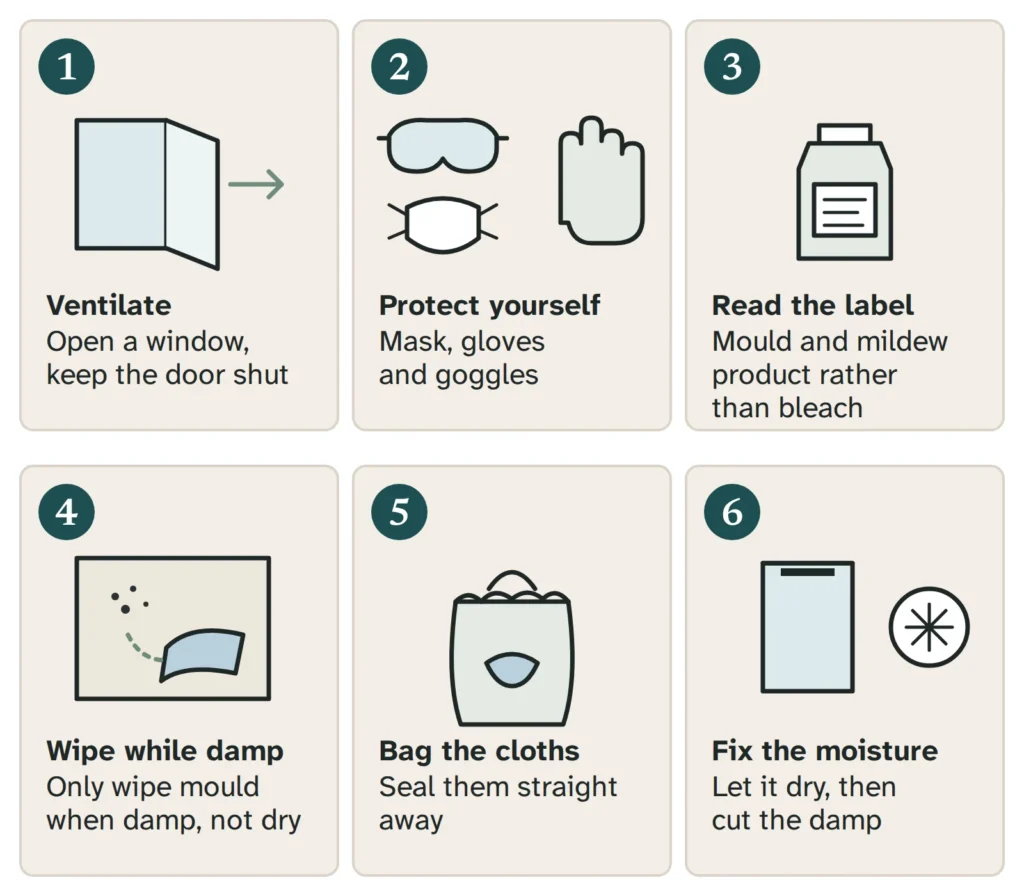
This follows GOV.UK, Energy Saving Trust and Oxford City Council guidance. Use one product only, exactly as its label says.
- Put on gloves, a mask and goggles. Open the window and close the door to the rest of the house.
- Choose one product. GOV.UK says mould and mildew products “should be used in preference to bleach, for health and safety reasons”. Oxford City Council accepts a bleach-based mould spray for small areas and a fungicidal wash with an HSE approval number for larger ones. Never mix products and never use one after another on the same patch: bleach and acidic cleaners such as vinegar or some descalers release chlorine gas when combined. To avoid bleach altogether, use a spray labelled for mould and mildew; the bleach versus vinegar guide explains why vinegar alone is a poor choice on porous paint.
- Wet the patch before you touch it. Energy Saving Trust is clear: “only wipe mould when it’s wet, not when it’s dry”. Dry mould releases spores when disturbed. Spray the patch, then leave the product on for the dwell time on the label.
- Wipe, do not brush. Oxford City Council warns against brushing or vacuuming mould because it throws spores into the air. Wipe with a disposable cloth in one direction, folding to a clean face as you go. Do not scrub a textured ceiling.
- Bin the cloth. Put cloths straight into a bag and into the outside bin. Wipe over with a fresh cloth and clean water only if the label says to.
- Dry the ceiling and ventilate. Leave the window open or the fan running until the ceiling is fully dry. Some staining may remain when the mould is dead; that is dealt with at the painting stage, never before.
Do not paint or wallpaper over mould you have not treated; Oxford City Council makes the same point. Paint traps live mould and it grows through.
White mould versus black mould on a ceiling
Black or dark green speckles are the familiar form; white, grey or fluffy patches appear on damp plaster and plasterboard, and a ceiling can show both. Colour does not tell you what species is growing, and both are cleaned and prevented in the same way, so the question does not change what you do next.
One look-alike: a white, powdery or crystalline deposit that brushes off as dust is usually salt left behind by drying water (efflorescence), not mould. It appears on plaster after a leak has dried out and points to a damp patch rather than condensation.
How to permanently stop mould on a bathroom ceiling
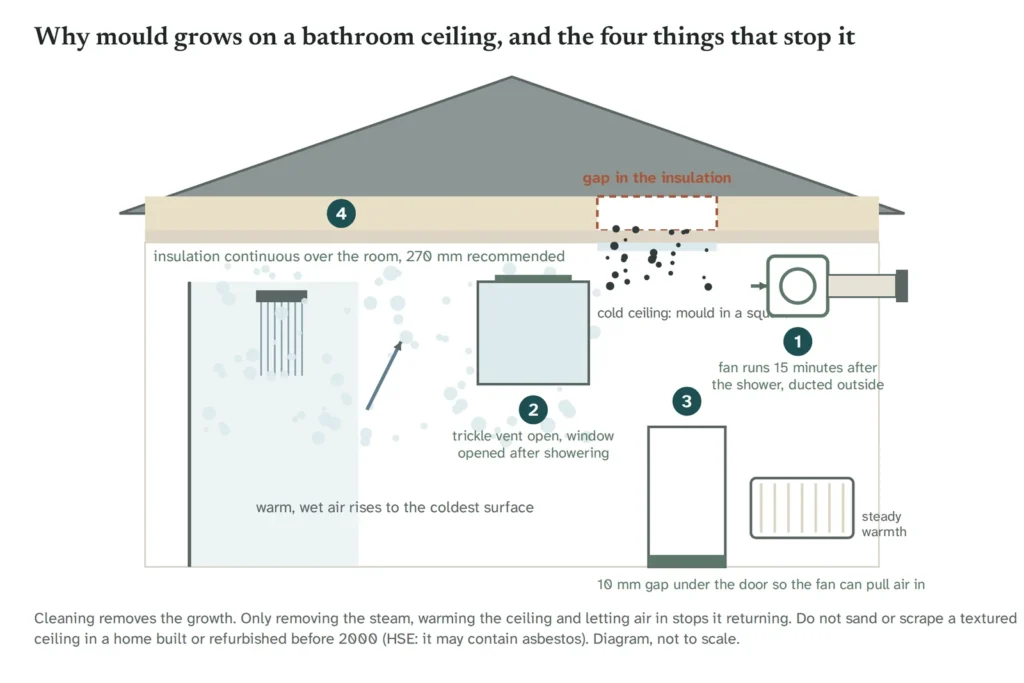
Cleaning removes the growth. Only moisture control stops it returning. In a bathroom the order of priority is clear.
1. Make the extractor fan work, then run it long enough
Energy Saving Trust’s advice is to let the bathroom fan run “for at least 15 minutes after taking a shower or a bath”. Fans that switch off with the light, are too weak to move air, or vent into the loft instead of outside are behind much bathroom mould. A quick check: hold a sheet of toilet paper against the grille with the fan running. If it does not hold, the fan is not moving useful air, perhaps because of a crushed duct, a dusty grille, a failed motor or an outside flap stuck shut.
For a benchmark, Approved Document F (the ventilation part of the Building Regulations for England) sets an intermittent extract rate of 15 litres per second for a bathroom in new work. It does not apply to an older home, but it shows what a fan should be capable of; the rating is printed on the fan or its box. Replacing or rewiring a fan is electrical work covered by Part P of the Building Regulations, so use a registered electrician.
Two features are worth asking for:
- Timer overrun. The fan keeps running for a set period after the light goes off, so it covers the 15 minutes after a shower without anyone remembering.
- Humidistat. The fan switches itself on when the room’s humidity rises above a set level and off when it drops, so it catches steam even when nobody turns the light on.
2. Give the air a way in
A fan can only pull air out if air can get in. Energy Saving Trust recommends a gap of at least 10 mm under internal doors; a bathroom door fitted tight to a new floor starves the fan. Opening the bathroom window for a few minutes after showering helps too, and Energy Saving Trust’s general advice is to open windows several times a day for at least five minutes.
3. Small habits that cut the steam
- Shut the bathroom door while showering and for the 15 minutes after, so the fan handles the steam instead of the landing ceiling.
- Run the fan from the moment the shower goes on, not after the mirror fogs.
- Put lids on pans in the kitchen and use the cooker hood, as Energy Saving Trust advises; kitchen steam finds its way upstairs.
- Do not dry washing on the bathroom radiator with the door shut and the fan off. If the bathroom is the only place, run the fan the whole time.
4. Insulate above the bathroom
If the mould sits in one clear patch, or in stripes, the cause is almost always a cold bridge (a place where heat escapes faster, such as a gap in insulation), and the fix is in the loft. GOV.UK describes improving loft insulation to a minimum of 270 mm as “a particularly effective means of keeping homes warmer”. Check that the insulation over the bathroom is continuous, has not been rolled back for a downlight, pipe or tank, and covers the corner where the ceiling meets the outside wall. Looking into a loft is a job for someone comfortable on a fixed loft ladder with boards to stand on; otherwise ask an insulation installer or a TrustMark-registered tradesperson to look.
A flat roof above a bathroom is a harder case: the insulation is inside the roof build-up, so it usually needs a roofer’s assessment rather than a top-up.
5. Heat the room steadily
A bathroom that is never heated, or a bedroom kept much colder than the rest of the house, collects moisture on its coldest surface. RICS suggests indoor temperatures of about 18 to 21 C, and Energy Saving Trust advises against switching heating off completely in colder months. Steady background warmth does more than a blast of heat once a day, because it keeps the ceiling above the dew point overnight. For the numbers, see what humidity should a house be and how to reduce humidity in a house.
Anti-mould paint and bathroom paint
Mould-resistant paints contain a fungicide that manufacturers say slows regrowth on the painted surface. Oxford City Council’s advice is to apply a good-quality fungicidal paint when redecorating after mould has been treated. Two conditions apply: treat first (clean and dry the ceiling, and leave it long enough to see whether anything returns), and fix the moisture first. Fungicidal paint is a last line of defence, not a substitute for a fan or insulation; a ceiling that condenses every day will beat any coating.
If a leak or old mould has left a brown stain, a stain-blocking primer stops it bleeding through the new coat. And again: no sanding on a pre-2000 textured ceiling, and no sanding of paint applied before 1992 without checking for lead.
Renters: what to report and to whom
Report ceiling mould in writing, with dated photos, to your private landlord, letting agent or housing association, and keep a copy. Say where it is, how big it is, when it started, and whether the fan works. If your landlord does nothing, the council’s environmental health team can inspect a private rented home.
For council and housing association tenants, Awaab’s Law has applied since 27 October 2025. Social landlords must investigate a potential damp and mould hazard within 10 working days, make significant hazards safe within 5 working days of identifying them, carry out emergency works within 24 hours, and offer alternative accommodation if they cannot make the home safe. Further phases follow in October 2026 and October 2027. Private renters are due to be covered under the Renters’ Rights Act at a later date. GOV.UK’s guidance to landlords is that they should not wait for medical evidence before acting, and should revisit at least six weeks after treatment. For disputes or compensation questions, use Shelter, Citizens Advice or GOV.UK; this site does not give legal advice.
Common mistakes
- Scrubbing dry mould with a brush.
- Using bleach, then vinegar “to be sure”, on the same patch.
- Painting over the patch before the cause is fixed.
- Assuming a fan that makes a noise is moving air.
- Standing in the bath or on a chair to reach the ceiling.
When to get help, and from whom
| Situation | Who |
|---|---|
| Patch larger than about a square metre, or returning after two cleans | Damp and mould treatment company; for renters, the landlord |
| Textured ceiling that is flaking or needs sanding, pre-2000 home | Asbestos surveyor before any work |
| Fan not working, or new fan needed | Registered electrician (Part P) |
| Mould in a single square or stripe pattern | Insulation installer or TrustMark-registered tradesperson to check the loft |
| Stain ring, bulge or wet plaster | Plumber (leak from above) or roofer (roof or gutter); see damp patch on a ceiling |
| Anyone in a higher-risk group in the home | Landlord or professional to remove; NHS or GP for any health question |
FAQ
Is it normal to have mould on a bathroom ceiling?
It is common, because a bathroom produces more steam than any other room and its ceiling is usually the coldest surface. Common is not the same as acceptable: it means the moisture is not being removed. A bathroom with a working fan, a door gap and insulation above should stay clear.
If the mould is on the walls as well, how to remove mould from walls covers the same method at arm’s height, and the surface mould hub links every guide on this site.
Next step
Sources
- Understanding and addressing the health risks of damp and mould in the home, GOV.UK (DLUHC and UKHSA), updated 1 April 2026
- Fixing damp and condensation, Energy Saving Trust, updated 22 May 2026
- Get rid of mould, Oxford City Council
- Approved Document F, Volume 1: Dwellings (2021 edition), HM Government
- Asbestos, Health and Safety Executive
- Damp and mould consumer guide, RICS, 16 June 2025
- How Awaab’s Law changes the rules on hazards in social housing, Shelter, October 2025