
Musty Smell in the House: How to Find the Source Room by Room
A musty, damp smell means something is staying wet somewhere you cannot see. A room-by-room method for tracking it down, the usual culprits, and what to do when you find it.
Quick answer
A musty smell is the smell of something that has been damp long enough for mould or mildew to grow on it, usually somewhere air does not move: behind a wardrobe on an outside wall, inside a cupboard against a cold wall, under a sink with a slow drip, in a washing machine seal, in a carpet that got wet, or in a loft or under a floor. Air fresheners and scented candles hide it for an hour. To get rid of it, find the wet thing, dry it or remove it, and fix why it was wet. The method below works through the house from the places most often responsible to the ones that need a professional.
On this page
What the smell is telling you
The earthy, cellar-like smell people call musty or damp comes from mould and mildew growing on a surface that has stayed wet, and from the compounds they release into the air as they grow. Where there is a smell there is growth, even if it is out of sight; where growth is out of sight it is because it is somewhere dark, still and cold. That narrows the search.
Two things the smell is not: it is not a diagnosis of the type of damp, and it is not, on its own, a health verdict. The GOV.UK guidance on damp and mould treats mould as something to find and remove and its cause as something to fix; anyone with symptoms they think are linked to it should speak to a GP or NHS 111. This guide is about finding the source.
The smell is often stronger in the morning, after rain, or when the heating comes on and warms a damp surface. Note when you notice it most; that is a clue you will use below.
Before you start: two readings and a walk
A cheap thermo-hygrometer tells you which rooms are holding moisture. Take a reading in each room first thing in the morning; a room several points higher than the rest of the house, or one that reads high with no obvious moisture source, is where to look first. The guide to what humidity a house should be explains the numbers.
Then walk the house with your nose, slowly, opening cupboards and moving furniture. Smells pool low and in enclosed spaces, so crouch. Get close to soft furnishings, carpets and the backs of wardrobes; fabric holds the smell after the wet has gone.
Room by room
Bedrooms
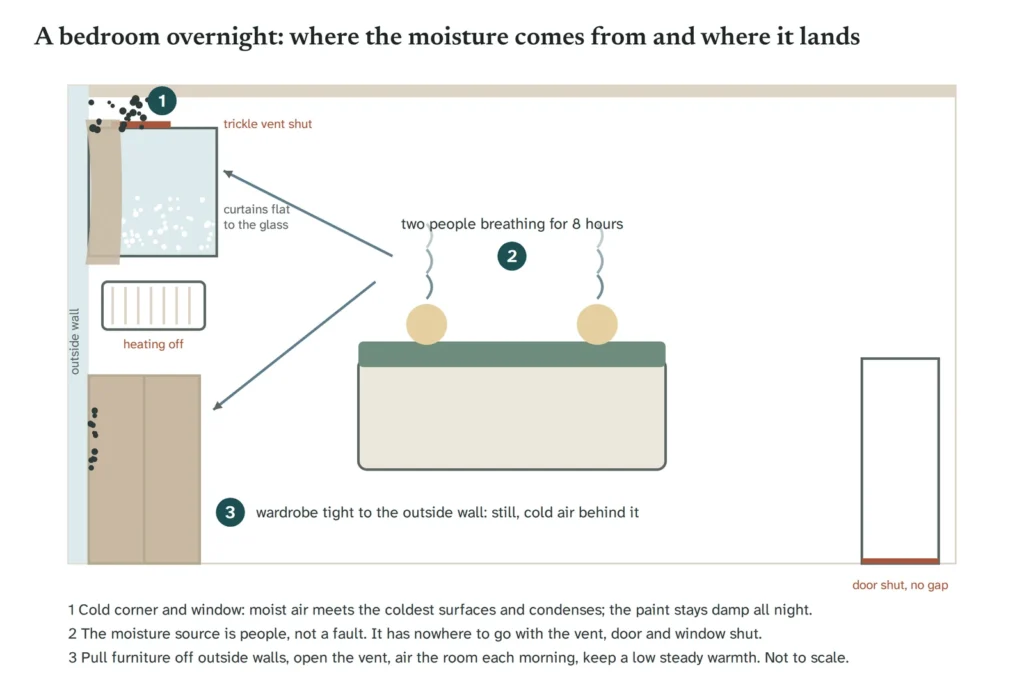
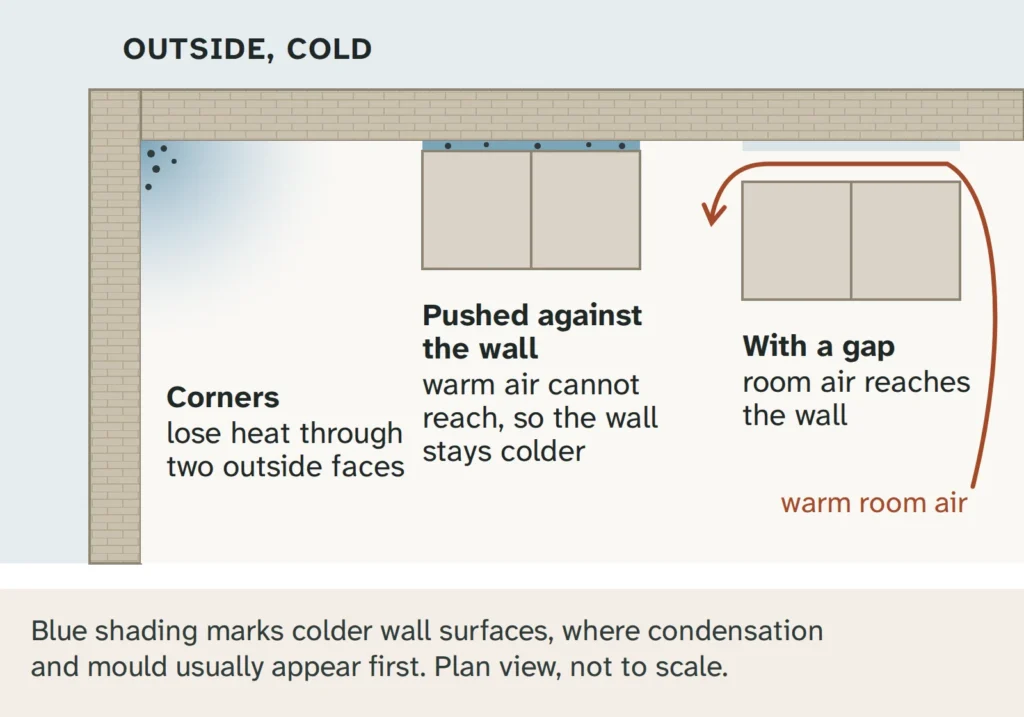
- Behind and inside wardrobes on outside walls. The most common source in the house. The wardrobe traps a pocket of cold, still air against a cold wall, condensation forms behind it and inside it, and clothes and shoes at the back go musty. Pull the wardrobe out and look at the wall and the back panel. See mould in the bedroom.
- Under and behind the bed, especially a bed with drawers or a solid base pushed into a corner. Mattresses that have got damp hold the smell.
- Curtains that touch the glass. Condensation soaks the lining every night.
- Inside built-in cupboards and airing cupboards, particularly those on outside walls.
Bathroom
- Under the bath panel. A slow leak from the waste, the overflow or the silicone joint keeps the floor under the bath wet for years. Take the panel off and look.
- Silicone and grout. Black mould in the joints smells. See black mould on silicone.
- Bath mats, towels and a laundry basket that never dries. Wash and dry them, then see whether the smell goes.
- The extractor fan and its duct, if the fan vents into the loft or the duct has come off.
Kitchen and utility
- Under the sink. A weeping trap, a loose dishwasher or washing machine hose, or a pipe joint that drips a little every day soaks the base of the cupboard, and chipboard cupboard floors swell and smell once wet. Empty the cupboard and feel the base.
- The washing machine. The rubber door seal traps water and detergent residue and grows a black film; the drum smells when the door is kept shut between washes. Wipe the seal, run an empty hot wash as the manufacturer suggests, and leave the door ajar between uses.
- Behind the fridge, freezer and washing machine, where a defrost tray or a leak has run unnoticed.
- A tumble dryer vent hose that ends indoors, or a condenser dryer with a full tank.
- Bins, compost caddies and the space behind them.
Living room and hall
- Behind sofas and bookcases on outside walls, for the same reason as wardrobes. Move them and look.
- Carpets and underlay that got wet once: a spill, a leak, a flood, a pet. Underlay holds water and smell long after the surface feels dry. Lift a corner.
- The cupboard under the stairs, which is often cold, unventilated and next to a pipe run.
- A chimney breast with a blocked-up fireplace and no vent. A sealed flue holds damp air and can carry rain down from a chimney with no cap. A vent in the blocked-up opening and a cap on the pot are the usual answers; a roofer for the cap.
- Old books, boxes and paper stored against an outside wall.
Loft
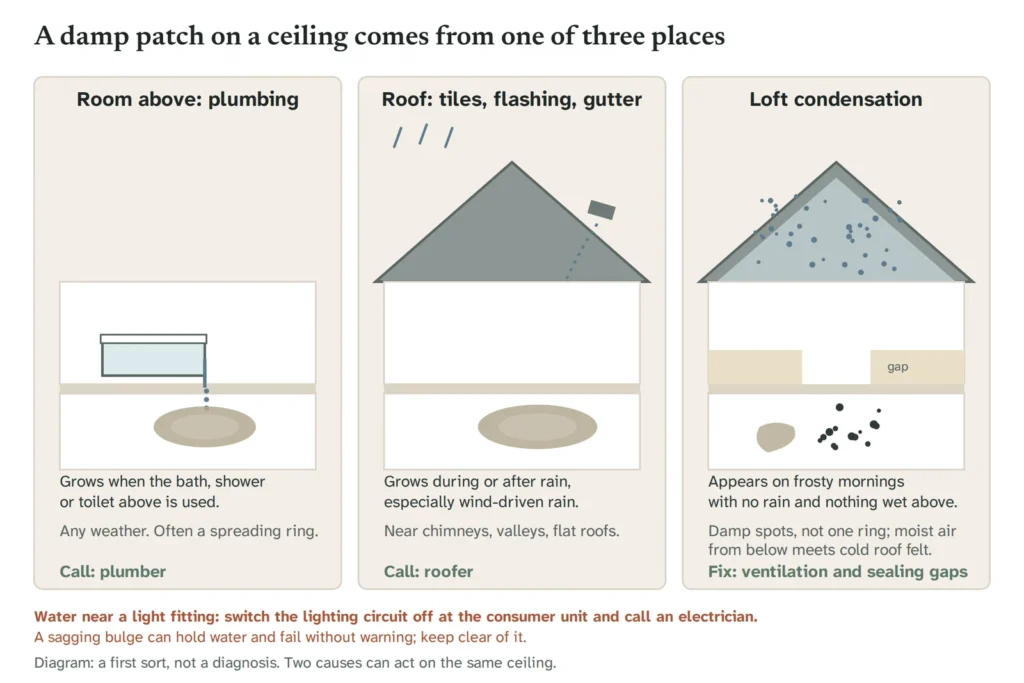
- Only from a safe, boarded position with a fixed ladder and a light; do not walk on joists or insulation. Look for damp or discoloured insulation, water beads on the underside of the roofing felt, and a bathroom or kitchen fan duct that ends in the loft. Loft condensation smells musty at the top of the stairs on frosty mornings. See damp patch on a ceiling.
- Stored bags of clothes, cardboard and soft items that have absorbed the damp.
Under the floor
- A suspended timber ground floor with blocked or missing air bricks under it can be damp and musty underneath, and the smell rises through the boards. Look outside for the air bricks low on the wall and check they are clear of soil, paving and paint. A floor that feels soft or springy near an outside wall is a job for a surveyor.
- A leaking pipe under a solid floor shows as a warm or damp patch on the floor and a musty smell with no obvious source; a plumber can trace it.
Drains
- A musty or eggy smell that is strongest near a plughole, a floor gully or an unused toilet is more likely to be drains than damp. A dry trap under a rarely used basin, shower or toilet lets drain air into the room; running the tap and flushing refills it. A blocked or damaged drain outside needs a drainage company or, for the public sewer, the water company. This site does not cover drains in detail.
What to do when you find it
- Photograph it with the date, especially if you rent.
- Dry or remove the wet thing. Soft items that are mouldy through, such as underlay, a mattress, a chipboard cupboard base or bagged clothes, are often not worth saving; GOV.UK notes that heavily mouldy absorbent items may need to be thrown away. Hard surfaces can be cleaned.
- Clean small patches of surface mould safely. One mould and mildew product, as its label says; gloves, mask and goggles; wipe when wet and bin the cloth; never mix products. Larger areas, or anyone in a higher-risk group in the home, means a professional. The method is in removing mould from walls.
- Fix why it was wet. Most sources above come down to one of four things: condensation on a cold surface with no air movement, a slow leak, water coming in from outside, or ground moisture under a floor. Damp or condensation? sets out how to tell them apart and when to bring in a surveyor. RICS advises an inspection by someone with no commercial interest in selling a treatment if the cause is not obvious.
- Air the house properly while it dries. The Energy Saving Trust suggests opening windows several times a day for at least five minutes, keeping trickle vents open and running extractor fans for at least 15 minutes after showers and cooking. A dehumidifier speeds drying in one closed room.
- Wash fabrics that hold the smell. Curtains, cushion covers, throws, clothes from the back of the wardrobe. Dry them outside or in one ventilated room, not on the radiator in the room that just dried out.
When the smell has no source you can find
If you have done the walk, moved the furniture, opened the cupboards and looked under the bath and sink, and the smell is still there:
- Check the hygrometer readings again. A whole house that reads high in every room points to a general ventilation and heating problem, covered in reducing humidity, rather than one wet spot.
- Consider the places you could not see: under a solid floor, inside a cavity wall, inside a boxed-in pipe run, in a flat roof. These are for a surveyor with a moisture meter, a borescope and the training to interpret them. Ask for an inspection that follows the Joint Position Statement (JPS 2022) and is done by someone who does not sell damp-proofing.
- Rule out drains, as above.
- If the smell arrived after a flood, a leak or building work, say so; the surveyor will look in different places.
Common mistakes
- Air fresheners, plug-ins and scented candles. They mask the smell for an hour and add nothing else.
- Cleaning the visible mould and leaving the wardrobe pushed back against the same cold wall.
- Keeping the house sealed and warm to “dry it out”. Warm, sealed air holds the moisture; ventilation removes it.
- Painting or papering over a musty wall.
- Assuming the smell is harmless because nothing is visible. A smell is growth somewhere.
If you rent
If you rent, report it in writing with dated photographs and keep a copy. Under Awaab’s Law, from 27 October 2025 social landlords must investigate a potential hazard within 10 working days, make significant damp and mould hazards safe within 5 working days of identifying them, complete emergency safety works within 24 hours and offer alternative accommodation if they cannot. Private renters are due to be covered under the Renters’ Rights Act at a later date; meanwhile the council’s environmental health team can inspect a private rented home. Shelter and Citizens Advice cover the legal side; this site does not give legal advice.
Describe the smell, where it is strongest, when it is worst and what you have checked. If the source is a leak, a blocked air brick, a fan that vents into the loft or a cold uninsulated wall, it is the landlord’s to fix.
Sources
- Understanding and addressing the health risks of damp and mould in the home, GOV.UK (DLUHC and UKHSA), updated 1 April 2026
- Fixing damp and condensation, Energy Saving Trust, updated 22 May 2026
- Damp and mould consumer guide, RICS, 16 June 2025
- Get rid of mould, Oxford City Council
- How Awaab’s Law changes the rules on hazards in social housing, Shelter, October 2025