
Does Bleach Kill Mould? Bleach vs Vinegar, Surface by Surface
Bleach kills surface mould on tiles and glass but mostly lightens it on painted plaster and timber. UK guidance, a surface-by-surface verdict, safety.
Quick answer
Bleach can kill surface mould on hard, non-porous surfaces such as glazed tiles, glass and uPVC, and it lightens the black staining so the patch looks clean. On porous surfaces such as emulsion-painted plaster, plasterboard, wallpaper and bare timber it tends to bleach the colour out while growth in the surface survives, so the mould comes back. UK guidance prefers a purpose-made mould and mildew product over bleach for health and safety reasons, and for anything larger than a small patch a fungicidal wash with a Health and Safety Executive (HSE) approval number. Vinegar is safer to handle but weaker, and has the same problem on porous surfaces. Whichever you use, nothing works for long if the moisture that fed the mould is still there.
On this page
What bleach does to mould
Household bleach is a solution of sodium hypochlorite in water. The UK Health Security Agency’s chemical information page says household bleach “usually contains approximately 5% sodium hypochlorite although some may contain up to 10%”. The rest is almost entirely water.
Sodium hypochlorite is an oxidiser: it pulls electrons from other molecules and breaks them apart. That is why it kills microorganisms on contact and why it strips colour from anything it touches, including the dark pigment that makes mould look black. Those two effects explain the confusion about whether bleach works, and whether it “just hides” mould:
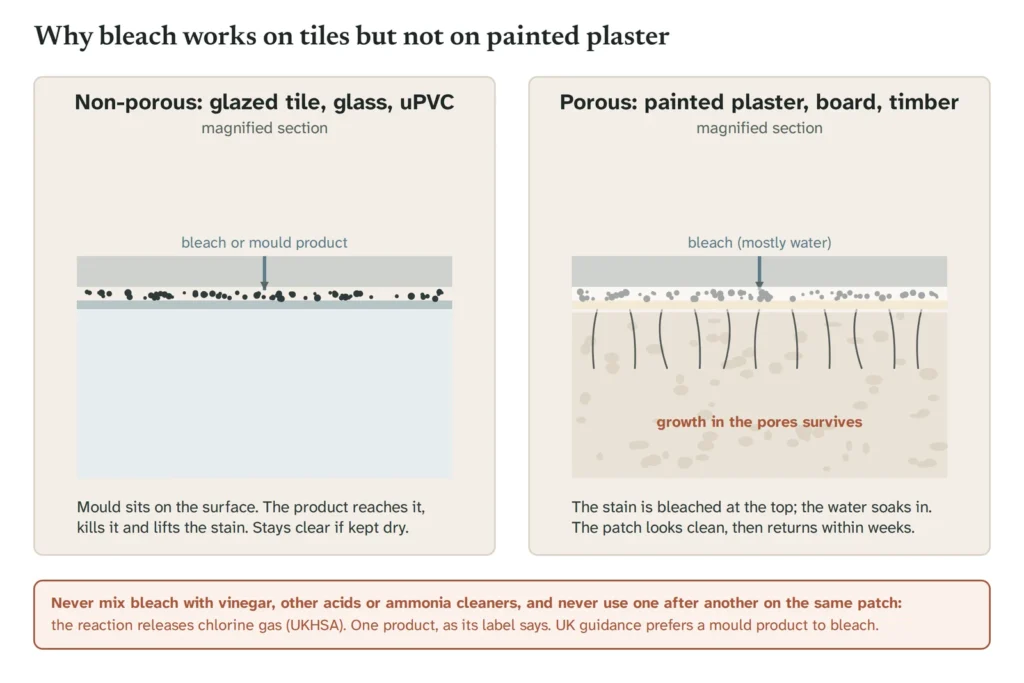
- On a non-porous surface (glazed tile, glass, uPVC, glossy sealed worktop) the mould is sitting on top. The bleach reaches it, kills it and removes the stain, and the patch stays clear as long as the surface is then kept dry.
- On a porous surface (emulsion paint, bare plaster, plasterboard, timber, wallpaper, grout) the mould has grown into the pores. Bleach is mostly water, and water soaks in while the chlorine reacts with the first thing it meets. The visible stain vanishes because the pigment near the surface is bleached; the growth deeper in is largely untouched and regrows from there, often within weeks if the surface is still damp. On porous surfaces, bleach hides more than it kills.
There is a second sense in which any cleaner can hide mould: the stain is a symptom. Mould on a bedroom wall means that wall has been cold and wet for long enough to support growth. Cleaning removes the symptom; only lowering the moisture, or warming the surface, removes the reason. See why condensation forms on walls and how to reduce humidity in a house.
What vinegar does
Household white vinegar is a weak solution of acetic acid, usually labelled at around 5 per cent. It lowers the pH of whatever it touches, and undiluted vinegar left in contact can deal with some light surface growth. Its limits are similar to bleach’s, with two extra points against it:
- It is also mostly water, so on porous surfaces it has the same trouble reaching growth in the pores.
- It does not remove the black stain the way an oxidiser does, so a treated patch on a wall can look almost unchanged.
Vinegar is gentler on you than bleach, but not on every surface: acids etch natural stone such as marble, limestone and travertine, and can affect some sealants, grout and unsealed finishes. Test a hidden spot first and keep it off stone.
Safety first: never mix, never use one after the other
This applies whatever surface you are cleaning.
- Never mix bleach with vinegar or any other acid. The UKHSA states that when sodium hypochlorite is combined with acidic products “chlorine gas is produced”. Minor exposure causes “a burning sensation of the eyes and throat, coughing and sore throat”; severe exposure can be life-threatening. Household acids include vinegar, lemon juice, many descalers and limescale removers, and some toilet cleaners.
- Never mix bleach with ammonia-based cleaners. The same UKHSA page notes that this can produce chloramines, “which are also highly irritating to the respiratory tract”.
- Never use one product after another on the same patch. If you have already sprayed vinegar and it “didn’t work”, do not follow it with bleach, or the other way round; residue in a porous surface is enough to react. If one product has not worked, the answer is a purpose-made mould product on a fully dry surface another day, or a professional.
- Ventilate. GOV.UK guidance is that “windows should be left open during and after the clean up activity”, with the door to the rest of the home shut so spores do not spread.
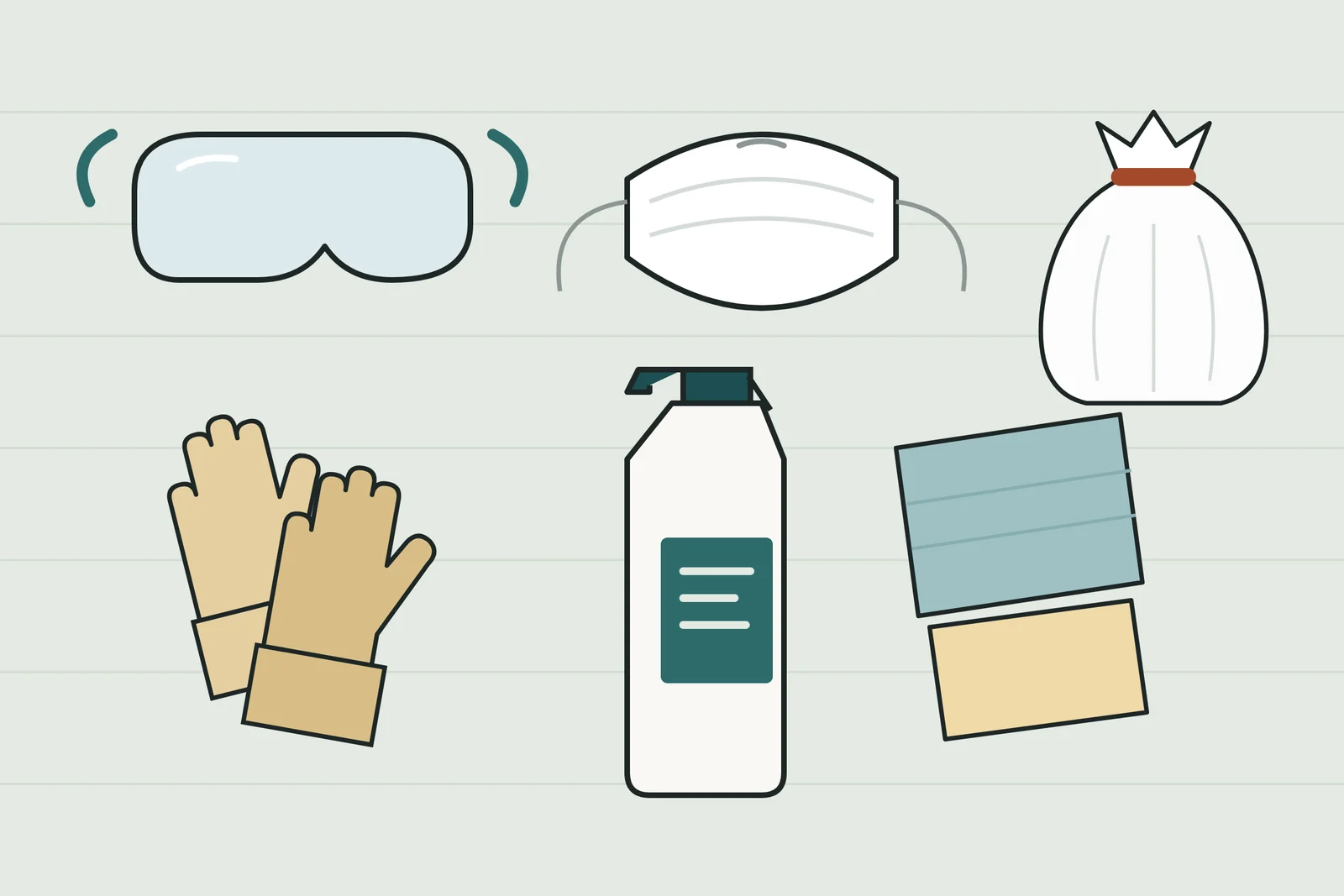
- Wear protection. GOV.UK says to wear “a mask, gloves and goggles, in order to avoid contact with mould spores”. Bleach adds a second reason for gloves and goggles: it burns skin and eyes.
- Do not brush or vacuum dry mould. Oxford City Council warns this “can release spores into the air and increase the risk of breathing problems”. The Energy Saving Trust puts it as “only wipe mould when it’s wet, not when it’s dry”.
- Bin the cloth. Use a disposable cloth and throw it away.
Bleach vs vinegar vs mould product: surface-by-surface verdict
Whether a cleaner works depends far more on the surface than on the bottle. This table is for a small patch. “Mould and mildew product” means a spray or wash sold for the job that carries an HSE approval number on the label; “better route” is what to do so the patch does not return.
| Surface | Bleach | Vinegar | Mould and mildew product | Better route |
|---|---|---|---|---|
| Glazed tiles | Works on the tile face; stain lifts | Works on light growth; slow, no stain removal | Works; the usual choice | Wipe tiles dry after showers; run the extractor for at least 15 minutes afterwards |
| Grout | Lightens stain; growth in the porous grout often survives | Limited; can weaken some grout with repeat use | Works better; may need repeat treatment | If grout is crumbling or stays black, re-grout and seal |
| Silicone sealant | Lightens surface stain; mould under and inside the silicone survives | Limited; may affect some sealants | Limited once mould is inside the bead | Cut out and replace the sealant; keep the new bead dry |
| Glass and uPVC | Works; stain lifts | Works on light growth | Works | Deal with the condensation that wets the frame, see mould on window frames |
| Emulsion-painted plaster | Bleaches the colour; growth in the paint film and plaster tends to survive; can mark the paint | Poor reach into the surface; stain stays | Better reach; still needs the wall to dry | Fix the cold or damp cause, then redecorate with a fungicidal paint after treatment, see removing mould from walls |
| Plasterboard | Same as above; soaks in and can soften the board | Poor | Better; badly affected board may need replacing | Find the moisture source first, see damp or condensation? |
| Wallpaper | Bleaches and marks the paper; mould behind it survives | Poor; wets the paper | Poor once mould is behind the paper | Strip the affected paper, treat the wall, do not repaper until dry |
| Bare timber | Lightens; soaks in; growth in the grain survives | Limited | Better; timber needs to dry out | Find why the timber is wet; persistent mould on timber can be a sign of a leak or of damp needing a professional look |
| Fabric and soft furnishings | Not suitable on most fabrics | Not a reliable treatment | Product-specific | Heavily mouldy absorbent items may need to be thrown away, as GOV.UK notes |
Bleach earns its reputation on tiles and glass. The same bottle on a painted bedroom wall gives a clean-looking patch that is back in a month, and a patchy paint finish in the meantime.
What UK guidance says about bleach
GOV.UK (Department for Levelling Up, Housing and Communities and UKHSA) states: “Mould and mildew products should be used in preference to bleach, for health and safety reasons.” It also sets out who should be doing the cleaning: “While most tenants could reasonably be expected to remove condensation and very small amounts of mould using an appropriate mould and mildew cleaner, larger areas of mould should only be addressed by qualified professionals.”
Oxford City Council allows bleach for the easy cases: if the mould is limited to a small area, you can “wipe it away from windows, bathroom tiles and other affected surfaces using a bleach-based mould removal spray”. Note that this means a product formulated and labelled for mould, not thin household bleach from under the sink. For anything bigger it is blunt: “Everyday cleaning products like bleach or washing-up liquid will not work” on a large area, and it advises a fungicidal wash instead, “following the manufacturer’s instructions, but check that it carries a Health and Safety Executive approved number”. It adds: “do not paint or wallpaper over untreated mould”, and use “a good-quality fungicidal paint” when redecorating.
Energy Saving Trust does not mention bleach at all. Its advice is: “You should use an antifungal cleaning product or a product that’s designed to kill mould”, wipe only when wet, use a disposable cloth, and wear gloves and a mask.
The US Environmental Protection Agency takes the same line: using a biocide such as chlorine bleach “is not recommended as a routine practice during mold cleanup”, and because “dead mold may still cause allergic reactions in some people”, mould must be removed, not just killed.
How fast does bleach kill mould?
There is no reliable universal number; any figure quoted online for household bleach is a guess. Contact time depends on the concentration, dilution, surface, temperature and how established the growth is.
Use a product sold for the job and follow the contact time on its label. Oxford City Council’s instruction to follow “the manufacturer’s instructions” is not a formality: the contact time is part of what the HSE approval is based on. Spraying and wiping straight off is the least effective way to use any of these products.
The conclusion
For a small patch on a non-porous surface, bleach is more effective than vinegar and removes the stain; vinegar is safer to handle but slower and leaves the mark. For porous surfaces neither is a good answer, and the real comparison is between both of them and a purpose-made mould and mildew product, which wins on reach, on safety, and on what UK guidance recommends. If you use vinegar anyway, on a suitable surface: use it undiluted, leave it in contact rather than wiping immediately, use a disposable cloth, and never let it meet bleach.
- Choose a product with an HSE approval number for the job. A mould and mildew spray for a small patch on hard surfaces; a fungicidal wash for a wider area of wall or ceiling. This site does not recommend brands; the approval number on the label is what matters, together with whether the label says it suits your surface.
- Use it exactly as the label says, including the contact time and the rinsing instructions.
- Set up before you start: windows open, door shut, mask, gloves and goggles, disposable cloths, and a bag for the cloths.
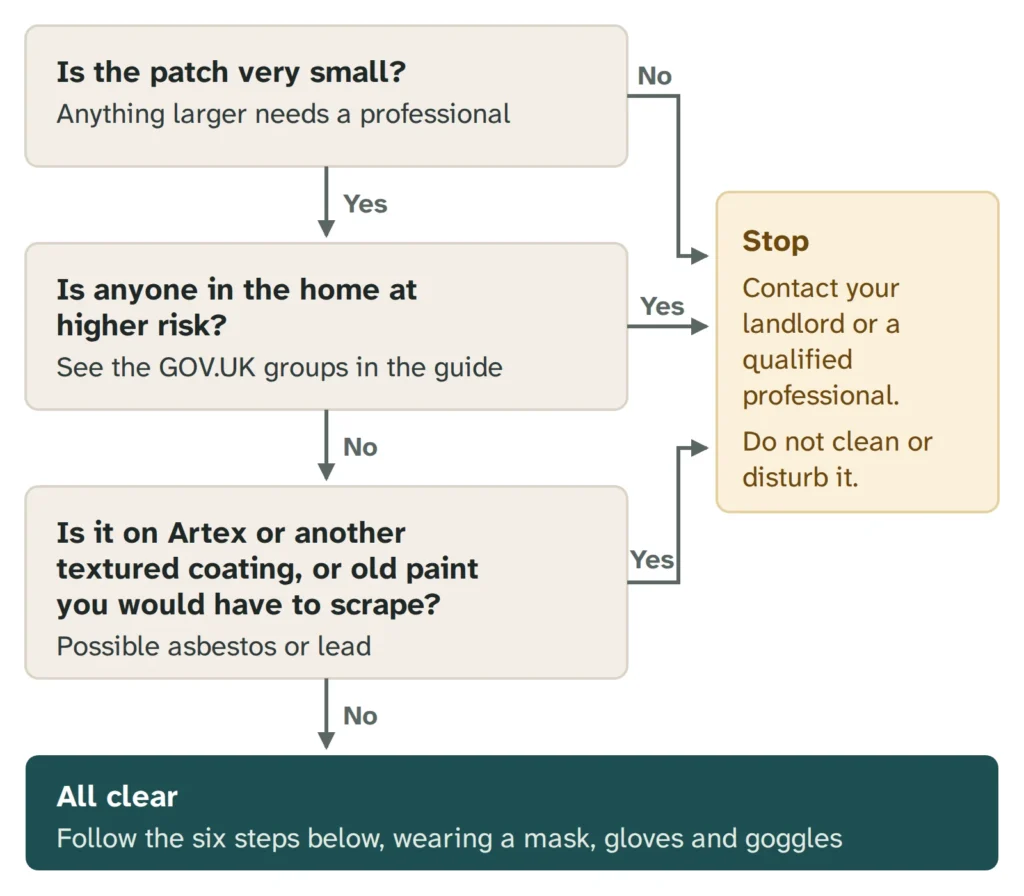
- Keep it small. “Very small amounts” is the GOV.UK wording for what a householder can reasonably tackle. Retailers commonly use under 1 square metre as a rule of thumb, not an official limit. Beyond that, or if the mould keeps returning, or if anyone in the home is in a higher-risk group, it is a job for a professional and, for renters, the landlord.
- Fix the moisture. Work out whether it is damp or condensation, then follow the guide for that cause. For the cleaning steps themselves, see how to remove mould from walls.
Renters
Cleaning a small patch is reasonable; a recurring or spreading patch is a repair issue, not a cleaning one. Report it in writing to your private landlord or letting agent, or to your housing association or council if you are a social tenant, and keep dated photos. Since 27 October 2025, under Awaab’s Law, social landlords must investigate a potential hazard within 10 working days and make significant damp and mould hazards safe within 5 working days of identifying them. Private renters are due to be covered under the Renters’ Rights Act at a later date. If a landlord does not act, your council’s environmental health team can inspect.
Health
If anyone in the home has breathing problems or is in a higher-risk group, do not clean mould yourself, and speak to a GP or use NHS 111 about any health concern.
FAQ
What is the best mould killer?
There is no single best product, and this site does not name brands. Pick a mould and mildew product that carries an HSE approval number, is labelled for your surface, and is the right type for the size of the job: a spray for a small patch on hard surfaces, a fungicidal wash for larger areas of wall or ceiling. Then follow the label’s contact time.
Why should you not put bleach on mould?
It is a hazard to you (fumes, skin and eye burns, and chlorine gas if it meets an acid such as vinegar); UK guidance prefers mould and mildew products; on porous surfaces it hides the problem rather than solving it; and on painted walls it can leave a pale, patchy mark that needs redecorating anyway.
Does bleach kill mould on plastic?
On smooth, non-porous plastic such as uPVC frames, sills and bath panels, a bleach-based mould spray does kill and lift surface mould. On textured or aged plastic that has become porous, growth can survive in the surface. Rinse well; bleach can discolour some plastics with repeat use.
Next step
Sources
- Understanding and addressing the health risks of damp and mould in the home, GOV.UK (DLUHC and UKHSA), updated 1 April 2026
- Get rid of mould, Oxford City Council
- Fixing damp and condensation, Energy Saving Trust, updated 22 May 2026
- Sodium hypochlorite: general information, UK Health Security Agency via GOV.UK, updated 24 April 2025
- How Awaab’s Law changes the rules on hazards in social housing, Shelter, October 2025
- Should I use bleach to clean up mold?, US Environmental Protection Agency