
Mould on Window Frames: Why It Grows and How to Stop It
Black mould on window frames, sills and seals is condensation on cold surfaces. How to clean uPVC, timber and aluminium frames and stop it returning.
Quick answer
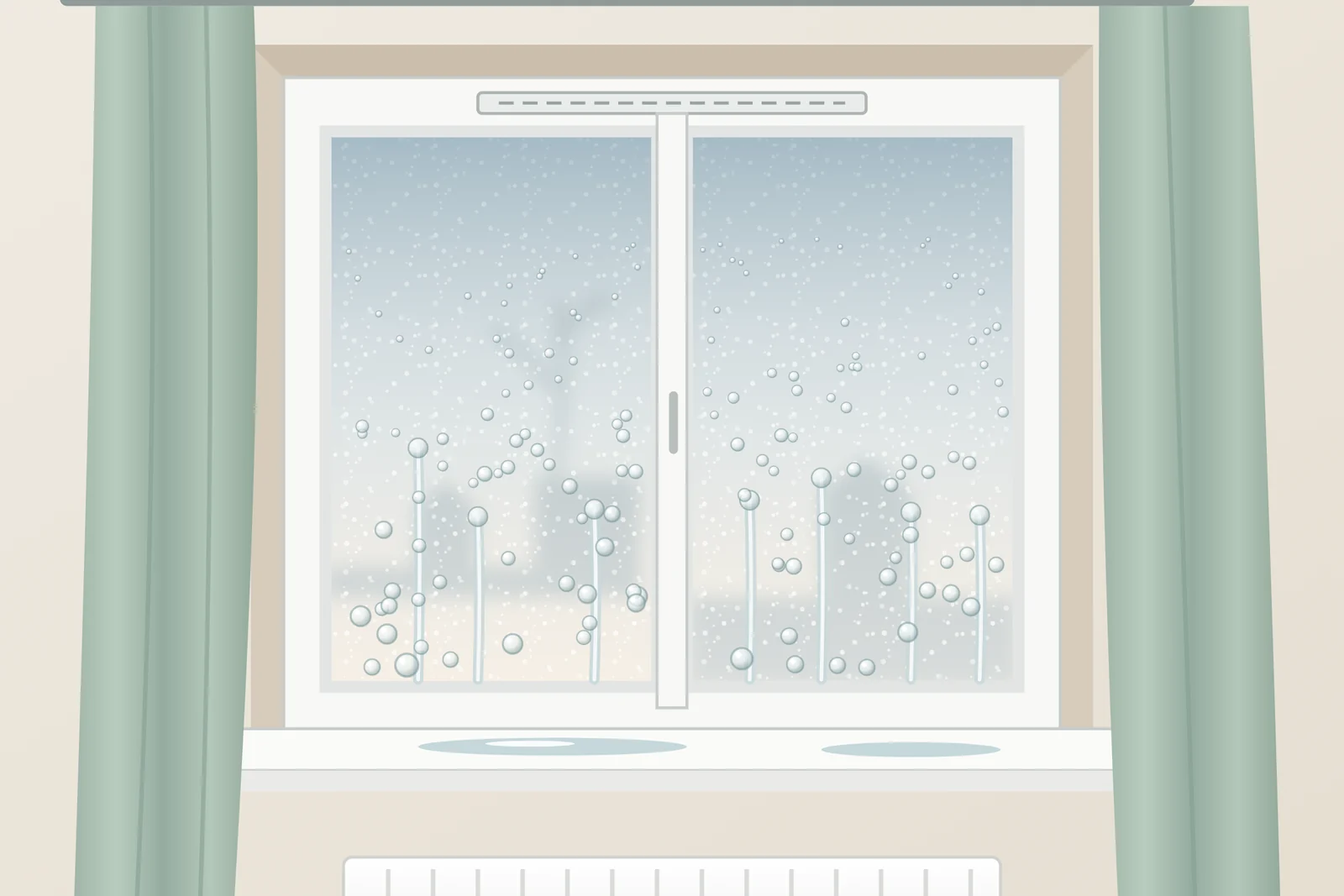
Mould on window frames is almost always condensation. Warm, moist room air meets the coldest surfaces in the room (the glass, the frame and the seals), water runs down the pane and sits on the bottom bead, the sill and the rubber gaskets, and mould grows in the film of water that never quite dries. Clean small patches with a mould and mildew product, then stop the water: wipe the glass and frame each morning, keep trickle vents open, and warm the room steadily rather than in short bursts. If the mould is on the plaster around the window rather than on the frame itself, the cause is a cold bridge in the wall (an uninsulated reveal or lintel), not a fault with the window.
On this page
Where mould grows around a window, and why
Condensation forms when a surface is at or below the dew point of the air touching it, the temperature at which air can no longer hold its moisture as vapour. For a room at 20 C and 65 per cent relative humidity that is about 13.2 C, and on a winter night the inside face of a window is usually the coldest thing in the room. Check your own figures on the dew point calculator.
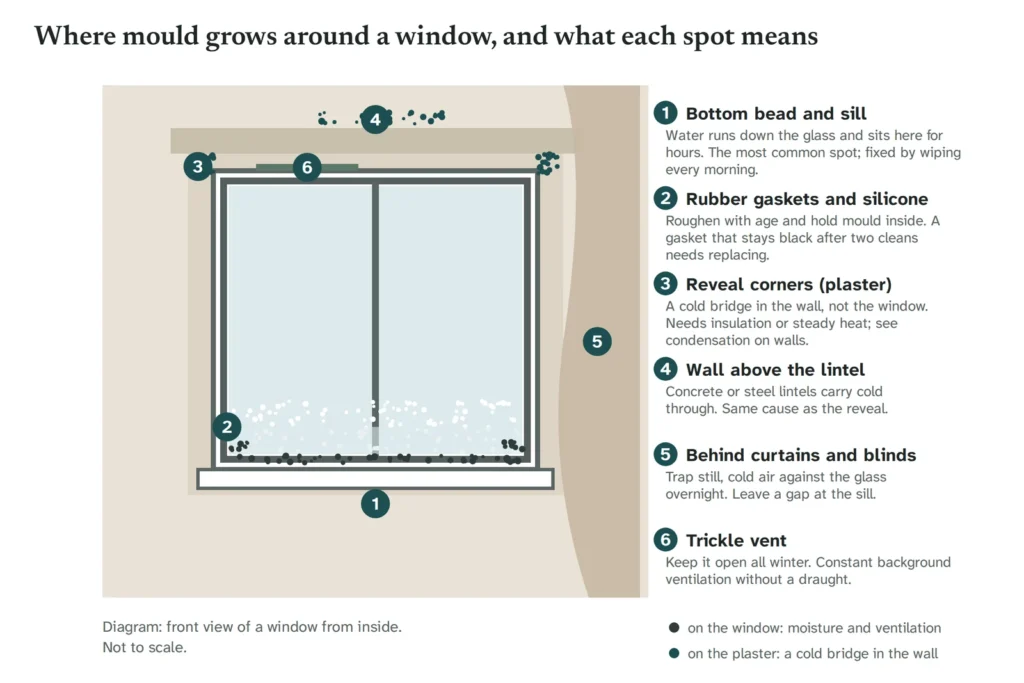
Which part of the window is affected tells you what to fix.
- Bottom bead and sill. Water that condenses on the glass runs down and pools where the glass meets the frame, and the sill sits in that puddle for hours each morning. This is the most common place for black spots and the easiest to fix, because it is purely a matter of removing the water.
- Rubber gaskets and silicone. These are smooth when new but roughen and become slightly porous with age, so mould gets a grip inside the surface. That is why an old gasket can stay grey or black after a thorough clean.
- The plaster reveal, and the wall above and beside the frame. The reveal is the strip of wall that returns from the room face to the frame. In many houses it is uninsulated, and the lintel above the window is often solid concrete or steel that carries cold straight through the wall. These are cold bridges: parts of the wall that are colder than the rest because heat passes through them more easily. Mould on the plaster here, especially in the top corners, is a wall problem rather than a window problem; see condensation on walls.
- Behind curtains and blinds. Heavy curtains and close-fitting blinds trap still, cold air against the glass overnight, so condensation is heavier. Bedrooms with blackout blinds are often the worst room in the house for it.
Bedroom windows are the classic case: two people breathing out overnight with the door and window shut, the heating off and the curtains closed. Mould in the bedroom covers the whole room.
Is it condensation, a leak or a failed window?
Check that condensation really is the cause before you clean anything, because the fix is different for each.
| What you see | Most likely cause | What to do |
|---|---|---|
| Droplets on the inside of the glass in the morning, worst on cold nights, mould on the bottom bead, sill and seals | Condensation | Clean, then wipe daily, ventilate and warm the room (this article) |
| Misting or droplets trapped between the two panes of a double-glazed unit that you cannot wipe from either side | Sealed unit failure (the edge seal has gone and moisture has got into the cavity) | Not a mould problem. The unit needs replacing by a glazier; the frame usually stays |
| Water on the sill or wall after rain, mould in a patch below the window rather than along the bead | Penetrating damp through a failed external seal, cracked sill or blocked drainage holes | Check outside for gaps and blocked weep holes; see signs of penetrating damp |
| Mould on the plaster in the corners of the reveal or on the wall above the window, with the frame itself fairly clean | Cold bridge at the reveal or lintel | Insulation, not cleaning; see condensation on walls |
Condensation on the outside of the glass on a cold morning is not a fault: the outer pane of a well-insulated window stays cold, and it clears as the day warms up.
Frame material: what changes
The cleaning method is much the same for every frame, but each material has its own weak point.
| Frame material | Why it gets mouldy | Cleaning notes | Watch out for |
|---|---|---|---|
| uPVC | Non-porous, so mould sits on the surface and in the gasket line and joints | Mould and mildew spray on a cloth, leave for the time on the label, wipe, dry | Abrasive pads, scouring creams and strong solvents dull the finish and roughen the surface, which gives mould a hold next time |
| Timber (painted or stained) | Standing water lifts paint and stain, and bare wood underneath is porous | Clean gently on sound paintwork. Once dry, repaint or restain where the finish has failed so the wood is sealed again | Do not sand old paint without checking for lead: UKHSA notes lead paint sales were banned in the UK from 1992, so earlier paint may contain it. Never sand rotten timber; soft, spongy or crumbling wood needs a joiner |
| Aluminium (older frames) | Many have no thermal break, so the metal conducts cold straight through to the room face and condenses heavily | Same as uPVC, no abrasives | Condensation will keep forming on the frame however well you ventilate. Secondary glazing or replacement is the long-term answer |
How to clean mould off window frames, sills and seals
This is for small areas: a line along the bead, spots on the sill, a patch on the gasket. GOV.UK says most tenants “could reasonably be expected to remove condensation and very small amounts of mould using an appropriate mould and mildew cleaner”, and that larger areas should only be addressed by qualified professionals. Retailers commonly use about one square metre as a rule of thumb for “small”; that is a trade convention, not an official figure. If anyone in the home is in a higher-risk group (GOV.UK’s list includes people with lung or heart conditions or allergies, people with weakened immune systems, pregnant women and women who have recently given birth, children and young people, older people, people with a mental health condition, and anyone bedbound, housebound or with mobility problems), ask someone else to do it, or get a professional.
- Get the kit out. Mask, gloves and goggles (GOV.UK), a disposable cloth, and a mould and mildew product. GOV.UK says these “should be used in preference to bleach, for health and safety reasons”. Oxford City Council suggests a bleach-based mould spray for small areas on windows and tiles, so either is acceptable; pick one and use it alone.
- Open the window, shut the door, so the room is ventilated and spores stay out of the rest of the house.
- Never mix products or use one after another on the same patch. Bleach and an acid such as vinegar or some descalers release chlorine gas. The bleach versus vinegar guide explains what each does and does not do.
- Wet it, do not brush it. Spray or wipe the product on and leave it for the dwell time on the label. Energy Saving Trust says to “only wipe mould when it’s wet, not when it’s dry”, and Oxford City Council says not to brush or vacuum mould, because both throw spores into the air.
- Wipe, then bin the cloth. Work along the bead and into the corners of the gasket; a cotton bud you will bin afterwards reaches the groove between glass and gasket.
- Rinse and dry. Wipe with clean water and dry the whole frame with a second cloth. A wet frame is a fresh start for mould.
Common mistakes:
- Gaskets that stay black. If a gasket is still grey or black after two cleans, the colour is staining inside the rubber, not live mould, and it will not come out. A glazier can replace gaskets on most uPVC and aluminium windows without replacing the window.
- Silicone that is black inside the bead. Mould that has grown into the silicone cannot be cleaned out. Cut it out and reseal with a fungicidal silicone (sold as bathroom or kitchen sealant) once the joint is fully dry.
- Painting over it. Oxford City Council is blunt: do not paint or paper over untreated mould. Clean, dry, then use a fungicidal paint on timber or plaster if you are redecorating.
If the mould has spread from the frame onto the wall around the window, follow how to remove mould from walls, which covers plaster and emulsion rather than plastic and rubber.
Stopping it coming back: the daily routine
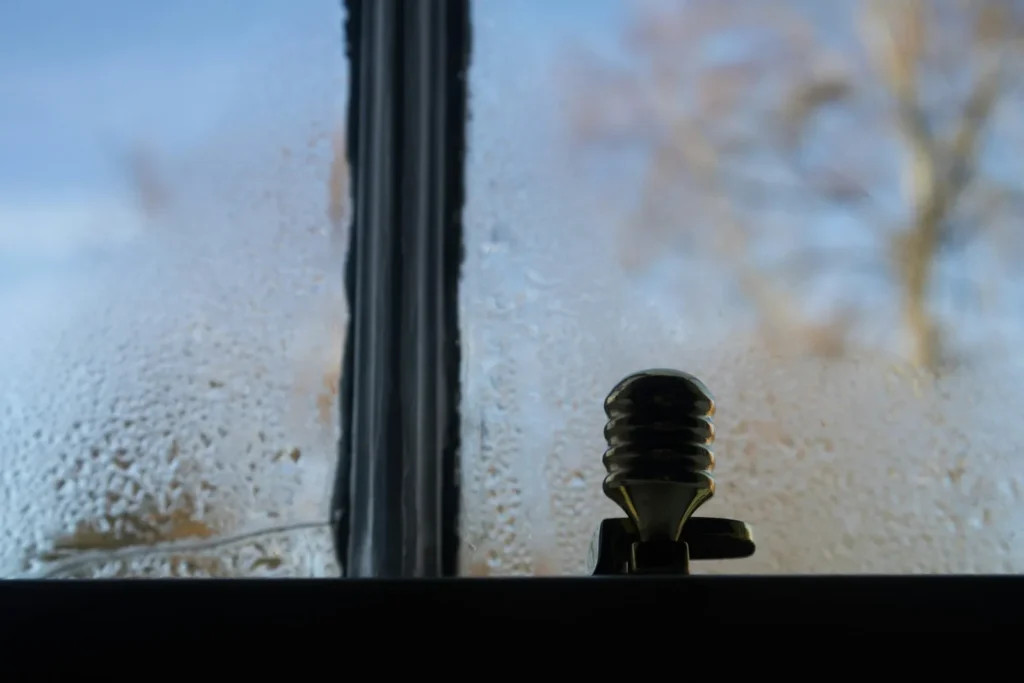
- Wipe the glass and frame every morning. A microfibre cloth wrung out into the sink, or a window vacuum, takes the water out of the room instead of letting it evaporate back into the air. Energy Saving Trust recommends a squeegee or towel. See condensation on windows for why the water forms.
- Keep trickle vents open. These are the small slotted vents in the top of the frame that let a continuous trickle of fresh air in without a draught. Energy Saving Trust says to keep them “always open and clear of obstructions”, and GOV.UK notes that all replacement windows are required to have them under building regulations. If your windows have none, open the window to the vent position (partly open and locked) when you can.
- Open curtains and blinds in the day so room warmth reaches the glass and the frame dries. At night, leave a gap of a few centimetres between a blind and the glass rather than pulling it tight against the pane.
- Open the window properly, several times a day. Energy Saving Trust suggests at least five minutes each time. A bedroom benefits most from a window opened as soon as you get up.
- Cut the moisture at source. Lids on pans, extractor fan running for at least 15 minutes after a shower or after cooking, no clothes drying on radiators in the bedroom. A household produces up to 100 litres of moisture a week (Energy Saving Trust). The full list is in how to reduce humidity in your house, and what humidity a UK home should be explains how to read a hygrometer.
Does having the heating on stop mould?
Partly. Warming the room raises the temperature of the frame, glass and reveal, so they spend less of the night below the dew point. Steady heating at a modest temperature does this better than a blast in the evening followed by a cold night, because the overnight drop is what puts the frame below the dew point. RICS suggests about 18 to 21 C as a sensible indoor range.
What heating does not do is remove any moisture. A warm room holds the same water as vapour; let one room go cold with the door shut and it comes straight back out onto the coldest surface. Energy Saving Trust also warns that leaving the heating on constantly to control damp “would use a lot of energy and cost a lot of money”. Steady warmth helps, ventilation removes the moisture, and you need both.
When to get help, and from whom
A line of black spots along the bead that cleans off and stays off once you start wiping each morning is a home job. Get someone in if:
- Mould keeps returning across the wall around the window or in the reveal corners despite daily wiping and ventilation. That points to a cold bridge or a ventilation shortfall. A surveyor or a TrustMark-registered insulation installer can advise on insulating the reveal.
- The plaster is soft, crumbly or blown around the frame, or there is a tidemark or a damp patch after rain. That is water getting in, and it needs a builder or a surveyor; see damp or condensation.
- Timber is rotten. A joiner can splice in new timber or fit a new sill.
- The sealed unit has failed (misting between the panes) or the gaskets have gone hard and split. A glazier can replace units and gaskets in the existing frame.
- You want the windows replaced. Replacement windows are controlled building work, so use a FENSA-registered installer or another competent person scheme. New windows have trickle vents and better-insulated frames, but FENSA’s own advice is that condensation “primarily stems from ventilation issues”. In an unventilated room, replacement moves the condensation onto the wall around the new frame rather than removing it.
If you rent
Report window mould in writing to your landlord, letting agent or housing association as soon as you notice it, with dated photographs, and say what you have already done. GOV.UK is clear that it is “totally unreasonable” to blame damp and mould on lifestyle choices and that the fundamental cause is usually building deficiencies, inadequate ventilation, inadequate heating or poor energy efficiency. Landlords should not wait for medical evidence before acting, and should revisit at least six weeks after treatment.
Under Awaab’s Law, from 27 October 2025 social landlords (councils and housing associations) must investigate a potential hazard within 10 working days, make significant damp and mould hazards safe within 5 working days of identifying them, complete emergency safety works within 24 hours, and offer alternative accommodation if they cannot. Private renters are due to be covered under the Renters’ Rights Act at a later date. If a landlord does not respond, your council’s environmental health team can inspect, and Shelter or Citizens Advice can explain your options.
FAQ
Is mould on windows harmful? Small patches on a frame are common and cleanable, but mould is not something to live with, especially where anyone in the home is in a higher-risk group. If anyone has symptoms they think are linked to mould, speak to a GP or use NHS 111; this site does not give health advice.
Sources
- Understanding and addressing the health risks of damp and mould in the home, GOV.UK (DLUHC and UKHSA), updated 1 April 2026
- Fixing damp and condensation, Energy Saving Trust, updated 22 May 2026
- Get rid of mould, Oxford City Council
- Damp and mould consumer guide, RICS, 16 June 2025
- Condensation advice, FENSA
- Lead: general information, UKHSA, updated 31 October 2024
- How Awaab’s Law changes the rules on hazards in social housing, Shelter, October 2025