
Condensation on Windows: What It Means and How to Stop It
Condensation on windows explained for UK homes: inside, outside or between the panes, what is normal, a morning routine, and the fixes that actually work.

Quick answer
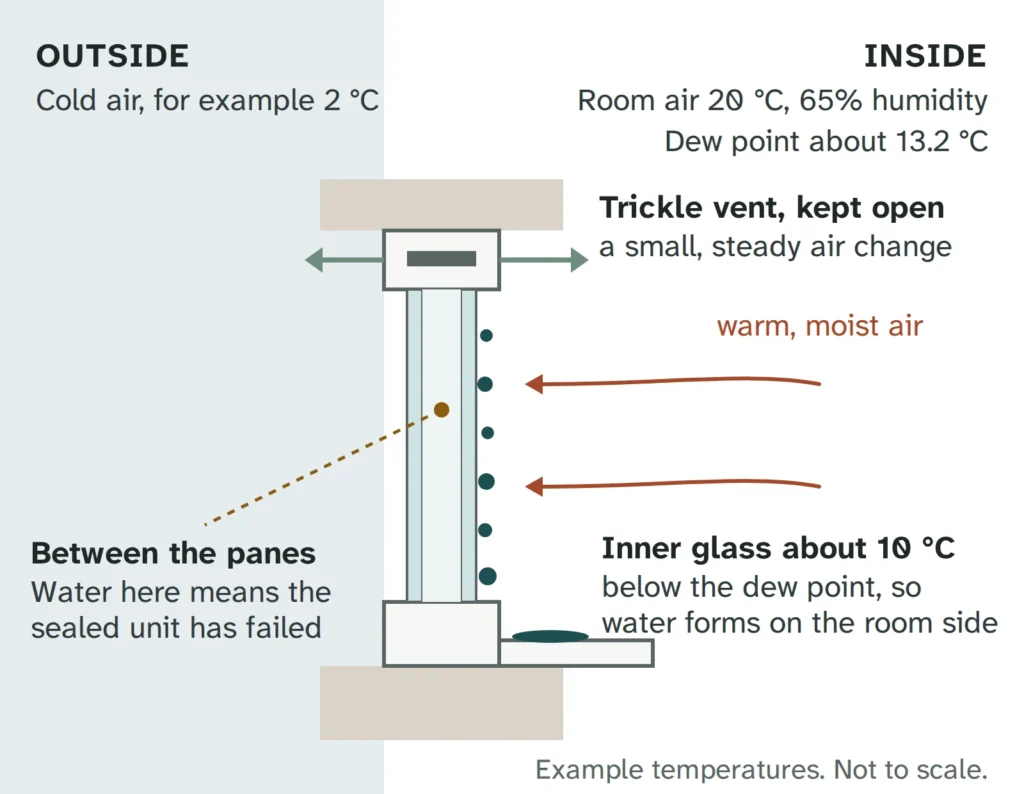
Condensation on windows forms when moist indoor air touches glass that is colder than the air’s dew point. It is a sign of too much moisture and too little ventilation, not a faulty window. Light misting on the inside of the glass on a cold morning that clears once the room warms is normal in UK homes. Water running down the glass, wet sills every day, or black spots on the frames means the moisture is beyond what the room can cope with, and that needs fixing before mould takes hold. Condensation on the outside of the glass is harmless. Condensation trapped between the two panes means the sealed unit has failed.
On this page
- First, work out where the water is
- Why windows get condensation
- What is normal and what is not
- A morning routine that stops the damage
- The fixes that work, in order
- Why moisture absorber pots barely help
- Bedroom windows overnight
- Condensation after new windows
- When condensation between the panes means a failed unit
- When window condensation points to a bigger problem
- Renters: what to record and who to tell
First, work out where the water is
The three possible surfaces mean three different things, and only one is a fault with the window.
| Where the water is | What it means | What to do |
|---|---|---|
| On the room side of the glass (you can wipe it off) | Indoor air is too moist for the temperature of the glass. The most common case and the subject of this guide. | Wipe it each morning, cut the moisture, improve ventilation and heating (below). |
| On the outside of the glass (you cannot wipe it from indoors) | The outer pane is cold because very little heat is escaping through the unit. This is a sign of good, well-insulating glazing, and it happens on still, clear mornings. | Nothing. It clears as the day warms. |
| Between the two panes (you cannot wipe it from either side) | The edge seal of the double-glazed unit has failed and moist air has got into the gap. The glass looks misted or streaky and may never fully clear. | The sealed unit (the glass, not usually the whole frame) needs replacing. Check your installer’s guarantee first. |
If it is between the panes, skip to the section on failed sealed units near the end.
Why windows get condensation
Warm air can hold more water vapour than cold air. Relative humidity is the amount of vapour in the air as a percentage of the most it could hold at that temperature, so cooling the air raises its relative humidity without adding any water.
The dew point is the temperature at which that air becomes saturated, at 100 per cent relative humidity. Any surface at or below the dew point pulls water out of the air touching it, as droplets. Glass is usually the coldest surface in a room, so it is the first place the dew point is reached.
A living room at 20 C and 65 per cent relative humidity, an ordinary evening in a UK home, has a dew point of about 13.2 C, so any part of the window colder than that will mist. On a frosty night the inside face of even a decent double-glazed unit can drop below it, and single glazing will be well below it. Run your own numbers, with a hygrometer reading from your room, in the dew point calculator.
The same physics explains why condensation is worst first thing in the morning (the glass has cooled all night while the house kept producing moisture) and worst at the bottom of the pane and in the corners (the glass is coldest near the frame and sill).
The moisture comes from ordinary living. The Energy Saving Trust says a household typically produces up to 100 litres of water vapour a week, from cooking, showers and baths, kettles, washing up, drying clothes indoors and breathing. Unless that vapour is ventilated out, it stays in the air and finds the coldest glass.
What is normal and what is not
Almost every UK home sees some window condensation between October and March. The question is how much and how long it lasts.
Normal:
- A light mist or small droplets on the bottom few centimetres of the glass on cold mornings.
- It clears within an hour or so of the heating coming on or a window being opened.
- The sill and frame stay dry, or need a quick wipe at most.
- It happens mainly in bedrooms and kitchens, the rooms that produce moisture or sit closed all night.
Excessive, and worth fixing now:
- Water running down the glass and pooling on the sill most mornings.
- Condensation still there at lunchtime, or that never fully clears.
- Wet or stained sills, peeling paint on the frame, or swollen timber.
- Black spots or a grey film along the bottom of the frame, the seals or the sealant. That is mould, covered in the guide to mould on window frames.
- Misting on windows in rooms that do not produce moisture, such as a spare room or hallway, which suggests the whole house is too humid.
If you own a cheap thermo-hygrometer, around 40 to 65 per cent relative humidity at about 20 C is the comfort and building-care range Historic England gives, and a good target for most homes. Readings that sit above that every evening will keep producing heavy condensation whatever you do to the windows. The guide to what humidity a UK home should be explains how to read the meter.
A morning routine that stops the damage
Wiping feels pointless because the condensation comes back, but it matters. Water left on the glass runs into the seals, sealant and frame and keeps them damp for hours. Building standards use about 80 per cent surface humidity as the mould-risk threshold, and a wet frame is well beyond that.

- Wipe the glass with a dry microfibre cloth or an old towel, top down. A window vac (a small battery squeegee that sucks the water into a tank) is faster and leaves no wet cloth. Empty the tank down the sink rather than leaving it in the room.
- Dry the sill and the bottom of the frame, including the rubber seals. This is where mould starts.
- Open the window for a few minutes. The Energy Saving Trust advises opening windows several times a day for at least five minutes. Cold outside air holds very little moisture, so even a short blast dilutes the humid indoor air, and the room soon warms back up.
- Hang the cloth to dry outside the room, or put it in the wash. Leaving it on the radiator puts the water straight back into the air.
Do this every morning through winter and mould on window frames becomes rare, even before you fix the underlying moisture.
The fixes that work, in order
Everything below reduces the moisture in the air, warms the glass, or both. Start at the top; the cheap changes usually do most of the work.
1. Make less moisture
- Put lids on pans, and do not leave a kettle or pan boiling longer than needed.
- Dry clothes outdoors when you can. Indoors, dry them in one room with the door shut and the window open or an extractor running, never on radiators in the living room or bedroom. The guide to reducing humidity in the house covers this in detail.
- Keep the bathroom door shut during and after a shower so the steam does not spread.
- Fix dripping taps and small leaks, and do not use unflued paraffin or bottled-gas heaters, which release a lot of water vapour as they burn.
2. Ventilate properly
- Open trickle vents (the small slotted vents in the top of a window frame) and leave them open all winter. They give constant background ventilation without a draught. If your windows have none, see the section on new windows below.
- Run the bathroom extractor fan during a shower or bath and for at least 15 minutes afterwards, and the cooker hood or kitchen fan for at least 15 minutes after cooking, as the Energy Saving Trust advises. A fan with a humidity sensor or overrun timer does this for you. Fitting or wiring a new fan is a job for an electrician under Part P of the Building Regulations.
- Leave a gap of at least 10 mm under internal doors (Energy Saving Trust) so air can move from room to room and reach the extractor fans.
- Ventilate bedrooms in the evening as well as the morning, and do not seal off vents or fans to save heat; a blocked vent costs far more in condensation than it saves.
3. Heat steadily rather than in bursts
Warm air holds more moisture, and warm glass sits further above the dew point. A home kept at a low steady temperature through the day keeps its walls and windows warmer than one blasted for an hour morning and evening then left to go cold. RICS suggests 18 to 21 C as the ideal internal range. If money is tight, keep one or two rooms steady rather than none, and combine heating with ventilation: heating alone rarely solves it, and warm, damp, sealed rooms are exactly what mould likes.
4. Let warm air reach the glass
- Do not draw heavy curtains or lower blinds tightly against the glass all night if you can avoid it. They trap a pocket of cold, still air against the window, and that air condenses. Leave a gap at the sill, or tuck curtains behind the radiator if there is one under the window.
- Keep radiators under windows clear. A radiator shelf or a sofa in front of it stops warm air washing the glass.
- Pull beds, wardrobes and chests of drawers a few centimetres off external walls so air can circulate. Furniture jammed against a cold wall is where hidden mould grows.
5. Use a dehumidifier where it is needed
A dehumidifier pulls water out of the air into a tank. It earns its place when the room produces more moisture than you can ventilate away (no extractor fans, clothes that must dry indoors, a bedroom that still runs wet after the steps above), or when opening windows is not practical because of noise, security or a busy road. It is not a substitute for fixing a leak or for an extractor fan, and it costs electricity, so use the tank to learn how much water you are removing and then attack the source. Compressor models suit warm rooms; desiccant models are generally better in cold or unheated spaces.
6. Secondary glazing or film, especially for renters
If the windows are single glazed, or old double glazing that has lost its edge, the glass itself is the problem. Secondary glazing (a second pane fitted on the room side of the existing window) raises the inner surface temperature and cuts condensation sharply. For renters and anyone on a budget, a clear window insulation film, stretched across the frame and shrunk tight with a hairdryer, does a version of the same job for a winter and peels off in spring. It is not as good as new glazing, but it is often enough to turn running water into light misting.
Why moisture absorber pots barely help
The disposable absorber pots and crystal tubs sold for a few pounds do pull water from the air. The problem is scale: a household puts up to 100 litres of vapour into the air each week, and a pot collects a few hundred millilitres over several weeks. It also does nothing to warm the glass. A pot on a sill is harmless, but if you are buying them repeatedly the money is better spent on a hygrometer, a window vac or, if the room really needs it, a dehumidifier.
Bedroom windows overnight
Two people breathe out a lot of water vapour over eight hours, the door is shut, the heating is off, the curtains are drawn, and the glass cools steadily until dawn. The fixes are the same, tuned to the room:
- Trickle vents open all night. If the window has none, leave it on the night latch or first notch if that is safe and secure.
- Curtains drawn but not pressed flat to the glass, with the radiator under the window uncovered.
- Wardrobes and the bed a few centimetres off external walls.
- Ventilate the room in the evening before bed as well as in the morning.
- Do not dry clothes in the bedroom, and do not run a shower with the bedroom door open to the landing.
- Avoid stopping the heating dead at 10 pm on cold nights; a low setting keeps the glass warmer.
- If it still runs wet, a small dehumidifier on a low, quiet setting overnight, tank emptied each morning.
Mould behind the headboard or in the ceiling corners means the room is holding too much moisture all night rather than just at the window. The guide to mould in a bedroom covers that.
Condensation after new windows
A common complaint: the old windows never misted, new double glazing was fitted in autumn, and now every morning is wet. Nothing has gone wrong. The old, draughty windows were ventilating the house without you noticing. The new windows are airtight, so the moisture stays in, and they show it first because they are still the coldest surface in the room.
The answer is to put the ventilation back deliberately. Approved Document F, the ventilation part of the Building Regulations for England, sets background ventilators (trickle vents) for new work at an equivalent area of 8,000 mm2 per habitable room in a multi-storey home and 10,000 mm2 in a single-storey one; older homes were built to older rules. If your new windows were supplied without trickle vents, talk to the installer about adding them. Meanwhile use the morning routine and evening ventilation above. The problem usually settles once the household gets used to airing rooms on purpose.
When condensation between the panes means a failed unit
Misting between the two sheets of glass means the perimeter seal has broken down and moist air has replaced the dry gas or air in the gap. It often starts as a faint haze in a corner and becomes a permanent streaky fog. It is a fault, not a ventilation problem, and it will not improve with heating or wiping. The unit is also insulating less well than it should.
The fix is to replace the sealed glass unit, which a glazier can usually do in the existing frame. Before paying, find the installation paperwork or ask the installer about the guarantee. FENSA’s own condensation advice is that controlled ventilation is the most effective remedy for ordinary condensation; a failed unit is the exception where the window itself is the cause.
When window condensation points to a bigger problem
Condensation on windows alone is a humidity and ventilation issue. Some things that appear alongside it are not, and they should change what you do next.
- Mould on walls, particularly in corners, behind furniture or on the ceiling, means the walls are reaching their dew point as well as the glass. See condensation on walls and, for cleaning small patches safely, removing mould from walls.
- A damp patch that is wet to the touch in one place, a tidemark near the bottom of a wall, or staining that grows after rain is not condensation. Those point to penetrating damp, rising damp or a leak, and the guide to damp or condensation explains how to tell them apart.
- Condensation that gets much worse suddenly in one room, with no change in how you use it, can mean a new source of moisture: a leaking pipe under a floor, a blocked extractor, or a washing machine or tumble dryer venting indoors.
- If anyone in the home is in a higher-risk group for damp and mould, treat recurring mould as something to deal with promptly rather than live with. GOV.UK lists people with pre-existing conditions such as allergies, asthma, COPD, cystic fibrosis and other lung and cardiovascular disease; people with weakened immune systems, including those having cancer treatment, who have had a transplant or take immune-suppressing medication; pregnant women, their unborn babies and women who have recently given birth; children and young people, including those at risk of worsening mental health; older people; people with a mental health condition; and people who are bedbound, housebound or have mobility problems. For any health concern, speak to a GP or use NHS 111.
Renters: what to record and who to tell
Wiping and ventilating are things a tenant can reasonably be expected to do, and doing them puts you in a strong position if the problem turns out to be the building. Also:
- Photograph the windows, sills and any mould with the date, once a week or so, and keep a hygrometer reading if you have one.
- Note which extractor fans work, whether the windows have trickle vents, and whether the heating can keep the flat at a steady temperature.
- Report it in writing (email or the letting agent’s portal) to your landlord or agent, describing what you have already done. Keep copies.
- If you rent from a council or housing association, Awaab’s Law applies from 27 October 2025: they must investigate a potential hazard within 10 working days, make significant damp and mould hazards safe within 5 working days of identifying them, complete emergency safety works within 24 hours, and offer alternative accommodation if they cannot. Private renters are due to be covered under the Renters’ Rights Act at a later date.
- If a private landlord does not respond, the council’s environmental health team can inspect. For disputes, deposits or anything legal, ask Shelter or Citizens Advice.
Next step
Sources
- Fixing damp and condensation, Energy Saving Trust, updated 22 May 2026
- Condensation advice, FENSA
- Understanding and addressing the health risks of damp and mould in the home, GOV.UK (DLUHC and UKHSA), updated 1 April 2026
- Damp and mould consumer guide, RICS, 16 June 2025
- Approved Document F Volume 1: Dwellings, 2021 edition, HM Government
- How Awaab’s Law changes the rules on hazards in social housing, Shelter, October 2025
- Assessing damp in historic buildings, Historic England