
Home › Silicone and grout
Topic
Silicone and grout
The joints around a bath, shower and sink stay wet longer than anything else in the house, which is why they go black first. What cleaning can and cannot do, when to cut out and reseal, and how to keep the joints dry.

Start here
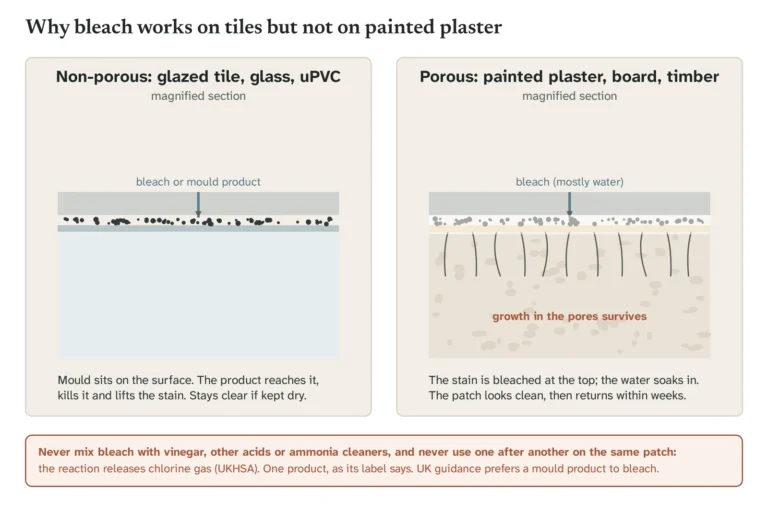
Silicone sealant is flexible and waterproof; grout is hard and porous. Both sit exactly where water collects after every shower, and both grow mould once the fungicide in new sealant has washed out or the grout has lost its surface. Surface mould on either will clean off with a mould and mildew product used as its label says. Mould that has grown into the silicone bead, or into porous grout, will not: the bead needs cutting out and replacing, and black or crumbling grout needs raking out and regrouting.
The rule that runs through this topic is the one that runs through the whole site: one product at a time, never mixed and never one after another on the same joint (bleach and an acid such as vinegar or a descaler release chlorine gas), and fix the water that feeds the mould, or it comes back. In a bathroom that means a fan that works, a wipe along the joints after showering, and any gap in the sealant fixed the day you see it.
Which guide do you need?
| What you are seeing | Points to | Read |
|---|---|---|
| Black spots or a black line along the bath or shower silicone | Mould on or in the bead | Black mould on silicone: clean it or replace it |
| Black grout lines that clean up then come back | Mould in porous grout | Bleach vs vinegar, surface by surface (grout row) while the grout guide is in preparation |
| A ceiling stain below the bathroom | Water getting behind a failed seal | Damp patch on the ceiling |
| Mould on the ceiling and the joints | The room is not clearing its steam | Mould on a bathroom ceiling |
Guides

Silicone
Black mould on silicone sealant
On the surface or in the bead: the test that decides, safe cleaning, when to reseal, and keeping it clear.
Sources: GOV.UK, Oxford City Council, UKHSA
Products
Does bleach kill mould?
What bleach and vinegar do on tiles, grout, silicone and plaster, the never-mix rule, and what UK guidance recommends.
Sources: GOV.UK, UKHSA, Oxford City Council
Ceilings
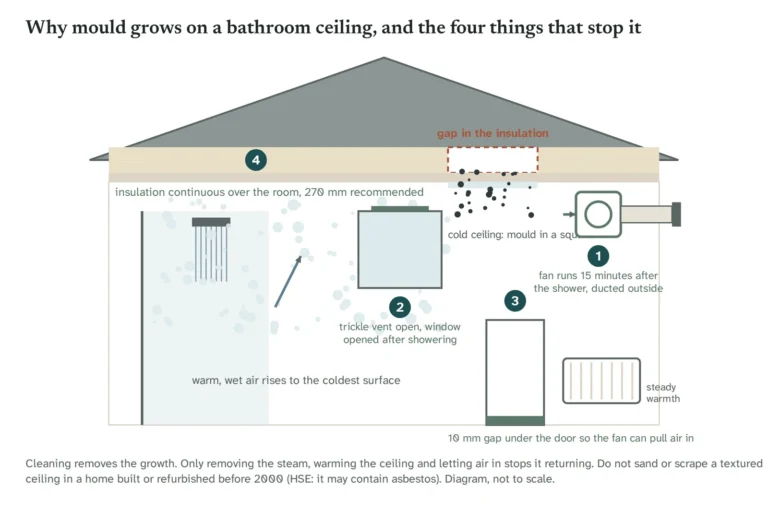
Mould on a bathroom ceiling
The fan, the door gap, the insulation and the habits that keep the whole room dry, joints included.
Sources: Energy Saving Trust, Approved Document F, HSE
Clean or replace: the one-clean test
Clean the joint once, properly, with the full contact time on the product label. Surface mould comes off. Mould that is still there afterwards is inside the silicone or the grout, and no stronger product will reach it. Cut out and reseal; rake out and regrout.
Keeping joints dry
- Extractor fan on during and for at least 15 minutes after a shower, door shut (Energy Saving Trust).
- A squeegee over the screen and tiles and a cloth along the bead after showering.
- Rinse soap scum off the joints; it is what the mould feeds on.
- Reseal a gap the day you notice it. Water behind a bead is a slow leak.
Safety
Never mix bleach with vinegar, other acids or ammonia-based cleaners, and never use one product after another on the same joint. Wear gloves and goggles; the work is at eye level. Cutting out old sealant with a blade scratches acrylic baths and trays; use a sealant remover tool and take your time.
If you rent
Cleaning a mouldy bead is reasonable to expect of a tenant. A bead that has failed and is letting water through, or a bathroom without a working fan, is a repair to report in writing.
Coming next in this topic
Guides in preparation: removing mould from grout, removing old silicone sealant cleanly, resealing a bath or shower, how long silicone takes to dry, cleaning and whitening grout, regrouting, and grout sealers. Several need a completed reseal to photograph; no fixed dates.
Next step
Black mould on silicone sealant: how to clean it and when to replace it
Start with the one-clean test.