
Home › Condensation and humidity
Topic
Condensation and humidity
Why water appears on windows and cold walls every winter, what the numbers on a cheap hygrometer mean, and the changes that cut it: less moisture, more ventilation, steadier heat.
Start here
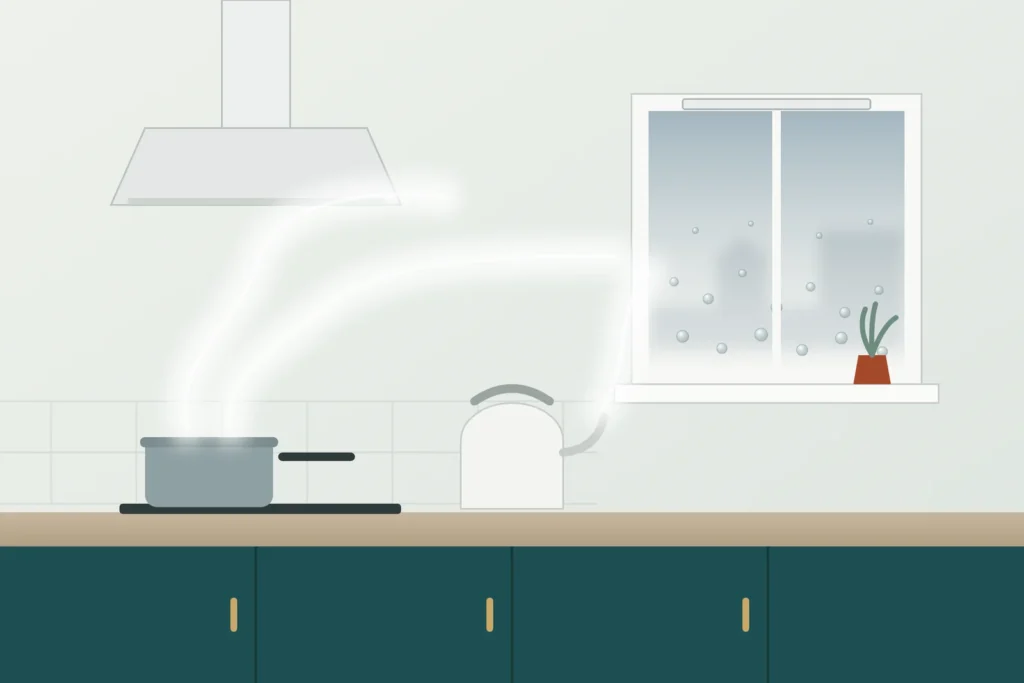
Condensation is water that was already in the air of your home. Cooking, showers, washing drying on radiators and simply breathing put a lot of water vapour into the air. Energy Saving Trust puts it at up to 100 litres a week for a typical household. When that air meets a surface colder than its dew point (the temperature at which it can no longer hold all of that water) the water comes out as droplets. In a British winter the coldest surfaces are single-glazed or poorly performing windows, the corners of outside walls, the wall behind a wardrobe and the ceiling under a cold loft. That is why the same house is dry in July and streaming in November.
The good news is that condensation is the one moisture problem you can usually fix yourself, without a builder, because you control all three variables: how much moisture goes into the air, how much of it gets out, and how warm the surfaces are. The guides below take those in order. If you are not yet sure the problem is condensation at all, start with damp or condensation? in the damp hub, because a leak or penetrating damp will not respond to any of this.
Which guide do you need?
| What you are seeing | Most likely | Read |
|---|---|---|
| Windows misted or running with water in the morning, wet sills | Normal winter condensation, or too much of it | Condensation on windows |
| Wet or cold patches on outside-wall corners, behind furniture, black speckled mould | Cold-surface condensation and cold bridges | Condensation on walls |
| Hygrometer reads 65 to 80 per cent most days, musty air, everything feels clammy | Too much moisture, too little ventilation | How to reduce humidity in your house |
| You have a reading and want to know if it is a problem | Depends on room temperature and the coldest surface | What humidity should a house be? |
| You know your room temperature and humidity and want to know which surfaces will condense | Dew point question | Dew point calculator |
| Black mould on frames, seals and the plaster around the window | Condensation that has been left to sit | Mould on window frames, sills and seals |
| A defined patch that grows after rain, a tide mark, a stain on the ceiling | Probably not condensation | Damp or condensation? |
| Bathroom ceiling still wet an hour after a shower; fan stops with the light | The extractor fan is not doing its job | Bathroom extractor fans |
| Washing dried on radiators; windows streaming next morning | Moisture from laundry with nowhere to go | Drying clothes indoors |
Guides
Condensation
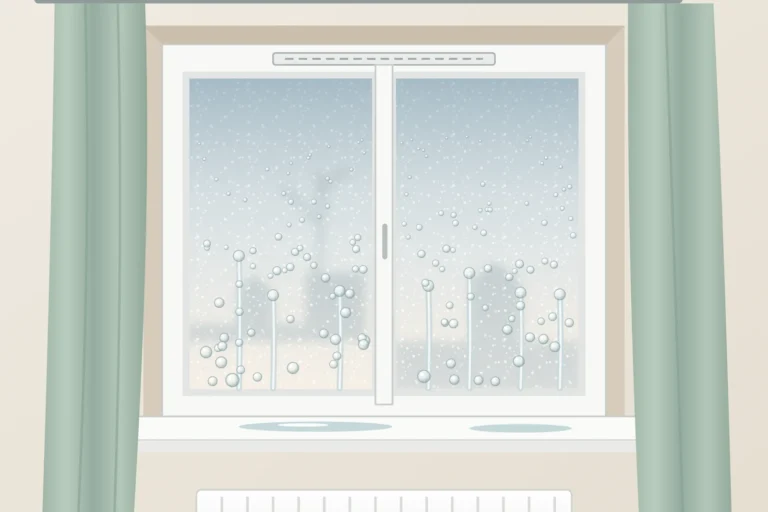
Condensation on windows
Inside, outside or between the panes: what each means, how much is normal, and the fixes that work in order.
Sources: Energy Saving Trust, FENSA, Approved Document F
Condensation
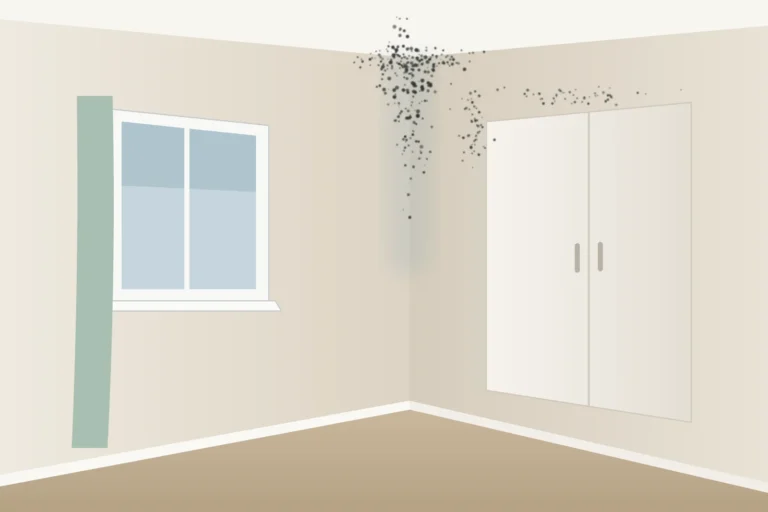
Condensation on walls
Why one wall sweats and another does not, cold bridges, furniture gaps, and what anti-condensation paint can and cannot do.
Sources: Energy Saving Trust, Historic England, Wealden DC
Humidity
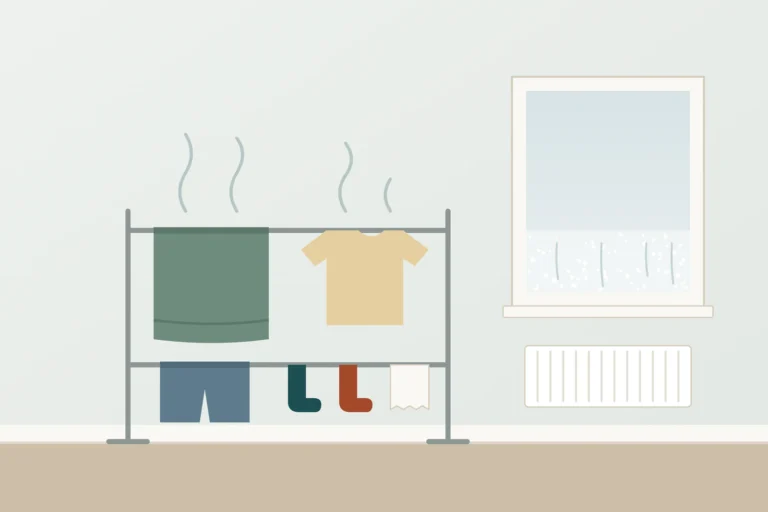
How to reduce humidity in your house
Measure first, then cut moisture at source, ventilate properly and heat steadily. Dehumidifiers last, not first.
Sources: Energy Saving Trust, Approved Document F, CSE

Humidity
What humidity should a house be?
What your hygrometer reading means at UK room temperatures, room by room, and the 80 per cent surface rule that matters for mould.
Sources: RICS, CSE, Historic England
Tool
Dew point calculator
Enter room temperature and humidity to see the surface temperature at which condensation starts, and what that means for your walls.
Sources: Magnus formula, IAPWS check
Mould
Mould on window frames, sills and seals
Where it grows, what to do for uPVC, timber and aluminium, and the morning routine that stops it.
Sources: GOV.UK, Energy Saving Trust, Oxford City Council
The five things that decide whether you get condensation
- How much water goes into the air. Up to 100 litres a week for a household (Energy Saving Trust). Drying washing indoors, unvented tumble dryers and bottled-gas heaters are the big avoidable sources.
- How much gets out. Extractor fans that are actually used and run on for at least 15 minutes (Energy Saving Trust), trickle vents left open, and windows opened for a few minutes several times a day. Building rules for new work expect a bathroom fan to move at least 15 litres a second and a kitchen fan 30 (Approved Document F), which is a useful benchmark for whether yours is doing anything.
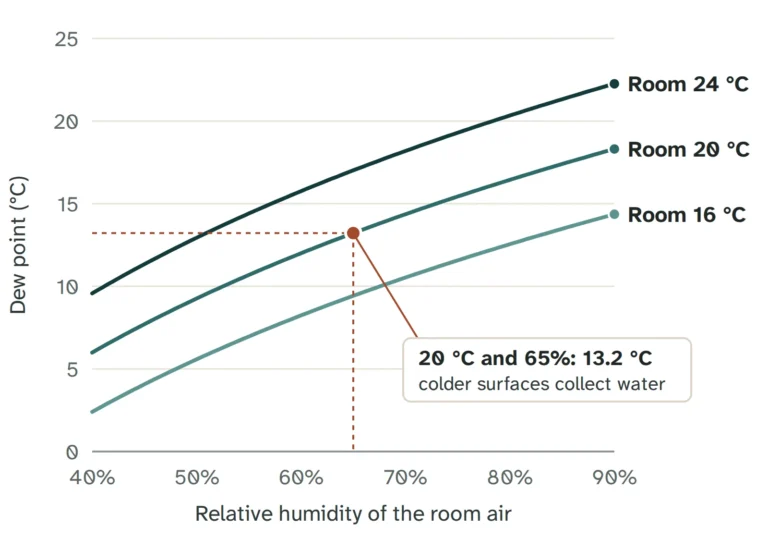
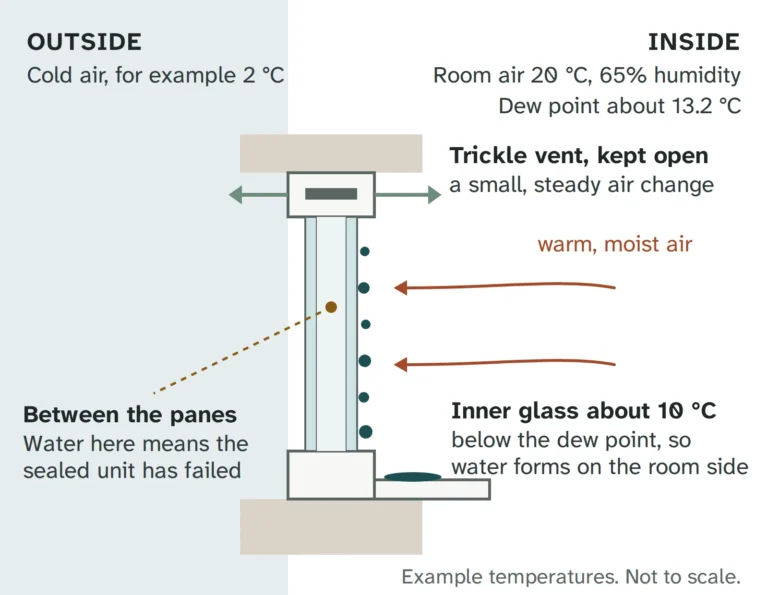
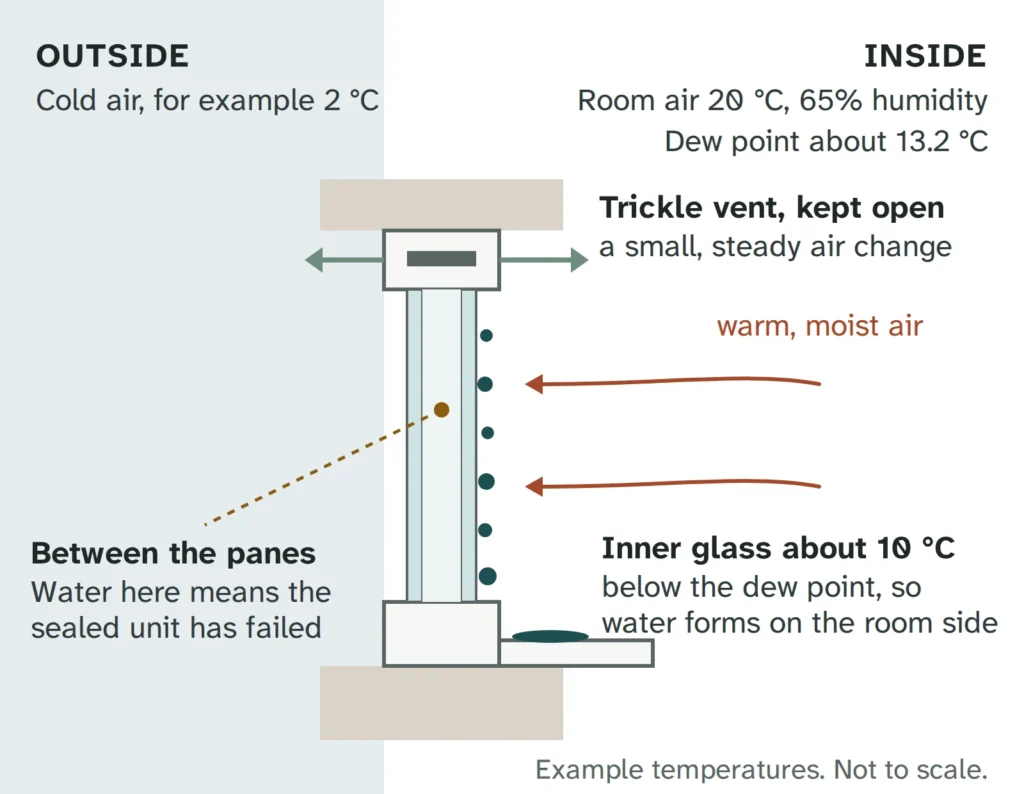
- How warm the surfaces are. Room air at 20 C and 65 per cent humidity has a dew point of about 13.2 C, so any glass or plaster colder than that will be wet. Steady low heating keeps surfaces above the dew point; short blasts do not.
- Whether air can reach the cold spots. Corners behind wardrobes and beds on outside walls stay cold and still, which is why mould starts there first.
- The building itself. Solid-walled pre-1930s houses, concrete-framed flats and any room under an uninsulated loft have colder surfaces to begin with. GOV.UK guidance points to loft insulation of at least 270 mm as one of the most effective ways to keep a home warmer.
Before you spend money
Most condensation is solved by habits and a few cheap items: a hygrometer, a window vac or cloth, and getting existing fans and vents working. Spend on a dehumidifier only when you have measured that the routine is not enough, and on insulation or new windows only once you know the moisture side is under control, or the new surfaces will simply move the condensation somewhere else. Anti-condensation paint and thermal lining paper can help a cold surface once the moisture is dealt with; they do not remove water from the air.
If you rent
Report condensation and mould in writing with dated photographs. Social landlords must investigate potential hazards within 10 working days and make significant damp and mould hazards safe within 5 working days under Awaab’s Law (from 27 October 2025). For a private tenancy, the council’s environmental health team can inspect. The routine in these guides is still worth doing meanwhile; it protects your belongings and your record.
Coming next in this topic
Guides in preparation: trickle vents and whether they stop condensation, condensation on the outside of windows, and positive input ventilation. Added as sources are checked; no fixed dates. Extractor fans and drying clothes indoors now have their own guides in the ventilation and dehumidifiers and laundry topics.
Next step
Damp or condensation? How to tell which you have
Rule out a leak or penetrating damp before you change anything.