
Damp or Condensation? How to Tell Which You Have
Tell condensation from penetrating damp, rising damp or a leak by timing, tide marks and the foil test, and learn when a damp survey is worth paying for.
Quick answer
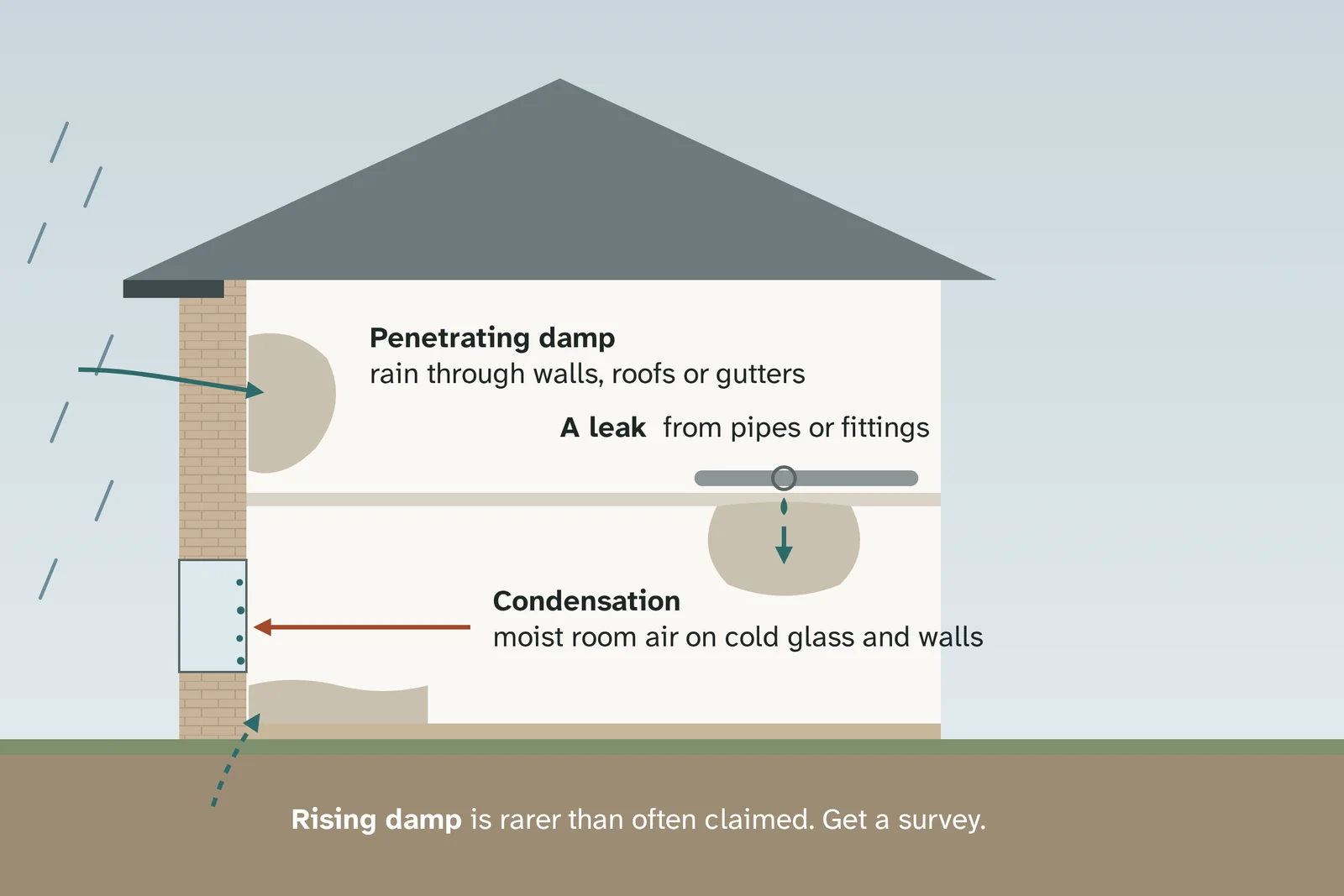
The three fastest tells are timing, position and pattern. Condensation is worst on cold mornings and in cold weather, sits on the coldest surfaces (windows, outside-wall corners, behind wardrobes) and grows speckled black mould rather than leaving a stain. Penetrating damp gets worse after rain, appears as a defined patch and lines up with something outside such as a gutter, crack or window sill. Rising damp is rare, stays on ground-floor walls and leaves a horizontal tide mark with white salts up to roughly a metre high. If it is constant whatever the weather, suspect a leak. Everything below is a household check, not a diagnosis; a professional survey is the only way to be sure.
On this page
Why the distinction matters
The fix depends entirely on the moisture route. Condensation is water that was already in the air of your home and has settled on a cold surface; you manage it with less moisture, more ventilation and warmer surfaces. Penetrating damp, rising damp and leaks are water coming from outside or from a pipe, and no amount of ventilation or anti-mould paint will stop them. Get this wrong and you spend money in the wrong place: a dehumidifier under a leaking roof, or a damp-proof course injected into a wall that only needed its gutter clearing.
GOV.UK’s guidance for landlords uses four categories, and so does this guide: condensation, penetrating damp, rising damp and “traumatic” damp, meaning leaks from pipes, tanks, baths, showers or appliances.
The four moisture routes compared
A few terms first. Relative humidity (RH) is how full the air is of water vapour compared with the most it could hold at that temperature. Dew point is the temperature at which that air starts to shed water as droplets. A cold bridge is a part of a wall or ceiling colder than its surroundings, such as a concrete lintel or an uninsulated corner. A damp-proof course (DPC) is the barrier built into a wall near ground level to stop ground water rising. Capillary action is the sponge-like suction that pulls water up through small pores in masonry. Efflorescence is the white, powdery salt left behind when water evaporates from a wall.
| Condensation | Penetrating damp | Rising damp | Leak (traumatic damp) | |
|---|---|---|---|---|
| Where it shows | Windows, window reveals, outside-wall corners, behind furniture, top corners of rooms, ceilings of cold rooms | Anywhere on an outside wall or ceiling, often at chimney breasts, under windows, around frames, below the roof line | Ground-floor walls only, from the skirting upwards | Below or beside a bath, shower, sink, radiator pipe, water tank or flat roof; ceilings under bathrooms |
| Pattern | Diffuse, spreading, follows the coldest surfaces; speckled black mould dots | A defined patch or streak with a clear edge; may map a crack or joint outside | Horizontal band, rarely above about 1 m; often a tide mark with white salts | A localised patch or ring, sometimes brown-edged, may drip or bubble |
| When it is worse | Cold weather, mornings, after cooking, showering or drying washing | During and after rain; can dry out in a dry spell | Fairly steady all year; may look worse in winter | Constant, or each time the fixture or appliance is used |
| Surface feel | Wet film or droplets on the surface, dry underneath; mould on top | Wall feels cold and damp through the plaster; plaster may blow, paper lifts | Plaster crumbly or salty; skirting may rot; musty smell | Plaster soft or bulging; paint blisters; may be dripping |
| Salts or tide mark | No | Sometimes, at the edge of a patch as it dries | Yes, characteristic | Sometimes, as a stain ring |
| Typical rooms | Bedrooms, bathrooms, kitchens, unheated rooms, cupboards on outside walls | Rooms facing the prevailing weather, chimney rooms, top floors | Ground-floor rooms of older houses, especially where outside ground has been raised or a DPC is bridged | Bathrooms, kitchens, rooms under bathrooms, near boilers and tanks |
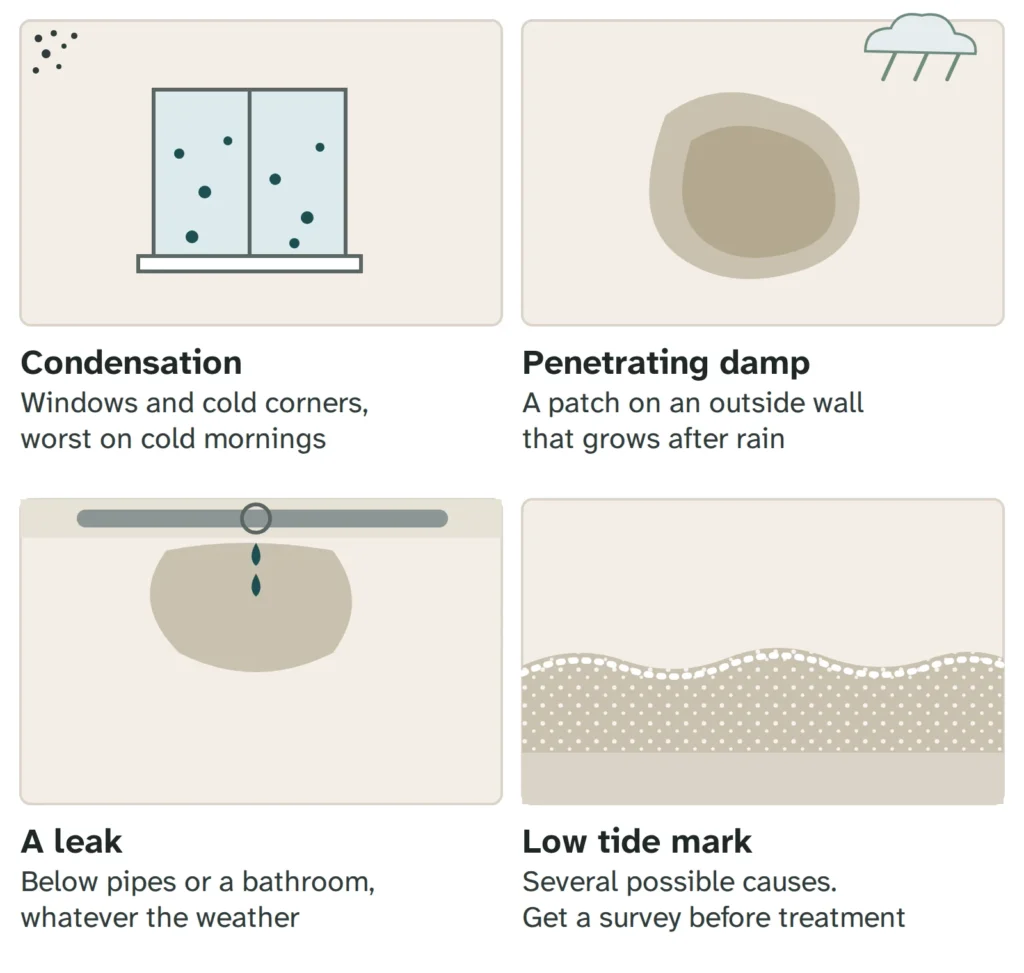
Energy Saving Trust draws the same lines: a tide mark at the bottom of a wall points to rising damp, and penetrating damp “usually shows up as a concentrated damp patch” that worsens in rain and comes from faults such as guttering or roofing. The Centre for Sustainable Energy gives the signature of condensation: “small black dots that appear near cold surfaces like window frames”.
Check it yourself, safely
None of this replaces a survey. It gives you a well-founded suspicion, dated photographs, and enough detail to describe the problem to a landlord, surveyor or tradesperson.
- Look at where it is. Map every wet, stained or mouldy area on a rough sketch of the room, including behind furniture on outside walls and inside built-in wardrobes. Condensation clusters in the coldest places; the other three cluster near their source.
- Look at the pattern. Speckled black dots and a general grey bloom are condensation mould. A patch with a clear edge, a ring, or a horizontal line with white powdery deposits is water arriving from somewhere.
- Note when it is worse. Keep a simple diary for two or three weeks: weather, what you did in the room, and how the wall looked each morning. Worse after a wet day points outside. Worse after a cold night, a shower or a wash load drying points to condensation. Unchanged whatever the weather points to a leak. This diary is the most useful thing you can hand to a surveyor.
- Inspect outside, from the ground only. Look at the section of wall that lines up with the wet area indoors for overflowing or leaking gutters, a downpipe discharging against the wall, green staining, cracked render, missing or crumbling mortar, a window sill without a drip groove, and soil, paving or a path built up above the damp-proof course (usually a visible line of black material or a course of different bricks two or three bricks above the ground). Do not go up a ladder or onto a roof; if you cannot see the roof or chimney from the ground, note that for the survey.
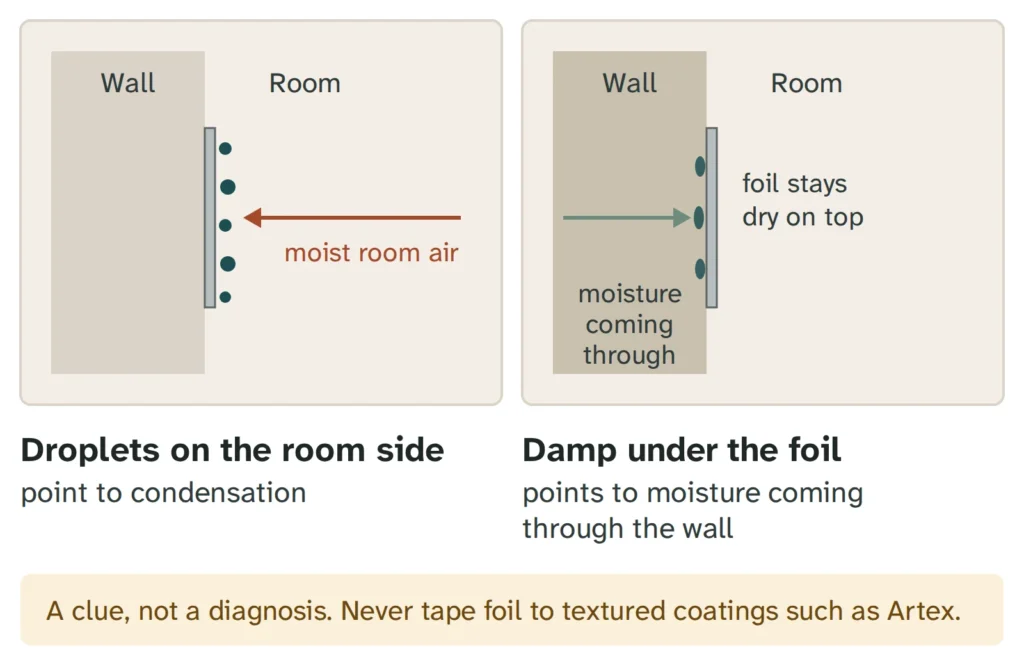
- Try the foil test as a rough indicator. Historic England describes taping a square of kitchen foil to a dry patch of the wall, sealed at all four edges, and checking it after a day or so. Moisture on the room side suggests condensation; moisture on the wall side suggests water coming through the wall. Its limits: the wall must start dry, a heated room can give a false clean result, and a cold damp wall can be doing both at once. One clue, not a verdict.
- Take a humidity reading. A cheap digital thermo-hygrometer shows room temperature and RH. Historic England treats about 40 to 65 per cent at around 20 C as a common comfort and building-care range. What matters for a wall, though, is the humidity at its surface. Air cools as it touches a cold wall and cooler air holds less water, so surface RH is higher than the room reading: air at 20 C and 55 per cent RH is about 75 per cent once cooled to 15 C. Building standards use about 80 per cent surface humidity as the mould-risk threshold, so a room reading in the sixties with a cold outside wall can be feeding mould while the meter looks fine. Read the meter at the coldest wall in the morning and compare it with a dry room. The dew point calculator shows what surface temperature would tip your reading into condensation.
- Photograph and date everything. Wide shots and close-ups in daylight, with something for scale, plus the outside photos. Repeat after rain and after a cold snap.
Why damp meter readings can mislead
The handheld meter a damp firm presses into your wall measures electrical conductivity, not water. RICS: “Damp meters test an electric current through a material. They are accurate for measuring moisture levels in timber, but in other materials may register high readings from other conductive materials, not just moisture.” Salts left in old plaster, foil-backed plasterboard, some wallpapers and carbon-containing materials all conduct, so a wall that was once damp and is now dry can still read high.
RICS therefore warns: “Be wary of any surveyor or commercial specialist who uses only a damp meter to diagnose the source of dampness, especially in hard walls and solid floors.” A high reading is a reason to investigate, not a diagnosis.
Why “rising damp” is so often the wrong answer
Rising damp is real, but it is the least common of the four routes and the most commonly claimed. RICS says rising damp “is often misdiagnosed”, that “a typical misdiagnosis would be that ‘rising damp’ is the cause of your problem and that your home needs a new damp-proof course”, and that “failure of an original damp-proof course is extremely rare.”
RICS also notes: “‘Rising damp’ is not a conclusion, as it does not identify the source of the excess moisture.” Water at the bottom of a wall has to come from somewhere: a leaking drain or gully, a path or flower bed built up above the DPC, a downpipe discharging at the base of the wall, a plumbing leak under the floor, a blocked sub-floor vent, condensation behind a sofa or wardrobe, salts left in old plaster from a long-fixed problem, or a cold, dense wall with a non-breathable finish. Fix the source and the wall dries. Inject a chemical DPC without finding the source and you have paid for the symptom. CSE makes the same point: damp is “often misdiagnosed as rising damp, when it is actually penetrating damp or even condensation”.
So a free survey from a company that sells damp-proofing is a sales visit, however honest the individual. Its findings are not neutral evidence and should not be the basis for spending on injection, tanking or re-plastering.
What a proper damp survey is
RICS advises asking for a Joint Position Statement 2022 (JPS 2022) compliant inspection: “A JPS 2022-compliant inspection report will give you an unbiased professional opinion from someone who does not have a commercial interest in selling you a product.” Look for “an AssocRICS/MRICS/FRICS building surveyor who has suitable experience in building pathology and the moisture issues described”, ideally a local one who knows the construction of houses in your area. A proper inspection looks at the outside of the building and ground levels, roof and rainwater goods, the sub-floor if there is one, internal finishes, heating, ventilation and how the home is used before naming a moisture route, and explains the evidence rather than just reporting meter readings.
When it is worth paying for one:
- A damp firm has told you that you need a new DPC, tanking or specialist plaster. Get an independent view before signing anything.
- You have followed the condensation steps for a full heating season and the wall is still wet or mould keeps returning.
- The affected area is spreading, the plaster is failing, or there is a musty smell you cannot trace.
- You are buying an older or solid-walled house and the valuation or homebuyer report has flagged damp.
- You are a landlord or a renter in a dispute and need a written, independent opinion.
For a suspected leak, a plumber or (for a flat roof, gutter or chimney flashing) a roofer is often the right first call. Energy Saving Trust suggests quotes from three TrustMark-certified professionals for structural damp work. This site does not publish survey or repair prices because they vary by region, house type and access.
What to do next for each verdict
Probably condensation. See condensation on walls for the cold-corner and furniture-gap fixes, how to reduce humidity in the house for the ventilation and heating routine, and what humidity a UK home should be for what your hygrometer reading means. If the mould is small, removing mould from walls covers the safe method. Bedrooms are the usual trouble spot; the mould in bedroom guide deals with that room.
Probably penetrating damp. The penetrating damp signs guide walks through the gutter, pointing, render, sill and cavity checks and who fixes each. Do not apply a water-repellent cream or sealant to an old solid wall as a first response: it can trap moisture in the wall and make things worse.
Possibly rising damp. Read the rising damp signs guide for the ground-level and bridged-DPC checks, then get an independent JPS 2022 survey before anyone injects anything.
Probably a leak. The damp patch on ceiling guide covers tracing a leak from above. Turn off the water to the fixture if you can, and call a plumber. A dehumidifier dries the room while the wall keeps getting wet.
Still not sure, or more than one at once. Old, cold, solid-walled houses often have a genuine outside defect and heavy condensation together. That is the case for an independent survey. The damp identification and condensation and humidity hubs collect the rest of the guides on each route.
If you rent
Report it in writing, with your dated photographs and diary, to whoever manages the tenancy: private landlord, letting agent, council or housing association. Keep a copy. Describe what you see and when it is worse; you do not have to name the cause, and it is better not to guess.
Awaab’s Law applies to social landlords (councils and housing associations) from 27 October 2025. They must investigate a potential hazard within 10 working days, make significant damp and mould hazards safe within 5 working days of identifying them, complete emergency safety works within 24 hours, and offer alternative accommodation if it cannot. Later phases follow in October 2026 and October 2027. Private renters are due to be covered under the Renters’ Rights Act at a later date; Shelter’s summary is in the sources.
If a social landlord does not act, use its formal complaints procedure and then the Housing Ombudsman. If a private landlord does not act, contact your council’s environmental health (sometimes called private sector housing) team, which can inspect and take action. GOV.UK tells landlords not to wait for medical evidence before acting, and to revisit the property at least six weeks after treatment to check it has worked.
If anyone in the home is in a higher-risk group, or you are worried about health, speak to your GP or NHS 111.
Common mistakes
- Painting over it. Paint, wallpaper and mould-resistant emulsion hide the surface and do nothing to the moisture. Oxford City Council’s guidance is not to paint or paper over untreated mould.
- Anti-damp or anti-condensation paint before the cause is known. These can help on a cold surface once the moisture source is under control; on a wall wet from outside, they peel or trap the water.
- A dehumidifier as the cure for a leak or penetrating damp. It lowers the room’s RH and makes the symptoms look better while the wall stays wet.
- Sealing old walls with waterproof coatings, tanking or cement render. Historic England’s guidance is that older solid-walled buildings need breathable materials and that moisture routes must be found, not covered. Sealing the surface moves the problem, often upwards or into the next room.
- Treating “rising damp” as the end of the investigation. It is a route, not a source. Ask what is feeding it.
- Blocking vents to stop draughts. Air bricks, trickle vents and sub-floor vents are part of the moisture control, especially in older houses. Sealing them raises humidity indoors and can leave a timber floor damp underneath.
FAQ
Can damp go away on its own?
Condensation can, in that it disappears in warm weather when surfaces are above the dew point, only to return in autumn. Penetrating damp from a one-off event such as a blocked gutter that has since cleared can dry out over weeks. Rising damp and leaks do not go away while the water source remains. A wall that dries by itself tells you something about timing; it does not mean the cause has gone.
Is it illegal to sell a house with damp?
This is a legal and conveyancing question and outside what this site covers. Shelter and GOV.UK publish guidance on buying and selling and on what sellers must disclose; a conveyancing solicitor can advise on your case.
Sources
- Damp and mould consumer guide, RICS, 16 June 2025
- Fixing damp and condensation, Energy Saving Trust, updated 22 May 2026
- Condensation, damp and mould, Centre for Sustainable Energy, reviewed December 2025
- Understanding and addressing the health risks of damp and mould in the home, GOV.UK (DLUHC and UKHSA), updated 1 April 2026
- Assessing damp in historic buildings, Historic England
- How Awaab’s Law changes the rules on hazards in social housing, Shelter, October 2025
- Get rid of mould, Oxford City Council