
Mould in the Bedroom: Why It Grows Overnight and How to Stop It
Why bedroom mould grows in corners, behind wardrobes and around windows, the winter routine that stops it, safe cleaning and what renters can do.
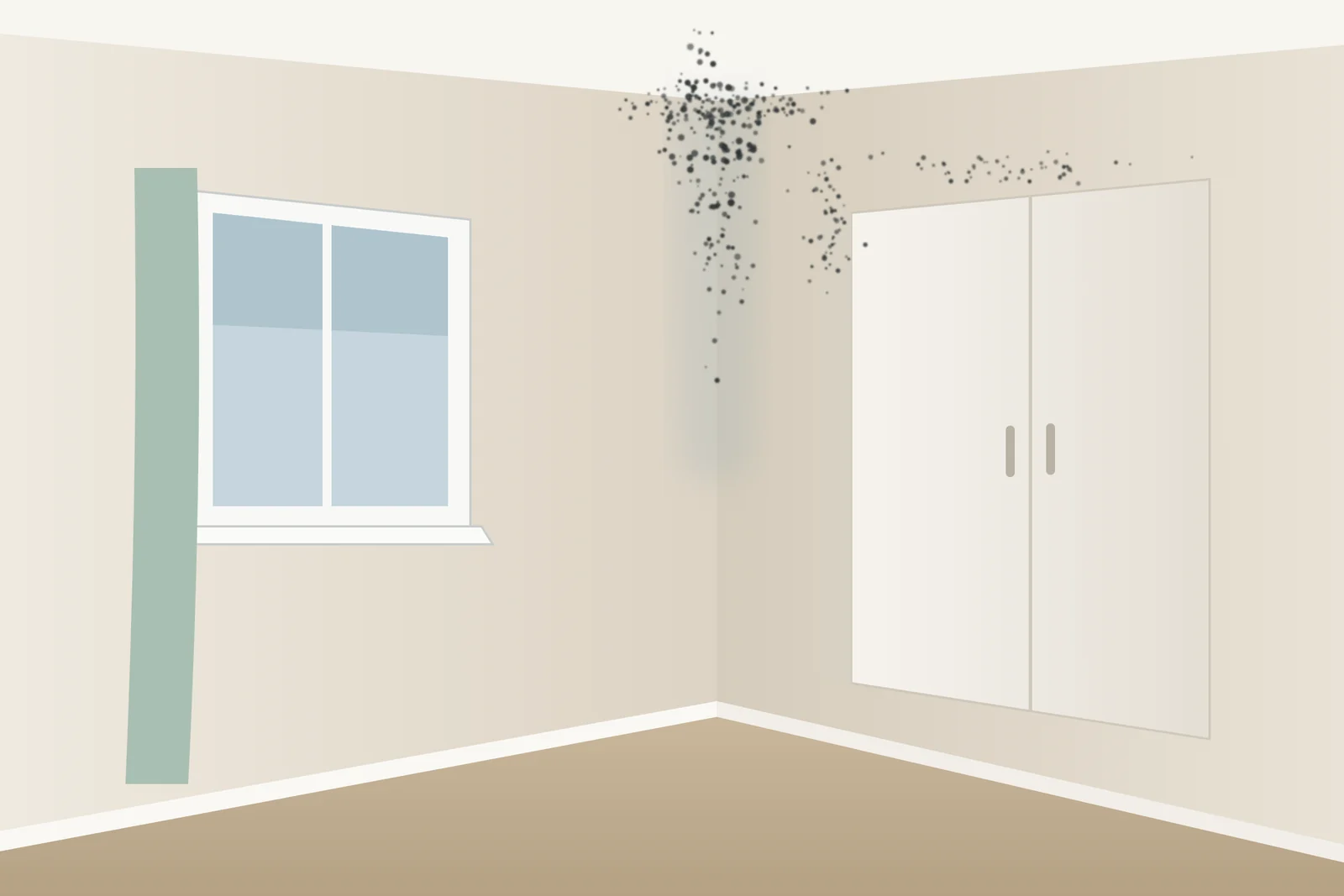
Quick answer
Bedrooms get mould because one or two people breathe out moisture for seven or eight hours in a closed, cool room. That moist air settles on the coldest surfaces, the corners of outside walls, the wall behind a wardrobe or headboard and the window frame, and those surfaces drop below the dew point overnight. Water forms, the paint stays damp and mould grows. The fix is not a stronger cleaning product. It is getting the moisture out each morning, keeping the room at a steady low warmth rather than cold all day, letting air move behind furniture, and cleaning the small patches you already have safely. If a patch keeps returning after all that, or it sits on a wall that gets wet after rain, treat it as a damp problem rather than a condensation problem.
On this page
- Why bedrooms are the room mould likes most
- Where it appears and what each spot is telling you
- Why winter, and why overnight
- The bedroom routine that works
- A dehumidifier in a bedroom
- Cleaning the patches you already have
- When it is not condensation
- Health, and who should not be doing the cleaning
- If you rent
- Common mistakes
- Frequently asked questions
Why bedrooms are the room mould likes most
Every other room has a moisture event and then a gap: the kitchen steams while you cook, the bathroom while you shower, and then both dry out. A bedroom’s moisture arrives slowly, all night, from breathing and skin, while the room is at its coldest, the radiator is off, the curtains are drawn and the door is shut. The Energy Saving Trust puts a typical household’s moisture output at up to 100 litres a week; sleeping is a share of that, and it lands in one small closed room at exactly the time the walls are coldest. That is why the same house can have a spotless kitchen and a black corner above the bed.
Mould also needs time. A surface that is damp for an hour after a shower rarely grows anything; a bedroom wall damp from midnight to nine, every winter night, gives it all the time it needs. Building standards use about 80 per cent surface humidity, held for long periods, as the mould-risk threshold, and a cold bedroom corner sits above that for most of the night.
Where it appears and what each spot is telling you
Condensation mould goes to the coldest surface with the least air movement, so the pattern in your bedroom points straight at the cause.
| Where you see it | What it usually means | What to do first |
|---|---|---|
| Window frames, the reveals (the short walls either side of the window) and the sill | Glass and frames are the coldest surfaces in the room, and the reveals are thin and often uninsulated. Water runs down the glass and soaks the paint. | Wipe the glass and frame dry each morning. Open trickle vents. See mould on window frames and condensation on windows. |
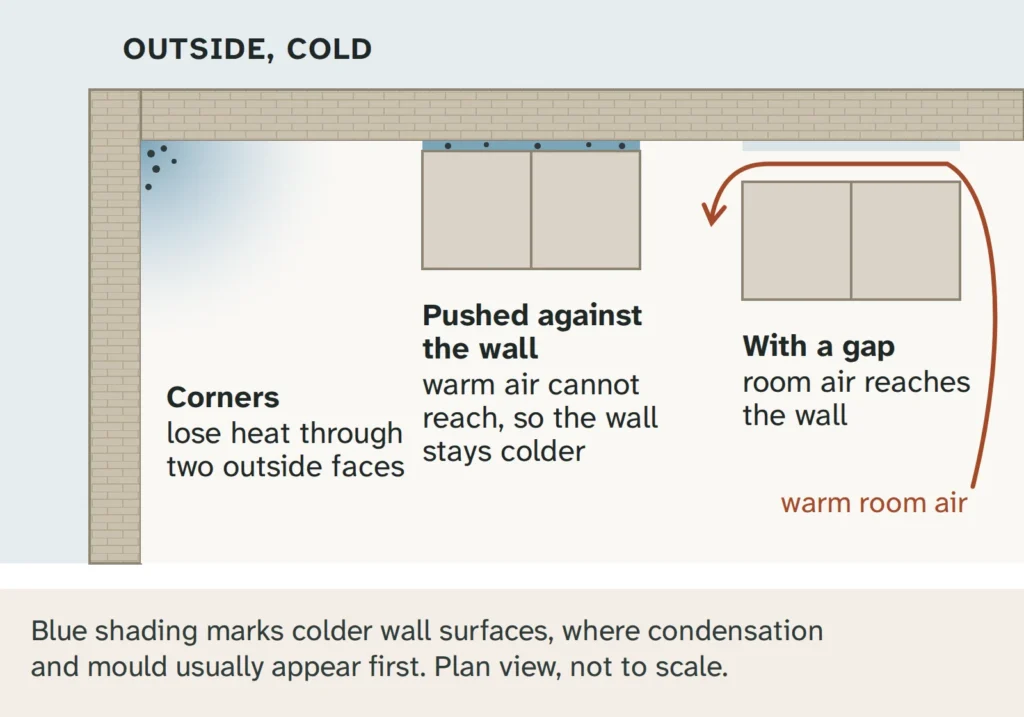
| Top corners of an external wall | A corner has two outside faces and one inside face, so it loses heat faster than the flat wall. The ceiling corner also sits under the loft edge, where insulation is often thin. | Improve air movement and steady the heating. Check loft insulation depth at the eaves if you can see it safely from the hatch. |
| Behind a wardrobe or headboard on an external wall | The furniture traps a pocket of still, cold air against the wall. Moist air drifts in and the surface never warms or dries. | Pull the furniture away from the wall. This is the single most common cause of a hidden patch. |
| Ceiling corners under the loft | Thin or displaced loft insulation at the edge of the room, or a gap where insulation has been pushed back for wiring or storage. | See mould on the ceiling. Do not go into the loft unless you can do so safely from boards. |
| Low on walls behind furniture or under a windowsill | Cold air pools low, and air behind a bed or chest of drawers barely moves. If there is a tidemark or the plaster is soft, read the damp section below. | Check the pattern against condensation on walls. |
| Inside a wardrobe, on the back panel, or on clothes and shoes | The wardrobe backs onto a cold wall and is packed tight, so the air inside is cold, still and moist. | Leave a gap behind and beside it, thin out the contents, and check inside monthly through winter. |
A patch in the middle of a flat internal wall, or one that spreads after heavy rain rather than after a cold night, does not fit the condensation pattern. See the section on when it is not condensation.
The corner above the bed
A flat section of external wall loses heat through one surface. A corner loses heat through two, with less warm room air reaching it, so its inside face is always a degree or two colder than the wall beside it. Add a wardrobe, drawn curtains or a bed pushed into it, and the air there barely moves. Warm, moist air from breathing rises, drifts into the corner and cools against it; if the corner is below the dew point of that air, water forms. In an uninsulated solid-walled house, or a cavity house with a cold bridge at the corner (a spot where the structure carries cold from outside to inside more easily than the wall around it), that happens on most winter nights. This is why the corner comes back after you clean it: the corner is still cold and still wet every night.
Why winter, and why overnight
Condensation forms when a surface is at or below the dew point of the air touching it. The dew point is the temperature at which the moisture in the air can no longer stay as vapour and turns to liquid, and it depends on how much moisture the air holds, not on room temperature alone. From this site’s dew point calculator: air at 20 C and 65 per cent relative humidity has a dew point of about 13.2 C, so any surface in that room at 13.2 C or colder will be wet. A poorly insulated corner, a window frame or the wall behind a wardrobe can easily be that cold on a January night while the middle of the room feels fine.
Run the bedroom through the night:
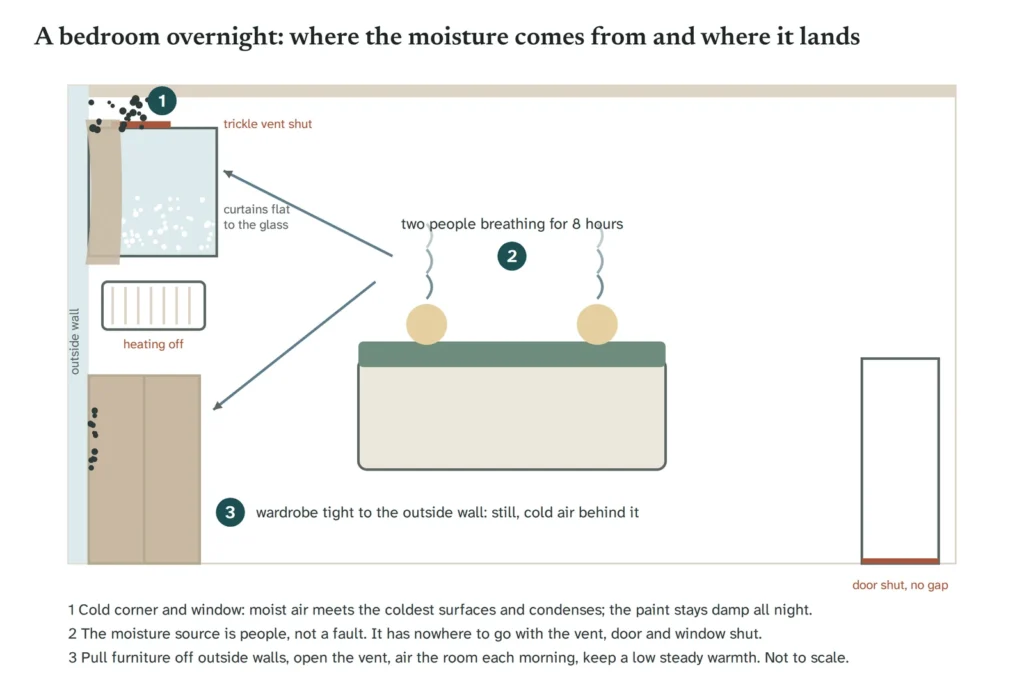
- The door is shut and the curtains are drawn, so the moisture from breathing has nowhere to go and the wall behind the curtain is cut off from the room’s warmth.
- The radiator goes off at bedtime. Relative humidity rises as air cools, even with no new moisture added: the same air that reads 55 per cent at 20 C is about 75 per cent at 15 C.
- Two people breathe for eight hours, adding moisture steadily to air that is already cooling.
- The cold surfaces reach the dew point in the small hours, and stay below it until the heating comes on and the window is opened.
Target humidity, and how to read a cheap thermo-hygrometer, is covered in what humidity a UK house should be. In a bedroom, put the meter on the bedside table and read it when you wake; that is the reading that matters.
The bedroom routine that works
None of this needs a product. It needs a routine kept through the cold months, because the problem is nightly.
- Air the room every morning. The Energy Saving Trust advises opening windows several times a day for at least five minutes; in a bedroom the morning one matters most, because that is when the air is fullest of moisture. Open the window wide as soon as you get up and pull the curtains right back so the window wall and reveals warm and dry.
- Keep trickle vents open and clear. Trickle vents are the small slotted vents in the top of a window frame that give a constant, small change of air without a draught. If yours are painted shut or stuffed with a cloth, start there. The Energy Saving Trust’s advice is to keep them open and unobstructed all the time.
- Leave the door ajar, or make sure there is a gap underneath. The Energy Saving Trust says internal doors need a gap of at least 10 mm underneath so air can move between rooms. If the door sits on the carpet with no gap, leave it slightly open instead.
- Keep the room at a steady low warmth rather than off all day. A bedroom that is cold all day and heated for an hour at bedtime has cold walls, and cold walls are what condense. The RICS consumer guide gives 18 to 21 C as the ideal indoor range; treat that as a reference, not a rule, and note the Energy Saving Trust’s point that leaving heating on all the time just to avoid damp is not sensible either. Steady and moderate is the aim.
- Do not dry washing in the bedroom. Wet clothes on a radiator or airer release their water into a room where it has nowhere to go. Dry outside when you can, or in a bathroom with the extractor on and the door shut. The wider moisture picture, room by room, is in how to reduce humidity in a house.
- Wipe the window each morning if it is wet. A cloth on the glass and frame takes that water out of the room instead of letting it evaporate back into the air or soak the paint.
Furniture and wardrobes on outside walls
GOV.UK names “corners and low points on walls behind sofas or wardrobes” as classic condensation spots and advises leaving a gap between furniture and external walls, so room air can move behind the furniture and a little warmth can reach the wall.
- Pull wardrobes, headboards and chests of drawers away from external walls. There is no official minimum gap; more is better where the room allows it. If the room is too small, move the wardrobe to an internal wall and put the bed on the outside wall instead, since a bed lets air through and a wardrobe does not.
- Do not overfill a wardrobe. Packed clothes stop air moving inside it, and the back panel against a cold wall becomes a damp, still pocket. Thin it out and leave space between hangers.
- Check inside monthly through winter. Look at the back panel, the corners of the base and the shoulders of coats that hang against the back. Catching a small patch in December is a wipe; finding it in March is a ruined coat.
A dehumidifier in a bedroom
A dehumidifier helps when the room is genuinely humid overnight and you cannot ventilate enough, for example a small bedroom with two adults, no trickle vents and a window that cannot be left ajar. It pulls water out of the air before it can reach the cold corner.
- It is not a cure for a leak or a damp wall. If water is coming through from outside, it will run all night, fill its tank and change nothing.
- Noise and light matter in a bedroom. Compressor models hum and click as they cycle; a night mode and a light that switches off are worth having.
- It has to be emptied, or plumbed to a drain, which is rarely practical in a bedroom.
- It works best with the door and window shut. A sensible pattern is the dehumidifier overnight with the room closed, then a proper air change in the morning.
- Run it on a humidity setting, not flat out. The middle of the comfortable range is enough.
Cleaning the patches you already have
Cleaning is the last step, not the first, because a patch cleaned while the corner is still cold and wet comes back within weeks. Get the routine going, then clean. The full method, with the safety kit and the mistakes to avoid, is in how to remove mould from walls. The points that matter most in a bedroom:
- Only tackle small patches. GOV.UK expects tenants to deal with condensation and very small amounts of mould; retailers commonly give under about one square metre as a rule of thumb, not an official figure. Anything larger, or anything that keeps returning, is a job for a professional and, for renters, the landlord.
- Nobody in a higher-risk group should be in the room while you clean, and they should not do the cleaning (the GOV.UK list is in the health section below). Open the window, shut the door and keep them out until the surface is dry.
- Wear a mask, gloves and goggles. That is the GOV.UK advice, and a bedroom is a small room where you are working close to the wall.
- Use a mould and mildew product rather than bleach, as GOV.UK advises for health and safety reasons. The Energy Saving Trust says to wipe with an antifungal product, using disposable cloths, and only when the mould is wet, because dry mould scatters when disturbed. Do not brush or vacuum it. Bin the cloth afterwards.
- Never mix products and never use one after another on the same patch. Bleach and acidic cleaners such as vinegar release chlorine gas when they meet. Pick one product, use it as the label says, rinse and let the wall dry completely. See does bleach kill mould.
- Do not paint or paper over it. Mould under paint carries on growing and lifts the new finish. Clean, let it dry fully, and only then repaint, ideally with a fungicidal paint. In a house built or refurbished before 2000, do not sand or scrape a textured ceiling or wall coating, which may contain asbestos (HSE).
- Strip and wash the bedding if the mould was near the bed, and move the bed away from that wall while the surface dries.
Black mould is not a special species that needs a special product. In a bedroom it is nearly always the same condensation mould, darker because it has been growing undisturbed for longer. Treat it the same way, with the same size limit and the same care about who is in the room.
When it is not condensation
Condensation mould is patchy, worst in winter, sits on the coldest surfaces and follows furniture. If yours does not behave like that, look again before you spend another winter airing the room.
- It appears or spreads after heavy rain, not after a cold night. That points to penetrating damp: water coming through the wall from outside. The Energy Saving Trust describes penetrating damp as concentrated patches from faulty guttering or roofing; in a bedroom the usual sources are a blocked or broken gutter above the window, cracked render or pointing, a leaking downpipe, or a roof or flashing fault above the ceiling. See penetrating damp signs.
- It is a defined stain with a brown or yellow edge, rather than spots, and the plaster feels soft or crumbly. That is water in the wall, not on it. See damp or condensation, including the foil test, which is a rough indicator rather than a diagnosis.
- It is in a ground-floor bedroom, low on the wall, with a tidemark. Rising damp is a possible route, but the RICS consumer guide notes it is often misdiagnosed and that failure of an original damp-proof course is extremely rare. Do not accept a damp meter reading as proof; those meters measure electrical conductivity and read high on salts. Ask for an inspection by a surveyor with no commercial interest in the outcome.
- The ceiling is stained, not the corner. A loft leak, a slipped tile or a bathroom above. See damp patch on ceiling.
A household can observe all of these. None of them is a diagnosis. If the pattern says damp rather than condensation, bring in a professional: a RICS surveyor for an independent opinion, or a roofer or guttering contractor if the source above the wall is obvious. No ladder work yourself.
Health, and who should not be doing the cleaning
If anyone in the home has symptoms they think are linked to mould, speak to a GP or the NHS; this site does not give health advice.
GOV.UK’s list of people at higher risk from damp and mould decides two practical things: who should stay out of the room while mould is cleaned, and how urgently a landlord has to act. The higher-risk groups are people with a pre-existing health condition such as allergies, asthma, COPD, cystic fibrosis, other lung diseases and cardiovascular disease; people with a weakened immune system, including those who have had a transplant or take immune-suppressing medication; pregnant women, their unborn babies and women who have recently given birth; children and young people, including those at risk of worsening mental health; older people; people with a mental health condition; and people who are bedbound, housebound or have mobility problems.
Someone spends a third of their life in a bedroom with the door shut, so mould in a bedroom used by anyone on that list is not a wait-and-see problem. The same guidance tells landlords that medical evidence is not a requirement for action, and that they should inspect at least six weeks after remedial work to check it has worked.
If you rent
Condensation and very small patches of mould are generally the tenant’s to manage with the routine above. Mould that keeps returning or covers a larger area, a cold uninsulated wall, broken trickle vents or a window that will not open are the landlord’s problem, and a bedroom makes the case stronger because of the hours spent in it.
- Record it. Photograph each patch with something for scale, note the date and the weather, and keep a log of when it returns after cleaning. If you have a thermo-hygrometer, note morning readings.
- Report it in writing to the landlord or letting agent, say where it is and who sleeps in the room, and keep a copy. Mention if anyone in the higher-risk groups above uses the bedroom.
- Social housing tenants: Awaab’s Law applies. From 27 October 2025, councils and housing associations in England must investigate a potential hazard within 10 working days, make significant damp and mould hazards safe within 5 working days of identifying them, complete emergency safety works within 24 hours, and offer alternative accommodation if they cannot. Further phases follow in October 2026 and October 2027.
- Private tenants: the same duties are due to be extended to private landlords under the Renters’ Rights Act at a later date. In the meantime, if the landlord does not act, contact your council’s environmental health team, which can inspect and require repairs. Find yours through GOV.UK.
- For advice on your rights, Shelter and Citizens Advice cover disrepair, what counts as a hazard and how to escalate. This site does not give legal advice.
Common mistakes
- Heating the room hard for an hour at bedtime and leaving it cold the rest of the day. The walls never warm; the air does.
- Sealing the room against draughts, blocking trickle vents and stuffing the door gap.
- Pushing the wardrobe back against the wall once the patch is cleaned.
- Buying anti-condensation paint for a corner that is still below the dew point every night.
- Assuming a dark patch after rain is “just condensation” because it is in a bedroom.
Frequently asked questions
Is it okay to sleep in a room with mould?
That is a health question, and the answer for your circumstances comes from a GP or the NHS, not a website about houses. Reducing exposure while it is dealt with is the sensible course: move the bed away from the patch, keep the room aired, and if someone in a higher-risk group sleeps there, treat getting it fixed as urgent rather than a job for the spring.
Sources
- Understanding and addressing the health risks of damp and mould in the home, GOV.UK (DLUHC and UKHSA), updated 1 April 2026
- Fixing damp and condensation, Energy Saving Trust, updated 22 May 2026
- Damp and mould consumer guide, RICS, 16 June 2025
- How Awaab’s Law changes the rules on hazards in social housing, Shelter, October 2025
- Get rid of mould, Oxford City Council
- Asbestos, Health and Safety Executive
- Find your local council, GOV.UK