
How to Remove Mould from Walls (and Stop It Coming Back)
How to clean mould off walls safely: the kit, the GOV.UK and council method step by step, which surfaces to leave alone, and how to stop it coming back.
Quick answer
For a small patch of mould on a hard, painted wall, use a mould and mildew cleaner exactly as the label says, wearing gloves, a mask and goggles. Wipe the mould off while it is wet, put the cloth straight in the bin and dry the wall. Then deal with the moisture that fed it, because cleaning alone does not stop mould coming back. If the patch is bigger than roughly a square metre, if it keeps returning, or if anyone in the home is in a higher-risk group, get a professional in and, if you rent, report it to your landlord.
On this page
- Should you clean it yourself?
- The safety kit
- How to clean mould off a wall, step by step
- Surface by surface: what works and what to avoid
- Bleach, vinegar or a mould cleaner?
- After cleaning: drying, painting and what not to do
- The "permanently" part: find and fix the cause
- When to call a professional, and who
- If you rent: report it, record it, and know the timescales
- FAQ
Mould on a wall is a symptom. Something is keeping that surface damp, usually condensation on a cold wall, sometimes a leak or damp through the building. This guide covers the cleaning, then finding and fixing the cause. For what mould is and where it grows, see the surface mould hub.
Should you clean it yourself?
Official guidance is clear that cleaning is for small amounts only. GOV.UK says most tenants “could reasonably be expected to remove condensation and very small amounts of mould”, but that “larger areas of mould should only be addressed by qualified professionals”. Retailers such as Ronseal put a figure on it: only remove mould yourself if it is caused by condensation and covers less than one square metre. Treat that square metre as a common rule of thumb, not an official limit.
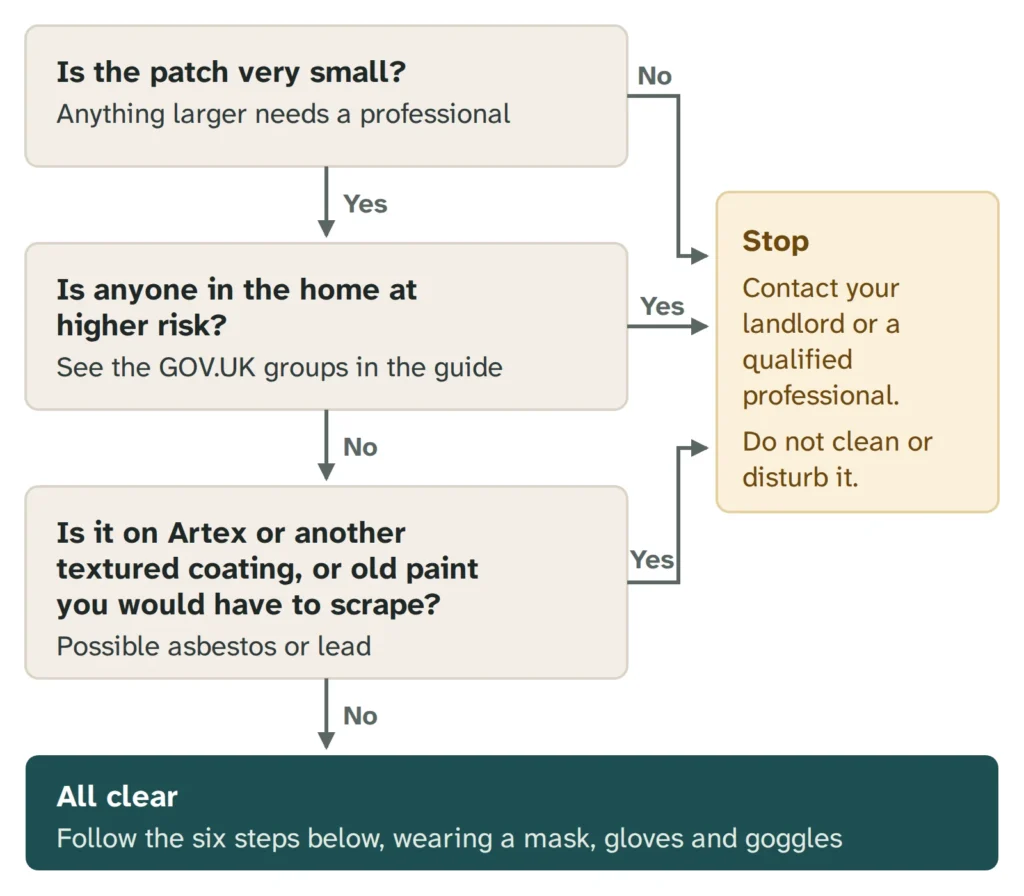
Stop and get help instead of cleaning if any of these apply:
- The area is larger than about a square metre, or several patches add up to that.
- It keeps coming back. Regrowth means the moisture problem is not solved, and repeated cleaning spreads spores and hides the evidence.
- The plaster or plasterboard is soft, crumbling or blown. That is a damp problem, not a cleaning job.
- The mould is on a textured coating (Artex-type finishes) in a building built or refurbished before 2000. HSE says these coatings may contain asbestos. Do not scrape, sand, brush or drill them. See the mould on ceilings guide.
- You rent your home. You can wipe a very small patch, but report it in writing first (see the renters section below) so there is a record and the landlord deals with the cause.
- Anyone in the home is in a higher-risk group. GOV.UK lists people with pre-existing conditions such as allergies, asthma, COPD, cystic fibrosis and other lung or heart disease; people with weakened immune systems (for example during cancer treatment, after a transplant or on immune-suppressing medication); pregnant women, their unborn babies and women who have recently given birth; children and young people, including those at risk of worsening mental health; older people; people with a mental health condition; and anyone who is bedbound, housebound or has mobility problems. If that describes someone in your household, they should not do the cleaning, and it is better for a professional to do it while they are out of the home.
If you have health concerns about mould exposure, speak to your GP or use NHS 111.
The safety kit
GOV.UK and the Energy Saving Trust both say to wear protection against spores and the cleaning product.
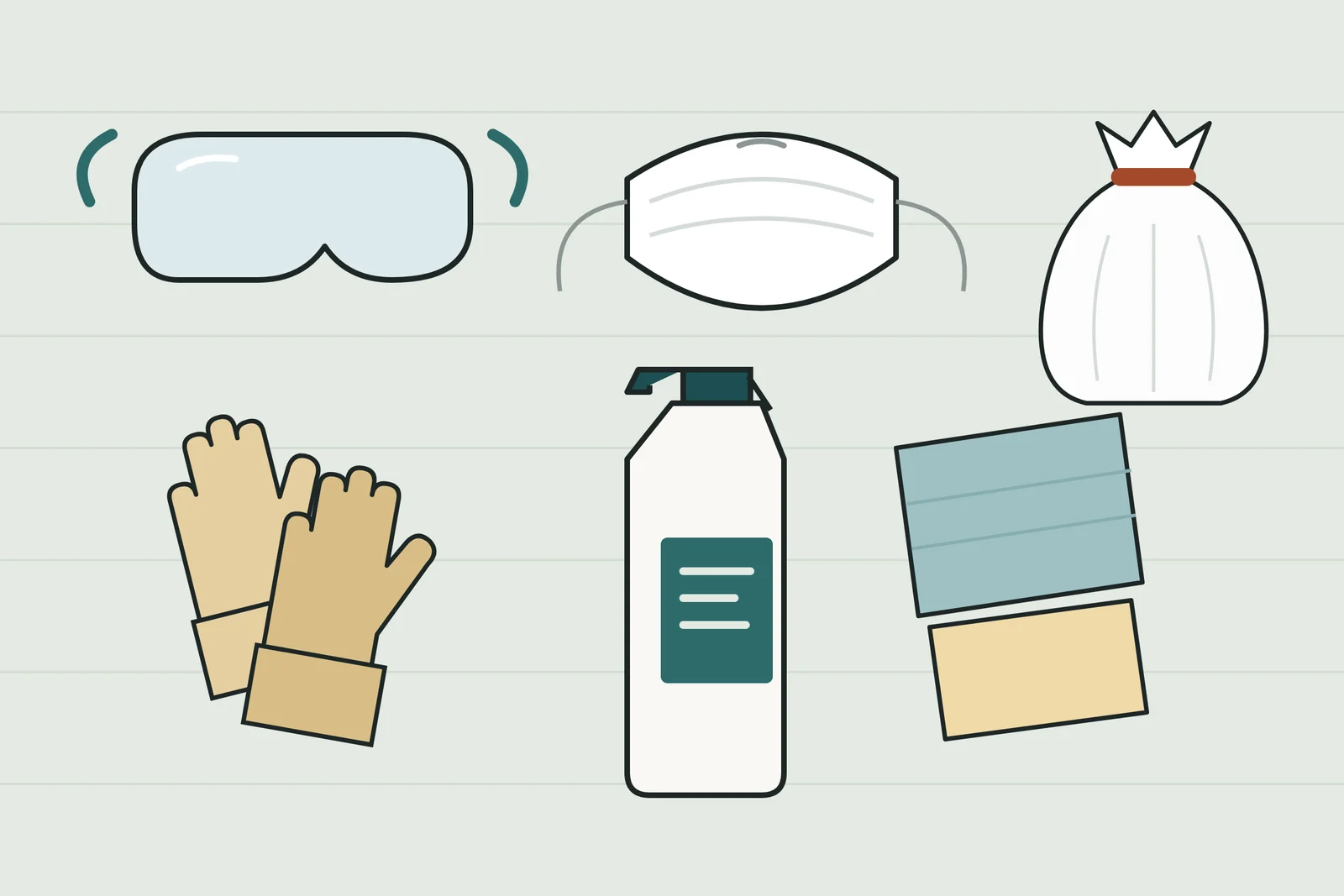
- Gloves. Long household rubber gloves, so splashes do not run onto your wrists.
- Goggles, not glasses. You will be wiping at eye level and above.
- A mask. A well-fitting one rated for fine particles (FFP2 or FFP3) does more than a loose paper dust mask.
- One mould and mildew cleaner. GOV.UK says mould products “should be used in preference to bleach, for health and safety reasons”. For larger areas, Oxford City Council recommends a fungicidal wash with a Health and Safety Executive (HSE) approval number on the label.
- Disposable cloths or kitchen roll, enough to throw each one away as it gets dirty.
- A bin bag to seal used cloths and gloves in.
- A dry cloth or towel for drying the wall afterwards.
- Old clothes you can wash straight away on a hot setting, or an apron.
How to clean mould off a wall, step by step
This method follows GOV.UK, the Energy Saving Trust and Oxford City Council, and is for a small patch on a hard, painted wall. Check the surface table below for anything else.
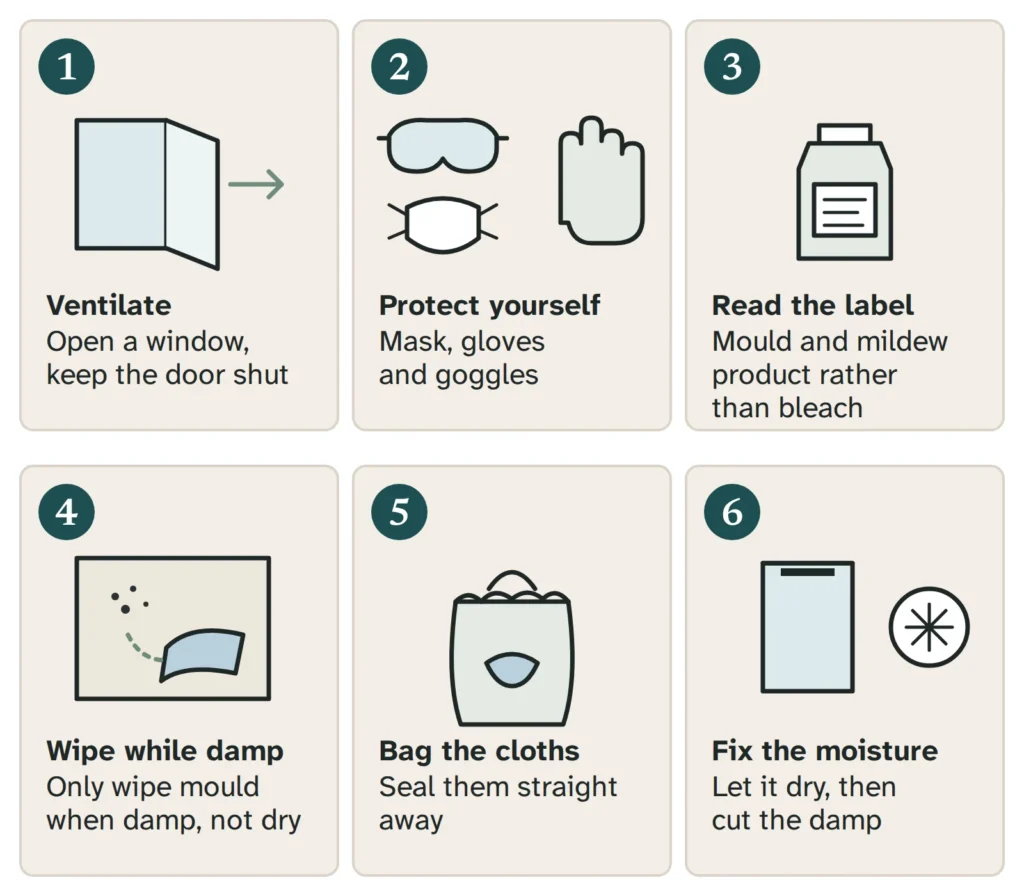
- Set up the room. Open the window and keep it open during and after the clean. Close the doors so spores do not drift into other rooms. Move furniture, curtains and anything soft away from the wall. Cover the floor below with newspaper or an old sheet you can bin.
- Put on the kit before you open the product, and read the label. Products differ in dilution, contact time and rinsing, and the label beats any general article, including this one.
- Wet the mould first. Apply the cleaner and let it soak for the time the label gives. Never brush, scrape or vacuum dry mould. Oxford City Council says brushing or vacuuming “can release spores into the air and increase the risk of breathing problems”; the Energy Saving Trust puts it as “only wipe mould when wet”.
- Wipe, do not scrub. Work from the edge of the patch inwards so you are not pushing spores onto clean paint. When the cloth is dirty, bin it and take a fresh one. Do not rinse cloths and reuse them.
- Rinse if the label says so, then dry the wall. Some products are left on; others need wiping with clean water. Either way, finish with a dry cloth. A damp wall is ready to grow mould again.
- Clear up. Seal cloths, gloves and floor covering in the bin bag and put it in the outside bin. Wash your hands and forearms, and wash the clothes you wore. Leave the window open and the door shut for a few hours.
One rule above all: do not mix products, and do not use one product after another on the same patch. Bleach and acids such as vinegar react to release chlorine gas, and other combinations are not safe either. If one product has not worked, the answer is a professional, not a second bottle.
Surface by surface: what works and what to avoid
| Surface | What usually works | What to avoid |
|---|---|---|
| Emulsion-painted plaster | Mould and mildew cleaner as the label directs, wipe wet, dry. | Scrubbing, which lifts the paint and spreads spores. Sanding paint that may pre-date 1992 (UKHSA: it may contain lead) without checking first. |
| Wallpaper | Ronseal says the same wipe method can be used on wallpaper. Use as little liquid as possible so the paper does not bubble. | Soaking it. If the mould is behind the paper (dark shadows through it, paper lifting), the paper needs to come off and the wall needs diagnosing, not cleaning. |
| Plasterboard | Small surface patches on painted board: as for emulsion. | Board that is soft, sagging or stained through. Wet board is affected all the way through, and cleaning the face does not reach it. A professional job. |
| Bathroom tiles and grout | Oxford City Council says a small area on windows and bathroom tiles can be wiped with a bleach-based mould spray, following the instructions, then the cloth thrown away. A mould cleaner works too. | Mixing a bleach spray with any other product. Scouring pads on glazed tiles. |
| Silicone sealant | Cleaner as directed, left for the full contact time. | If the black marks are inside the sealant rather than on it, cleaning will not shift them: the bead needs cutting out and replacing. |
| Timber (skirtings, frames, sills) | Wipe with cleaner as directed, then dry thoroughly. See the mould on window frames guide. | Soft, spongy or flaking timber. That is decay from persistent damp, and it needs the moisture source found and the timber assessed. |
| Textured coatings (Artex-type), pre-2000 | Leave it and get advice. HSE says these may contain asbestos. | Any brushing, scraping, sanding or drilling, however gentle. |
Old solid walls and lime plaster in period homes need breathable materials, and Historic England’s advice is that moisture routes must be found, not covered. Clean a small patch, but do not seal or coat the wall afterwards.
Bleach, vinegar or a mould cleaner?
Mould and mildew cleaners are the default in UK guidance, and GOV.UK prefers them to bleach. They are formulated to be left in contact with the surface, and for larger areas Oxford City Council’s advice is a fungicidal wash with an HSE approval number.
Bleach has a place: Oxford City Council names bleach-based mould sprays for small areas on windows and tiles, which are hard, non-porous surfaces. On a porous wall, bleach lightens the stain, which looks like success, but it does not reliably deal with growth in the surface. For large areas Oxford’s guidance is that “everyday cleaning products like bleach or washing-up liquid will not work”.
Vinegar feels safe, and on a hard surface it can wipe off a light surface bloom. On porous plaster, plasterboard and timber it has the same limitation as bleach.
Whichever you choose, use one. If you want to remove mould without bleach, a mould cleaner used as directed is the answer, not a mix of kitchen ingredients. For the chemistry and a surface-by-surface verdict, read does bleach kill mould? Bleach vs vinegar explained.
After cleaning: drying, painting and what not to do
Keep the room ventilated for the rest of the day and check the spot after a week or two. If a shadow returns in the same place, the wall is still damp and no amount of cleaning will change that.
Fungicidal or anti-mould paint has a role, but only in this order: mould removed, wall dry, moisture cause fixed, then paint. Oxford City Council’s advice when redecorating is to use a good-quality fungicidal paint and to “not paint or wallpaper over untreated mould”. Paint over a live patch and it grows through.
Two common mistakes:
- Stain blockers and “damp seal” paints on the inside of a wall. These can trap moisture in the wall and move the problem sideways. They are not a treatment for the cause.
- Wallpapering straight over cleaned mould. Paper and paste hold moisture against the wall. Wait until you are sure the wall stays dry.
The “permanently” part: find and fix the cause
Oxford City Council puts it plainly: “Removing mould will not solve the problem if excess moisture remains in your home.” GOV.UK tells landlords that cleaning “should not be a substitute for assessing and addressing the underlying issue, which should always be the priority”.
There are four broad ways a wall gets wet: condensation, penetrating damp (water coming through from outside), rising damp (moisture drawn up from the ground) and leaks. Most mould on internal walls in UK homes is condensation, and the pattern gives it away: it grows on the coldest surfaces, in corners, behind furniture against outside walls, around windows and in the coldest room, and it gets worse in winter. Damp from the building tends to show as a defined patch, a tidemark low on the wall, or staining that maps to a gutter, a roof or a pipe.
Working out which you have is the first job. See telling damp from condensation for what you can observe at home, including the foil test, and when it needs a surveyor. If the patch looks like it is coming through the wall, see penetrating damp signs and rising damp signs, with the caution from RICS that rising damp “is often misdiagnosed”.
If it is condensation, there are two levers, and you usually need both:
- Less moisture in the air. The Energy Saving Trust says a typical household produces up to 100 litres of moisture a week from cooking, washing, showering and breathing. Extractor fans run for at least 15 minutes after a shower and after cooking, lids on pans, windows opened several times a day for at least five minutes, and no clothes drying on radiators all cut that down. See reducing humidity in the house for a room-by-room approach, and what humidity a UK home should be for measuring it with a cheap hygrometer.
- Warmer wall surfaces. Condensation forms where a surface is at or below the dew point of the air touching it (the temperature at which that air’s moisture starts to condense), which for a room at 20 C and 65 per cent relative humidity is about 13 C. A cold corner or a wall behind a wardrobe on an outside wall sits below that for hours every night. Why walls get cold, and what helps, is covered in condensation on walls. Check your own room’s numbers with the dew point calculator.
If the mould is in a bedroom, the mould in the bedroom guide puts these together for that room.
When to call a professional, and who
| Situation | Who to call |
|---|---|
| Patch over about a square metre, several rooms affected, or it returns after cleaning | A mould remediation or specialist cleaning company. Ask what products they use, whether they are HSE-approved, and what they will do about the cause. Professional cleaning is still only cleaning. |
| Soft plaster, tidemarks, patches that map to the outside of the building, or you cannot tell the cause | An independent damp survey. RICS advises asking for an inspection that follows the 2022 Joint Position Statement, by someone with no commercial interest in selling a treatment. For structural damp, the Energy Saving Trust suggests quotes from three TrustMark-certified professionals. |
| Textured coating from before 2000, or you suspect asbestos anywhere | Do not disturb it. An asbestos survey before any work. |
| A fan needs fitting or rewiring | An electrician (Part P). Fan wiring is not a DIY job. |
| Mould near a boiler, flue or gas fire | Do not touch the appliance. A Gas Safe registered engineer for any gas work. |
| You rent | Your landlord, letting agent or housing association, in writing. |
If you rent: report it, record it, and know the timescales
Report the mould in writing before you wipe anything, because the cause is the landlord’s to investigate.
- Report by email or letter to your private landlord, letting agent or housing association, and keep a copy. Say where the mould is, how big it is, when you first saw it, and what you have already done about ventilation and heating.
- Take dated photos of every patch, with something for scale, before you clean anything. Take more if it comes back.
- Do not wait for medical evidence before reporting, and do not let a landlord ask you to. GOV.UK tells landlords that “medical evidence is not a requirement for action”.
- Awaab’s Law. From 27 October 2025, social landlords (councils and housing associations) must investigate a potential hazard within 10 working days, make significant damp and mould hazards safe within 5 working days of identifying them, complete emergency safety works within 24 hours, and offer alternative accommodation if they cannot. Private renters are due to be covered under the Renters’ Rights Act at a later date, with further phases in October 2026 and October 2027. GOV.UK also expects landlords to revisit at least 6 weeks after treatment to check it has worked.
- If nothing happens, contact your council’s environmental health team, which can inspect and require the landlord to act. For rights, disputes or compensation, use Shelter, Citizens Advice or GOV.UK. This site does not give legal advice.
FAQ
Is black mould on walls different? Colour is not a reliable guide to the species or the risk, and household cleaning advice is the same. What matters more is size, how long it has been there and who lives in the home. If it is spreading or returning, treat it as a damp problem and get it looked at. For health questions, speak to your GP or NHS 111.
Next step
Sources
- Understanding and addressing the health risks of damp and mould in the home, GOV.UK (DLUHC and UKHSA), updated 1 April 2026
- Get rid of mould, Oxford City Council
- Fixing damp and condensation, Energy Saving Trust, updated 22 May 2026
- Damp and mould consumer guide, RICS, 16 June 2025
- How Awaab’s Law changes the rules on hazards in social housing, Shelter, October 2025
- Asbestos, Health and Safety Executive
- Assessing damp in historic buildings, Historic England
- How to remove mould and damp from your home, Ronseal